






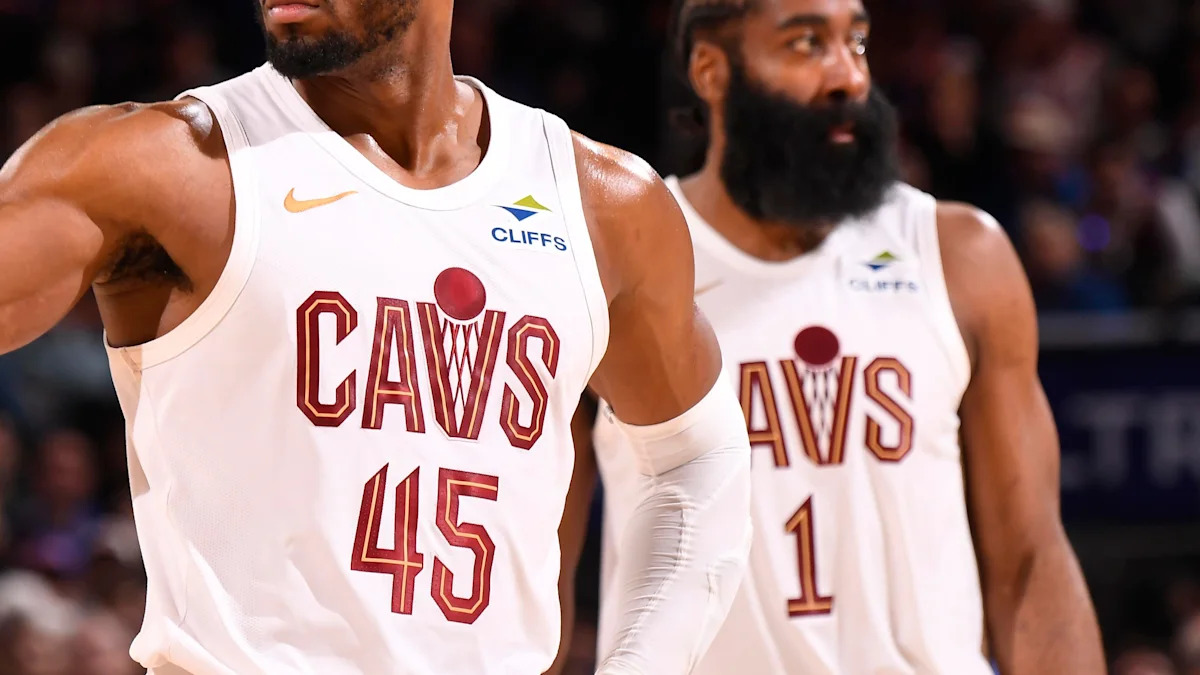
The Cleveland Cavaliers are in a precarious position. On one hand, they just had their most successful postseason run since trading for Donovan Mitchell four years ago – earning their first Eastern Conference Finals bid since 2018. However, on the other hand, the way they were so thoroughly dismantled by the New York Knicks made it apparent that they were far from a true title hopeful.
The first part of the offseason only served to further this gap. While the Philadelphia 76ers, Toronto Raptors, Indiana Pacers, and Boston Celtics all got better, the Cavaliers lost Dean Wade (one of the team’s best connectors) and Keon Ellis, and they completely flailed on the LeBron James sweepstakes.
Their championship window seemed to be slamming shut before it was ever really open. That is, until the Cavaliers front office got creative – orchestrating a five-team deal that cost them Dennis Schroder, Max Strus, and future draft capital to net Peyton Watson, the best two-way wing/forward left on the market at that point.
Now, the Cavaliers are officially all the way in. They made the big swing for Watson, shipped out Darius Garland for James Harden (then extended him), and gifted Donovan Mitchell a heavy extension. Cleveland has exhausted pretty much all their resources, but is it enough?
View Link
The 2026-27 Cleveland Cavaliers, On Paper
If you take one thing away from this article, it should be that everything kind of hinges on Watson. Since the Nuggets drafted Watson with the 30th overall pick, he’s always been a tantalizing defensive prospect. Folks compare him to prime Jonathan Isaac because of his combination of length, defensive playmaking, and lateral agility. He’s regularly in the upper echelon in block rate (93rd percentile block rate in the first three years of his career), despite not being a center and taking on tough perimeter defensive assignments.
In 2024-25, Watson began to flash some off-the-dribble upside, and then last year, courtesy of some injuries and his maturation as a player, it all started to coalesce. In the month of January (15 games), Watson averaged 21.9 points, 5.5 rebounds, 3.0 assists, 1.0 steal, and 1.5 blocks per game on 59.6% true shooting. To put that into some perspective, since the 2014-15 season (right around the start of the pace-and-space era), there have been 364 such instances where a player under 24 years old put those numbers up in a 15-game span (per Stathead). The only players who did that and haven’t made an All-Star team yet are Miles Bridges, Josh Giddey, and Cooper Flagg (who will surely be earning that honor someday soon).
That’s a very small sample, and an admittedly cherry-picked one at that. Injuries kept us from seeing how it would portend in a postseason setting, and the last time we saw him in the playoffs, his touch-and-go contributions on offense relegated him to 14.2 minutes per game.
His January scoring numbers won’t be a necessity for this Cavaliers team. At most, he’ll be a third option behind Harden and Mitchell, and an innings eater when one/both of them is off the floor.
What I’m really curious about is how good of a shooter he can be. Last year, he hit 41.1% of his 3.6 threes per game, but in the three years before that, those numbers were 32.8% and 1.8, respectively. Which sample size truly encapsulates who Watson is as a shooter today?
The pessimist in me still thinks he’s a below-average shooter (just so hard to shed the non-shooter label once you’ve been branded with it), but if I’m wrong, Watson’s combination of spacing, secondary creation, and defensive versatility would make him by far and away the best fifth starter this iteration of the team has rostered.
Speaking of the core four, Allen is about as metronomic as they come. Pencil him in for another top-10 center season in 2026-27. Harden’s also pretty consistent, but staring down his age-37 season, he’s far from a sure thing. Meaningful regression from him would increase the need for Watson’s independent scoring flashes to stick.
Mobley needs to get back to his 2024-25 form for this team to have the top-end talent to make this all work. After finishing 12th in the NBA in Estimated Plus-Minus that season, Mobley fell all the way to 59th last season (per Dunks & Threes). Some of this was probably a byproduct of him being overburdened at the start of the year (Cleveland was dealing with a lot of injuries), but a lot of it seems to be a lack of consistency in his aggression. On some nights, he’s willing to bulldoze his way into a crowded lane for a thunderous jam. While on others, he lingers around aimlessly, further confounding the Cavaliers’ spacing predicament. It’d also be nice if Mitchell upped his playmaking and didn’t lay goose eggs so often in the playoffs (his volatile nature can be both charming and damning), but his reliance on forceful side-to-side movements seems to have a deteriorating factor on his body, and at this point (next year will be his age-30 season), he is who he is.
To build this star-studded starting five, the Cavaliers had to sacrifice their depth. Jaylon Tyson took a big leap in Year Two – going from 14th percentile in EPM as a rookie to 77th percentile last year. Continued growth from him as a junior will be critical to the Cavaliers’ success. Sam Merrill will continue to be a wicked sharpshooter with defensive limitations. But after them, it’s Craig Porter Jr., Nae’Qwan Tomlin, Mario Hezonja, Thomas Bryant, Tyrese Proctor, Maleek Thomas, and a few other non-household names. It would be nice if one or two of those guys could punch above their weight (my bet would be Porter). Injury luck also needs to be on their side.
View Link
How Good Are The Cleveland Cavaliers?
As of right now, FanDuel gives the Cavaliers the sixth-best odds of coming out of the Eastern Conference (+900, 10%). I think that undersells them a bit.
To me, the Knicks and Toronto Raptors are in a class of their own. Before the Watson sign-and-trade, I expected Cleveland to regress to the point where they’d be participating in the play-in. But now, I think the Cavaliers belong in the same tier as the 76ers, Celtics, and Pacers. I’d even go as far as to say that the Cavaliers starting five puts them at the top of that group.
Last year, the Cavaliers were a very good offensive team (6th in offensive rating) and a middling team on the defensive side of the ball (15th in defensive rating). Adding Watson goes a long way toward fortifying their front line, and while losing a trustworthy veteran shooter like Max Strus isn’t great for their offense, the versatility that Watson opens up, coupled with having Harden for a full year and any potential improvements that come from Tyson, should keep them in the same ballpark on that end of the floor. This means that the Cavaliers have a real chance of being a top ten unit on both sides of the ball. Who else in the East – other than the Knicks and Raptors – can you confidently say that about at this point? Probably the Celtics, but that’s about it.
Things have changed for the Cavaliers. They are no longer the team that won 64 games in 2024-25, or the one that people anticipated to win the East at the start of last year. However, the idealized version of Watson is the best wing the team has had since The King was still in town. If that dice roll pays off, the Big Four remain formidable, some bench pieces rise to the occasion, and injuries don’t derail them, this could be the most complete version we’ve seen of them yet. But if they don’t, a teardown may be in order. One thing is certain: this is the year that rubber meets the road for the Cavaliers, one way or another.
Read the full article here


