

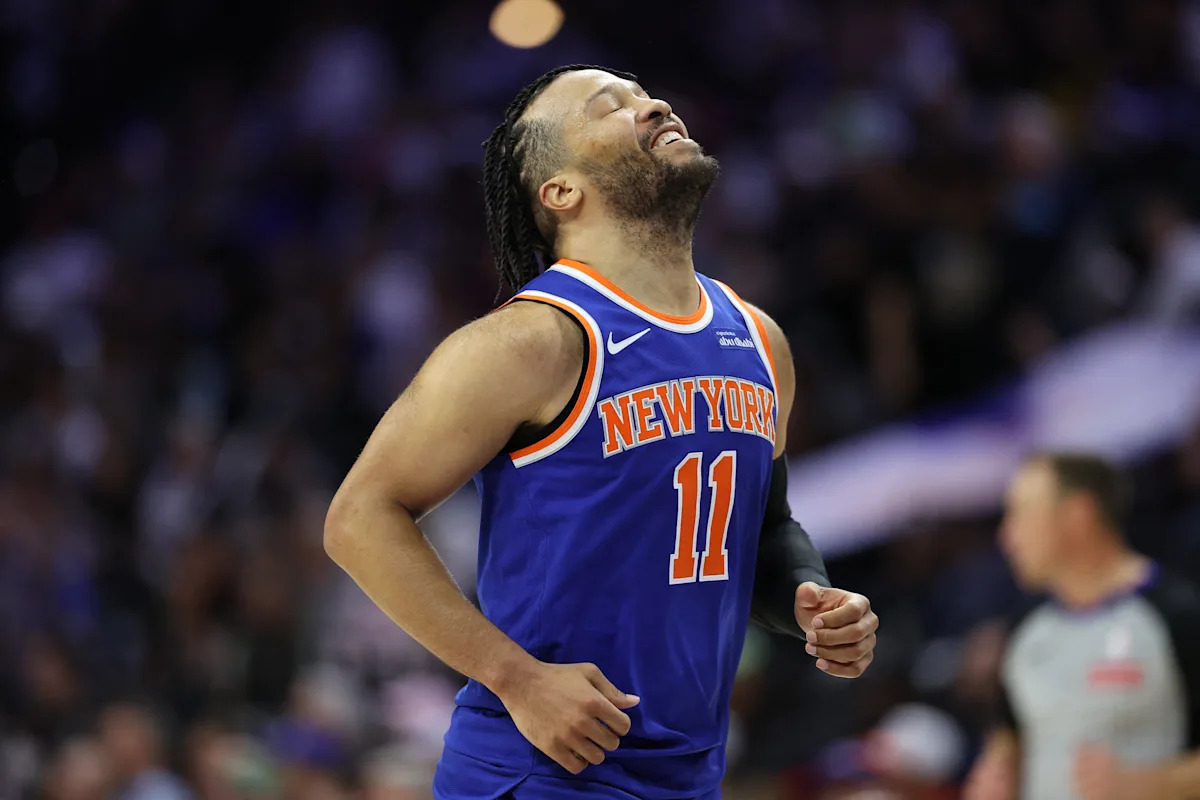
Nick Nurse understood the disadvantage his Philadelphia 76ers were facing, having just one day off between completing a shocking 3-1 comeback with an emotional Game 7 win in Boston on a Saturday night and tipping off the second round at Madison Square Garden on a Monday. All this considered, though, he didn’t really mind the quick turnaround.
“I’ve always said, even when I was coaching in the minors, that when your team’s winning, you just want to keep the games coming,” Nurse said before Game 1. “You don’t want any space between them. Just keep them coming. Let’s get to the next one.”
That, um, didn’t work out for the Sixers, but you’d certainly understand if Mike Brown was feeling that way at the start of the week. Why the hell would you want to take any time off when you’ve been playing as well as the New York Knicks have over the last two weeks?
Alas, the Knicks now find themselves with a week to kill, because they just spent a week killing Philadelphia. Four games, four wins, by a combined 89 points — one of the most dominant offensive postseason performances of the last 30 years, in which New York hunted Joel Embiid on one end of the court, smothered Tyrese Maxey on the other, and concluded the curbstomping with a Mother’s Day maiming that was over, for all intents and purposes, in about four and a half minutes.
New York’s nuking of the Sixers continued a run that’s seen Brown’s club rip off seven straight victories since CJ McCollum put them in a 2-1 hole — a moment of adversity that happened 19 days and roughly 9 million lifetimes ago — to advance to the Eastern Conference finals for a second consecutive spring. The vibes felt immaculate at this point last May, too, with New York having just vanquished a Boston squad that had its number throughout the regular season; when they beat the Celtics, the Knicks had reached a level that I’m not sure anybody outside 4 Penn Plaza believed they could reach.
The way the Knicks have played over these past seven games, though? It’s a level that I’m not sure any sentient being, in any far-flung fork of the multiverse, could’ve believed they’d reached. It’s Leon Rose’s wildest fever dreams, realized.
“Our guys have definitely tried to take it to another level with their focus on the details, and their energy and effort level, and that’s a lot of the reason why we’re playing pretty good basketball,” Brown said after finishing off the sweep of the Sixers. “When you talk about the elite and the great in any business — I don’t care what business that you’re in — there’s one word that stands out, and it’s the word consistency. The elite do it every frickin’ play, even if it gets boring or monotonous. And that’s what we have to figure out, to see if we can do. If we can do it every play, then we have a chance to be elite.”
Some of this, yes, is the result of an absolutely bonkers level of shot-making. Through 10 games, the Knicks are shooting 58.5% on 2-pointers and — after making a playoff-record-tying 25 3-pointers on Philly in Game 4 — 40.8% from 3-point land as a team. That’s good for a 59.6% effective field goal percentage (which accounts for 3-pointers being worth more than 2-pointers) and a 63% true shooting percentage (which factors in 2-point, 3-point and free-throw accuracy) — both of which not only lead the 2026 postseason, but are on pace to be the highest eFG% and TS% marks in NBA playoff history.
OG Anunoby, Karl-Anthony Towns and Mikal Bridges are all shooting either just under or just over 60% from the field. Anunoby, Towns, Jalen Brunson, Miles McBride, Landry Shamet and Jose Alvarado are all over 40% from deep (and, after his dreadful start to the postseason, so is Bridges over the last seven games). Non-Mitchell Robinson Knicks are shooting 81% from the free throw line; hell, even Mitch went 6-for-12 from the stripe over Games 3 and 4 in Philadelphia.
Sure, that level of net-scorching might be unsustainable. It’s worth noting, though, that the Knicks aren’t just the beneficiaries of a random magnet-ball: They lead the playoff field in shot quality, according to PBP Stats, and are coming off a regular season that saw them finish fifth in the NBA in midrange shooting accuracy and fifth in 3-point shooting accuracy. The Knicks outperformed their shot diet throughout the regular season, with only the Nuggets, Lakers, Celtics and Bucks ranking higher in points per shot over expectation, according to Synergy’s tracking; this, to some degree, is the benefit of building a roster on which everybody besides reserve centers Robinson, Ariel Hukporti and Jeremy Sochan — and, at times, Josh Hart (though he went 4-for-6 from deep in Sunday’s Game 4) — is a reliable threat from the outside.
“Guys were sacrificing good shots for better shots,” Hart said after Game 4 on Sunday. “When you do that, the ball has energy, and we’re able to knock down shots. Playing a style like that is fun.”
The Knicks have played that style more frequently and capably in these playoffs, averaging more passes, assists, secondary or “hockey” assists, drives and catch-and-shoot 3-pointers per game in Brown’s first postseason on the bench than they did last spring under Tom Thibodeau. They’re covering more ground, and doing it faster; they’re getting out in transition more frequently, scoring more points on fast breaks and off of turnovers; they’re creating and converting way more looks at the basket.
New York’s offense finished fifth in the NBA in points scored per possession last season, but often felt like it was grinding its gears in pursuit of that perch, arriving there largely by dint of sheer talent — Brunson’s individual shot creation, Towns’ overwhelming gravity and touch — and punishing offensive rebounding. The same felt true at times this season, as Brown worked not only to institute more ball and player movement, but perhaps more importantly, to get a core that had experienced a lot of success to buy into the notion that, by making certain shifts and pushing certain buttons, it could experience even more. What the Knicks have done through two rounds — nearly 129 points per 100 possessions, a historically elite performance — feels like a team that has finally understood how to become more than the sum of its parts.
“I feel like in that Atlanta series, we really turned it on,” said McBride, who went 7-for-9 from deep in the Game 4 demolition of Philadelphia. “It started with our coaching staff putting us in the right position, and then our leaders, our starting five getting out there and executing.”
That leadership starts with Brunson and Towns, both of whom have made significant changes to their games over the past two weeks that have helped New York’s offense reach the stratosphere.
Brunson has had to get comfortable working off the ball more frequently than he has since his days in Dallas, tweaking his shot profile — a little less pick-and-roll and isolation operating, a little more setting off-ball screens, curling off dribble handoffs and setting up as a spot-up shooter — and just generally loosening his hold on the reins of the offense a bit more.
Through the end of Game 3 in Atlanta, Brunson had the ball in his hands for 10 minutes per game in the playoffs, finishing nearly 32% of New York’s offensive possessions with a shot attempt, foul drawn or turnover committed. During this seven-game winning streak, that average time of possession is down by more than two minutes a night, and his usage rate has dropped by more than a percentage point.
“The thing about [Jalen], he’s a great screen-setter,” Brown told reporters after Game 4 against Atlanta. “He has a really good change of pace where he slips and stuff like that, which can cause confusion. So Jalen is about as coachable as they come […] Jalen is right up there with the Steph Currys of the world.”
Less has proven to be more for the All-NBA point guard, who’s averaging 27.3 points and 6.1 assists per game over the last seven outings on 52/43/90 shooting splits, despite playing fewer minutes per night — and who has seen the share of his buckets that have been assisted by a teammate increase by more than 8%, thanks to New York’s other All-NBA performer, who has transformed into an all-time quarterback:
Over the last two postseasons, Towns totaled 66 assists in 1,161 minutes over 34 total games. Through two rounds in the 2026 NBA playoffs, he has … 66 assists, racked up in 285 minutes, over just 10 games. Towns delivered 32 assists to Brunson during the regular season, according to PBP Stats; he’s already got 15 dimes on Brunson buckets in this playoff run. Towns had seven games with six or more assists over the course of the regular season; he has seven in the playoffs.
The last seven. As in, every game of the Knicks’ current postseason winning streak, which began in Game 4 in Atlanta, when Brown opted to redirect the offense through Towns in the high post — a decision that continues to unlock seemingly endless possibilities for this Knicks attack.
“I just love that I get to get my teammates involved, and I get the chance to quarterback the offense and put them in positions that I feel they could succeed, and they’ve obliged,” Towns said after the Knicks’ Game 2 win over the Sixers. “Like I said before, they’re trusting me more with the ball right now, and I just want to continue to repay their trust with the right plays and making the right decisions.”
Arguably just as important? Towns continues to make the right plays and right decisions on the defensive end, too, averaging more than four total steals, blocks and deflections per game in the postseason while posting the second-highest defensive rebounding rate of any player still active, behind only Victor Wembanyama. He’ll never be an elite rim protector, and Brunson will never be a top-flight point-of-attack stopper. But in spite of the conventional wisdom that said the Knicks couldn’t field a contending-class defense with them as vulnerable variables in the overall equation, they now rank fourth in the NBA in points allowed per possession since Christmas, behind only the Pistons, Thunder and Spurs. (They’re also fourth in offensive efficiency in that span — the only team in the NBA in the top five on both ends over that lengthy stretch.)
This unreal surge has been built on making the right decisions — the ones KAT makes with the ball up top, that Brunson makes as he decides to go set another flex screen in the corner, that Knicks defenders make as they rotate on a string behind the play, and what increasingly feels like damn near every bet that Rose’s front office has made paying off.
Anunoby played absolutely out of his mind through the first eight games of the 2026 postseason, looking like he was worth every cent of the $212.5 million the Knicks paid to retain him in the summer of 2024 before straining his right hamstring late in Game 2 against the Sixers and missing Games 3 and 4. (The one exception to the “when your team’s winning, you just want to keep the games coming” rule: when sweeping Round 2 gets your best two-way player an extra week of recovery ahead of Round 3.)
By Game 3 against the Hawks, Brown was fielding questions about whether or not he’d have to consider benching Bridges, who’d all but disappeared from New York’s offense and was struggling to stick with McCollum. Now, after getting untracked in the Knicks’ record-setting blowout Game 6 win in Atlanta, and spending the last four games averaging 18-4-4 on 64% shooting while the primary role in limiting an All-NBA guard in Maxey, Bridges once again looks like precisely the connect-all-the-dots wing piece that Rose was willing to fork over all them picks to procure.
The starters have all shouldered reduced workloads, both in terms of total minutes (thanks to playing two fewer games than last spring through two rounds, with a couple of full fourth quarters off) and in minutes per game, because Brown has used the bench that Rose gave him. Whether holdovers McBride, Robinson and Shamet, trade-deadline addition Alvarado, and offseason signing Jordan Clarkson — who has completely changed his game over the course of the season, going from a shoot-first-second-and-third microwave gunner into a dirty-work enthusiast making his presence felt with physical perimeter defense and relentless offensive rebounding — are playing this well because Brown trusted them, or Brown is trusting them because they’ve shown they can play this well, is the kind of chicken-or-egg question that can be difficult to definitely answer. What matters is that he has gone to the bench, earlier and more often, and has been rewarded with the kind of consistent contributions that last year’s Knicks didn’t find until they were already behind the 8-ball in the conference finals. The 2025 Eastern Conference finals was the closest the Knicks had come to playing for a championship since 1999, and losing it cost Thibodeau his job. That meant Brown came to the Garden with what seemed like a pretty clear means of measuring success, one made explicit by owner James Dolan midway through the campaign: “We should get to the Finals, and we should win the Finals.”
Brown, for his part, hasn’t coached like a man feeling the heat of those elevated expectations. Or, at least, like one used to applying that heat himself.
“People have talked about a mandate,” Brown said at practice between Games 1 and 2 against Philly. “I’m coaching to win. It doesn’t matter what others say. I’m disappointed if we’re not in the Finals and having a chance to win it. Been fortunate, blessed, lucky to be in six different Finals with three different teams, and fortunate, blessed, lucky to be a part of four championships. It’s the best feeling in the world, and I know that’s what I do it for.”
What Brown has done thus far — in getting his stars to buy in, in continuing to trust Bridges through his ups and downs, in empowering his bench, in increasing the number of options with which the Knicks can play on both ends of the floor, and in getting this roster to mid-May with an opportunity to enter the conference finals more or less healthy (depending on the status of Anunoby’s hamstring) — is something close to the best-case scenario that Rose and Co. were hoping for when they made the coaching change last summer.
The Knicks are back on the precipice — four wins away from the Finals, eight wins away from the title — and they’ve arrived playing the best basketball this franchise has seen in more than half a century. That doesn’t mean it will continue unabated; that doesn’t mean whichever opponent advances to face them in the next round won’t pose a new set of challenges; that doesn’t mean that the weight of the universe doesn’t rest on the recovery of Anunoby’s hamstring. But to have come through what Brunson called a “rollercoaster” ride of a season to get back to this point, this way? It does mean something.
“I think outside of the New York Knicks organization, things looked worse than what they were, from the outside looking in,” Brunson said after sweeping Philly. “But from everyone inside the building, we were working every single day to be the best team we could be. That’s all we were focusing on. And we had times where it was positives and negatives, ups and downs, but that’s what our goal was. That’s still our goal: be the best team we can be. Just continue to learn. Continue to get better. The journey shows you who you are.”
We’ll have to wait a while to find out how this team’s journey ends. What it’s shown us so far, though, has been pretty damn impressive.
“I think the longer we’ve played together as a team, the more we’ve grown,” Brunson said Sunday. “We’ve found ways to get better. It’s a chemistry thing. It’s a feel thing. It’s how things happen. Things get better over time.”
Read the full article here