





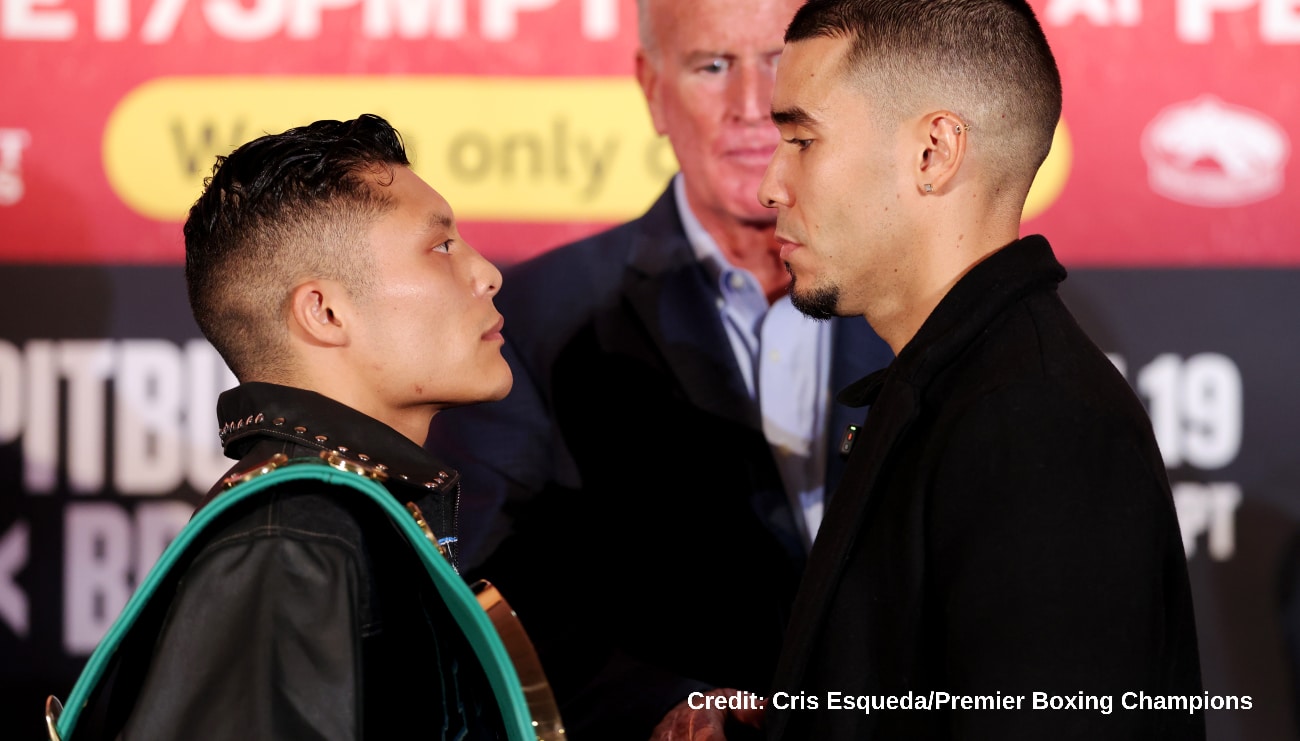
Isaac Cruz knows beating Nestor Bravo is only the minimum requirement Saturday night. He needs a dominant performance to preserve his place among the opponents Ryan Garcia is considering for December or January.
“This fight means a lot to me. This fight can be something that pushes my career forward. I have to win to go on and face the big names,” Cruz said during Thursday’s final press conference. “My mind is fully focused on Nestor Bravo. That’s the only thing I’m thinking of. I want the fans to be the biggest winner of the night.”
Bravo’s size makes that audition less comfortable than it looks. Cruz is around 5 foot 4, while Bravo is a rangy 5 foot 9. A steady jab, lateral movement, and clinching can leave Cruz lunging from too far away and swinging at empty space.
That is where Cruz’s first fight under Eddy Reynoso becomes interesting. Reynoso teaches counterpunching, upper body movement, and controlled distance, but Cruz built his reputation by overwhelming opponents with pressure. If he becomes too cautious while waiting for clean counters, Bravo may dictate the pace from outside.
Reynoso does his best work with fighters who have natural counter-punching instincts, good punch placement, and the patience to pick clean shots from mid-range. Think of Canelo Alvarez, Oscar Valdez, or Andy Ruiz when he was in that camp. Reynoso teaches a fighter to sit down on their base, slip incoming fire with subtle upper-body movement, and explode with lethal, compact counters. Pitbull Cruz is built on the complete opposite side of the spectrum.
His entire ring identity is predicated on crude forward aggression, raw physical pressure, and throwing wide, overhand bombs to break an opponent’s spirit. He is essentially a wrecking ball in a small package. He does not set traps; he does not control distance with a measured jab, and he has never shown the foot speed or angles needed to outbox anyone who knows how to move.
History shows that trying to completely rewrite a mature fighter’s ring identity in his late twenties usually produces hesitation rather than polish. When a pure brawler tries to think too much in the ring, he loses the one attribute that made him dangerous in the first place: reckless, suffocating intensity. Jose Valenzuela exposed the limits of the one-gear style, and Lamont Roach proved Cruz can be frustrated by simple ring IQ and lateral movement. But the idea that Reynoso can teach a 5’4″ brawler to suddenly box like Juan Manuel Marquez or slip and counter like prime Canelo is unrealistic.
At best, Reynoso might tighten up Cruz’s guard inside the pocket, get him to work the body with more discipline, and teach him not to square up completely when closing the distance. Beyond that, trying to force Cruz into being a slick technician will just make him second-guess himself. Against a rangy boxer like Nestor Bravo, any hesitation from Cruz will make him look slow and completely lost.
José Valenzuela already showed how disciplined movement can frustrate Cruz. Lamont Roach also gave him problems without agreeing to the close-range fight Cruz prefers. Cruz claims the Roach performance proved he is more than a pressure fighter. Bravo gives him another opportunity to support that argument.
A close decision will retain Cruz’s interim WBC light welterweight title without strengthening his Ryan sales pitch. Ryan just stopped Conor Benn at welterweight and holds major physical advantages over Cruz. Teofimo Lopez and Devin Haney also offer Ryan larger commercial fights.
Cruz therefore needs more than a victory. He must create enough demand to stop Ryan from treating him as a secondary option. Bravo is his gateway to another major payday, but only a forceful performance keeps that door open.
The DAZN broadcast from Pechanga Arena in San Diego begins at 8 p.m. ET/5 p.m. PT.
Read the full article here


