




Betteridge’s law of headlines dictates that any headline phrased as a question can be answered with a hard ‘no’, and disregarded. Certainly a cursory perusal of the odds being offered by various bookmakers reveals that long-time favourite George Russell remains the choice of the turf accountancy trade – if by a diminishing margin.
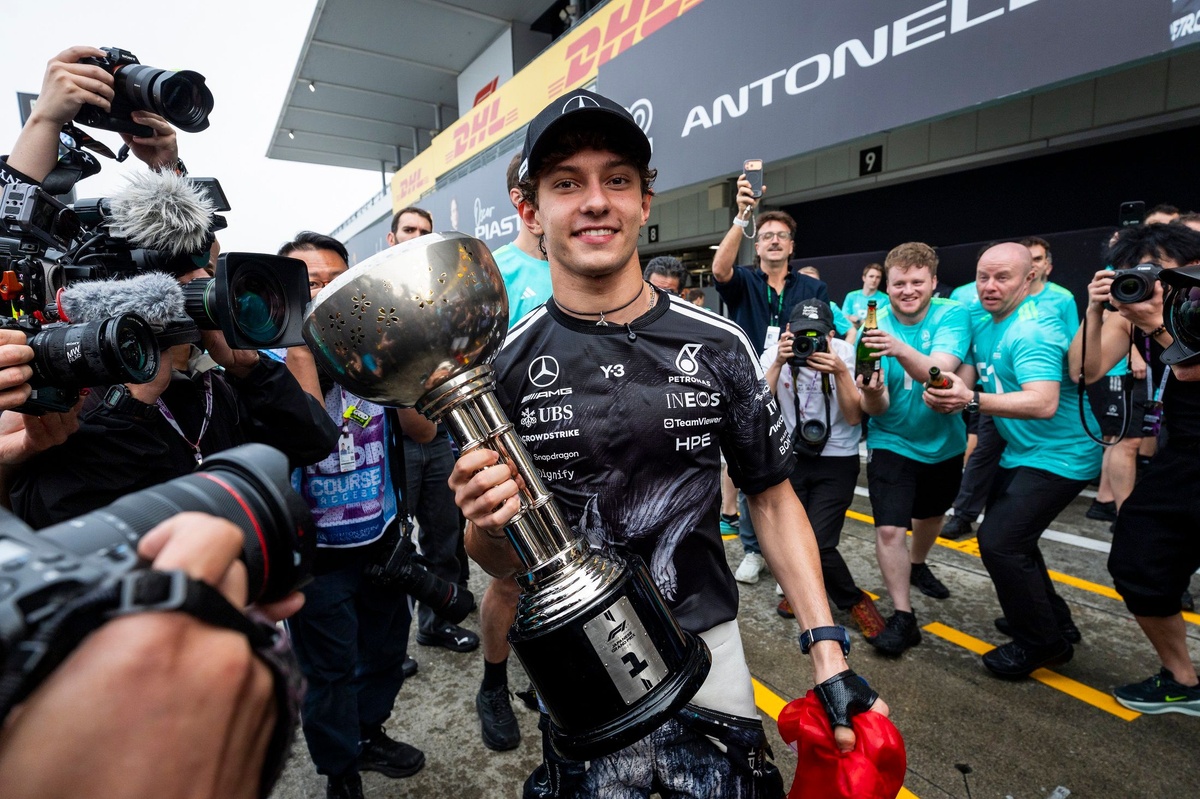
We may only be three grand prix weekends into a 22-round season, but Kimi Antonelli’s performance at Suzuka represents not just another clear progression in the trend line of quality, but also a clear statement of intent in terms of his championship ambitions.
Before the start of last season there were those who opined that Lando Norris was running out of time to win the drivers’ title, since his McLaren team-mate Oscar Piastri was improving at such a rapid rate he would likely become the dominant driver in that partnership – provided he didn’t plateau. Now, while the 2025 season took some twists and turns – it looked for a while like Piastri might deliver earlier than expected – that hypothesis is still valid.
On a similar note there are those within the paddock who felt that 2026 was likely a last chance for Russell, now entering his eighth season as a Formula 1 driver, to assert himself over sophomore Mercedes team-mate Antonelli. Russell has seen off every other intra-team rival during his F1 career, including Lewis Hamilton – albeit with some assistance from the ground-effect cars cramping Hamilton’s style – and last year he delivered yet another step up in quality, regularly maximising the points haul from an often difficult car.
The question he has to address now is whether that trajectory is continuing, given how rapidly his team-mate is improving his own game.
There has never been any doubt over Antonelli’s speed, or the excitement value he brings to F1. It is his often harum-scarum progress through a grand prix weekend which works on the blood pressure of his Mercedes team and its boss, Toto Wolff, who has taken a keen personal interest in Antonelli’s career.
FP3 shunt in Melbourne was an example of Antonelli’s tendency to make small but costly errors in otherwise strong weekends
Photo by: Paul Crock / AFP via Getty Images
That career had its ups and downs even before he reached F1, and Antonelli has often required a pep talk from Wolff – or a comforting arm around the shoulder – to put his head back in the correct space. Last year he endured a prolonged and demoralising mid-season slump, attributed to a rear-suspension upgrade which was eventually consigned to the dustbin of grand prix history. A pronounced uptick in form followed, including notably strong performances in Sao Paulo and Las Vegas.
But Sao Paulo also demonstrated that characteristic which continues to dog him: performing well through a weekend until making a small but costly mistake which skews the picture, in this case executing a safety car restart imperfectly and getting into a three-car tangle into Turn 1.
We’ve seen more of that this season: a car-breaking shunt in FP3 in Australia which nearly caused him to miss qualifying, followed by a poor start; then two more tardy getaways in China, a needless collision with Isack Hadjar on lap one of the sprint, followed by another imperfect safety car restart which cost him an opportunity to make more progress through the field. And then of course, a late-race lock-up while leading the grand prix, requiring a chivvy from the pitwall.
All of this served to confirm the impression that Antonelli wasn’t yet a fully rounded best version of himself.
And then came Japan. Throughout the weekend he was faster than Russell, who then responded by making a set-up change in qualifying which had a deleterious effect on rear-end performance. That, of course, then carried through to the race, where Russell was further inconvenienced by deployment troubles brought on by a software glitch.
Now, again Antonelli made a poor start in Japan – but this is understood to have had a different root cause to those in Australia and China, which were a result of wheelspin induced by low tyre temperature, itself a consequence of lacking electrical power on the formation lap. At Suzuka it was an honest mistake, misjudging his finger position on the clutch (Russell’s slow getaway, meanwhile, was put down to still having some brake pressure on, since the start straight has a downward gradient).

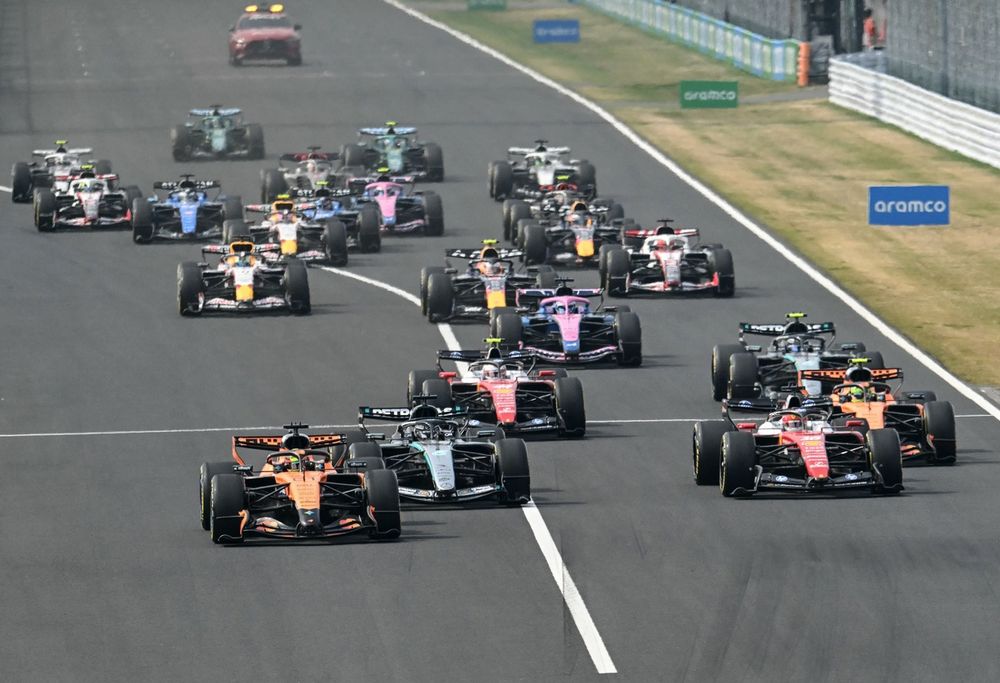
Both Mercedes had poor starts again in Suzuka
Photo by: Andrew Caballero-Reynolds / AFP via Getty Images
In the race, Antonelli made good progress after dropping to sixth place at the start, while Russell became worried about the undercut threat from Charles Leclerc’s Ferrari, triggering angst-ridden radio messages to the effect that extending the first stint would be a bad idea. That led to the early stop which, as it turned out, cost Russell more track position since Oliver Bearman promptly crashed his Haas, bringing out a safety car which gave Antonelli and Hamilton inexpensive pitstops.
“If that [the pitstop] was one lap later, we’d have won the race,” said Russell afterwards. “And if there was no crash, maybe we would have regretted not pitting at that point. And in racing, sometimes it goes for you, sometimes it goes against you.”
There is an element of wishful thinking here. Arguably the safety car deployment saved the Mercedes pitwall from having a difficult conversation with Russell, since the likelihood was that Antonelli would have caught him anyway.
The Italian was quick enough to win the race on merit and, at the time of Russell’s stop, was showing no signs of struggling on his medium-compound Pirellis. He was also thoroughly on top of the energy-management requirements – that controversial but essential element of 2026 F1 discipline – and more so than Russell, who has been the master of this art so far.
In contrast, Russell struggled with deployment and it was a change to the harvesting parameters, with a view to giving extra boost in his duel with Hamilton, which triggered an unexpected super clip that cost him a position to Leclerc (another example, you might say, of driving a 2026 F1 car being roughly analogous to arm-wrestling with an intrusive auto-correct function).
“It’s been a big step,” Antonelli said after the race. “Experience does a lot – obviously last year I’ve gone through a lot and it taught me massively more than what I anticipated, and for sure it’s helping so far this year. Of course there’s still a lot of work to do, but I definitely feel much more in control of the situation.”
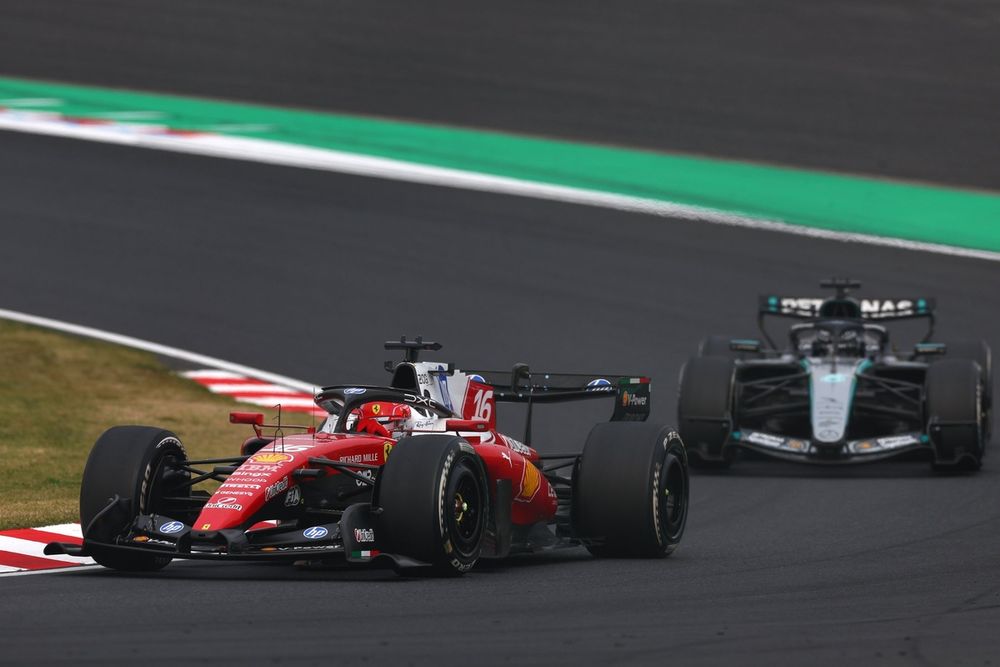
Software glitch caused Russell’s car to super clip unexpectedly, enabling Leclerc to seize the moment
Photo by: Andy Hone/ LAT Images via Getty Images
Russell, for his part, pointed out that this was race three of 22. But it will be point of concern for him that his young team-mate had an edge in areas where Russell has previously been in the ascendant.
Ultimately the Japanese Grand Prix represents a limited sample set, but it provided a timely reminder to Russell that he needs to maximise every race weekend to make the most of having the best car on the grid – because this picture could also change as other teams catch up.
“We need to stay feet on the ground,” said Wolff. “We’re three races in, we’re looking like the heroes. But three races from now on people could be saying, well no heroes anymore because the others got stronger.”
We want to hear from you!
Let us know what you would like to see from us in the future.
Take our survey
– The Autosport.com Team
Read the full article here


