



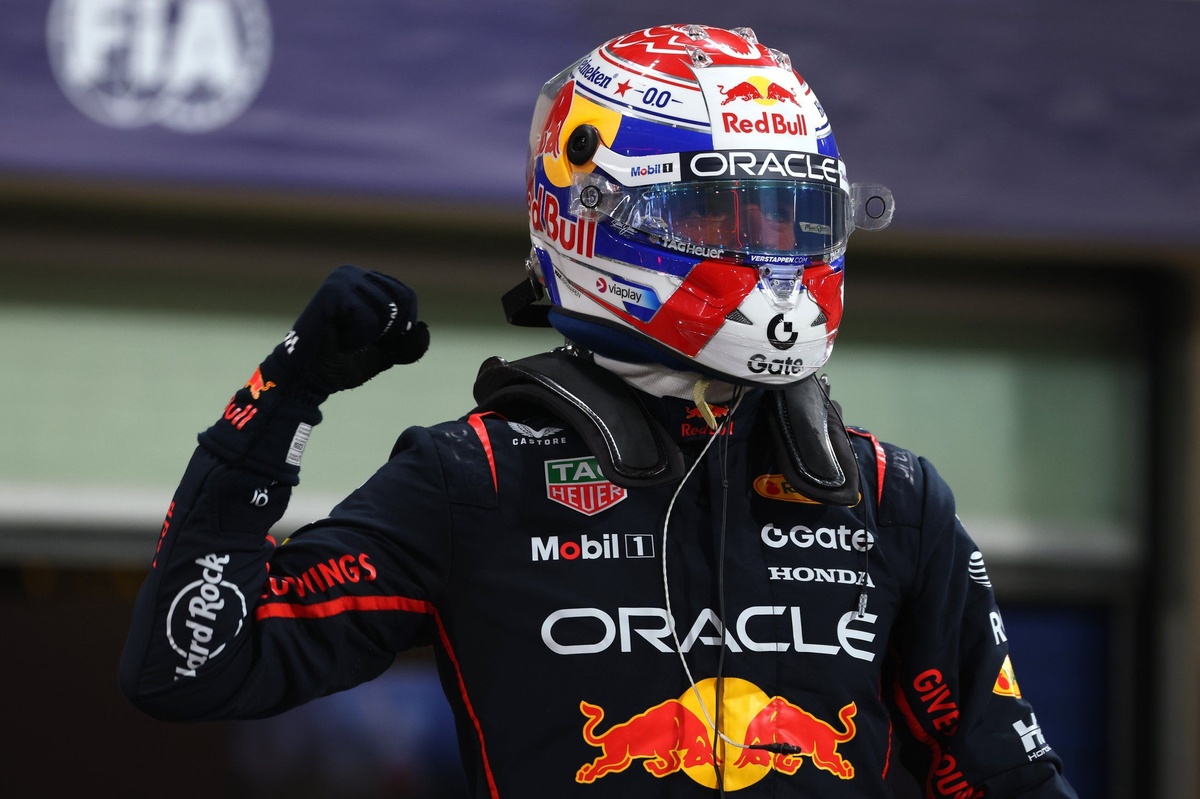
Ahead of last weekend’s Qatar Grand Prix, Max Verstappen opined that if he were Oscar Piastri and McLaren leaned on him to support Lando Norris’s title bid, he would “tell them to F off”. Slightly different circumstances, granted, but Yuki Tsunoda did not follow this advice when he was directed to help his team-mate out with a tow during his first Q3 lap in Abu Dhabi.
Not that he needed this assistance, as it turned out, because his second flier was eight hundredths faster than his first. And both of them were faster than Norris and Piastri, his rivals for the drivers’ title, could manage.
The challenge for teams and drivers here is that the Yas Marina circuit offers relatively little grip – Pirelli reckons that if you could remove ambient temperature from the equation, it would offer less grip than Las Vegas. Being a Hermann Tilke design it has a broad mix of cornering speeds, along with a couple of big stops from high speeds followed by hard acceleration.
This combination of cornering speeds and traction events makes it hard to strike a set-up compromise, because the need to build in some understeer to protect the rear tyres puts additional stress on the front-right and makes it prone to generating the small tears in the surface which evolve into graining – and on a track like this, graining rapidly induces thermal degradation which can’t be managed. Despite some commentators sending up warning flags about graining ahead of this weekend, though, the phenomenon seemed broadly limited to Pirelli’s soft-compound tyre, with a lower-order (but still measurable) effect on the medium and hard. Still, it was pronounced enough for McLaren to set its Friday running plan to save an extra set of hards for Sunday’s race.
The graining is expected to be less pronounced as the track evolves, but the extent of this will only become apparent on Sunday, given two of the support championships run on Pirelli rubber.
Max Verstappen, Red Bull Racing
Photo by: Clive Mason / Getty Images
Throughout Friday practice, and into FP3 on Saturday, Verstappen had complained about understeer and bouncing – to the extent that his feet were coming off the pedals. He was in a similar ballpark to the McLarens on pace through the opening sectors of the lap, only to fall back in the final one. The MCL39s of Norris and Piastri were mighty through Turn 9, the lightly banked left-hander introduced in 2021 in place of the jejune sequence of 90-degree bends which had defined the south end of the grand prix layout.
That was where the RB21 really started leaking lap time as its understeer balance manifested itself, compounded by the section around the hotel which ends the lap.
How much of Verstappen’s improved performance in qualifying came from set-up changes, and how much was a factor of Red Bull’s tendency not to show its hand until the sharp end of Saturday, is open to question. But he and the team were confident enough in his pace to run a used set of softs in Q2 so he would have two new sets available in Q3.
Max strikes first in sector one
If we compare Verstappen’s first lap with both McLaren drivers, the differences in sector one are marginal but Max emerged fractionally ahead, chiefly as a result of Norris (orange trace) being more conservative in his braking and throttle shape into Turn 1. Piastri (white trace) is later off the throttle and onto the brake, but not as late as Verstappen (blue trace).

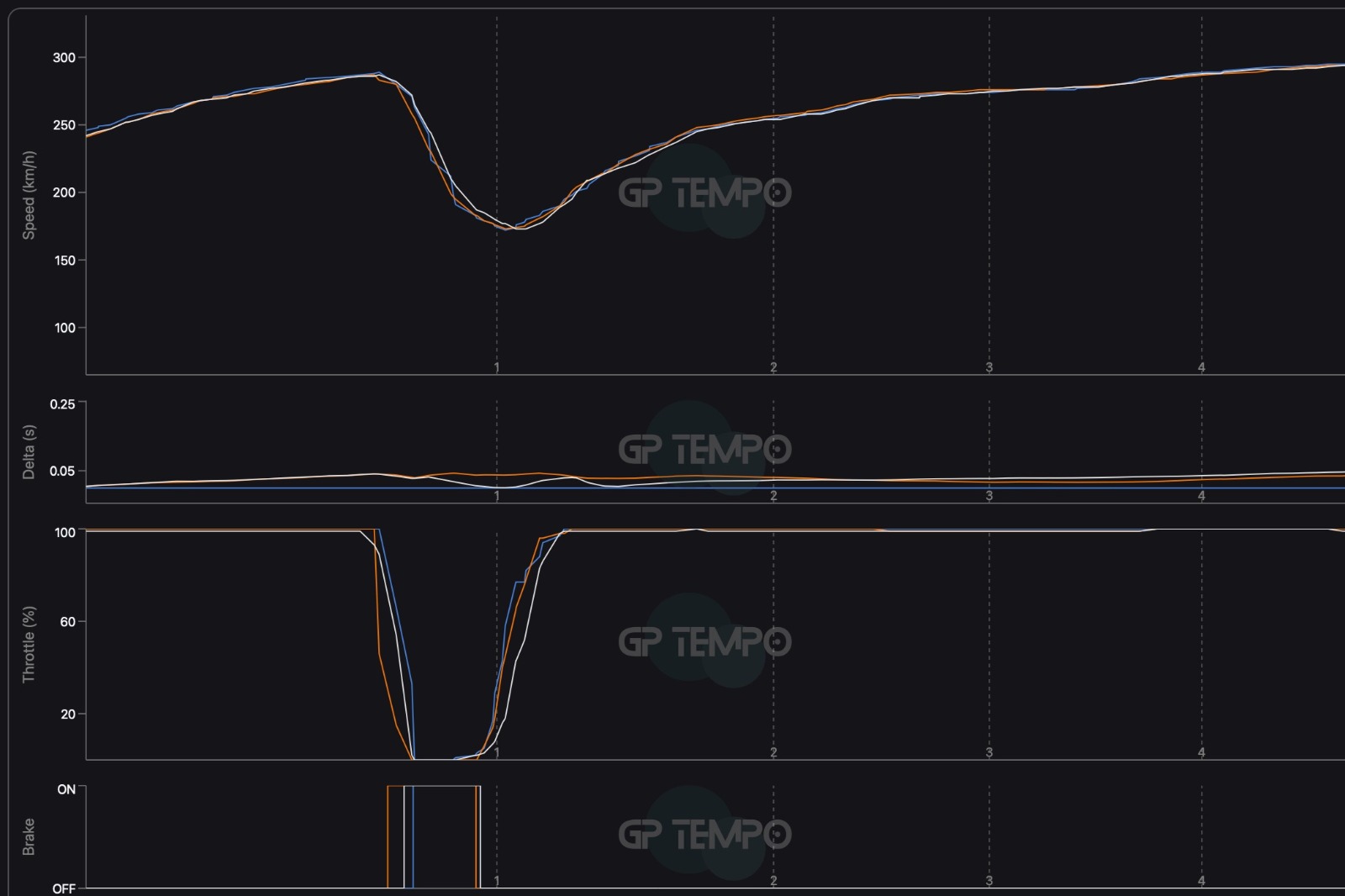
Piastri carried more speed into the corner for longer, though, so Verstappen’s initial advantage over him bled away towards the apex. The Norris reclaimed a fraction through the sweeper at Turn 3. Still, we’re talking about hundredths of a second here, which is all in the noise of slightly different trajectories through corners.
It’s not about the tow
Into sector two, we can see both McLarens briefly overturned Verstappen’s advantage at Turn 5, where the track slopes down towards the apex, compounding the tendency of cars with an understeer balance to scrub off speed. But actually the loss here was partly a result of Max braking fractionally earlier, blending this more aggressively with his removal of the throttle to encourage the back end to slide a little more and help get the car pointing the right way at the exit.
The slide killed some momentum and cost him around 10km/h relative to the McLarens as the apex loomed. He tried to pick up the throttle decisively at the exit but had to feather his application slightly to control wheelspin.
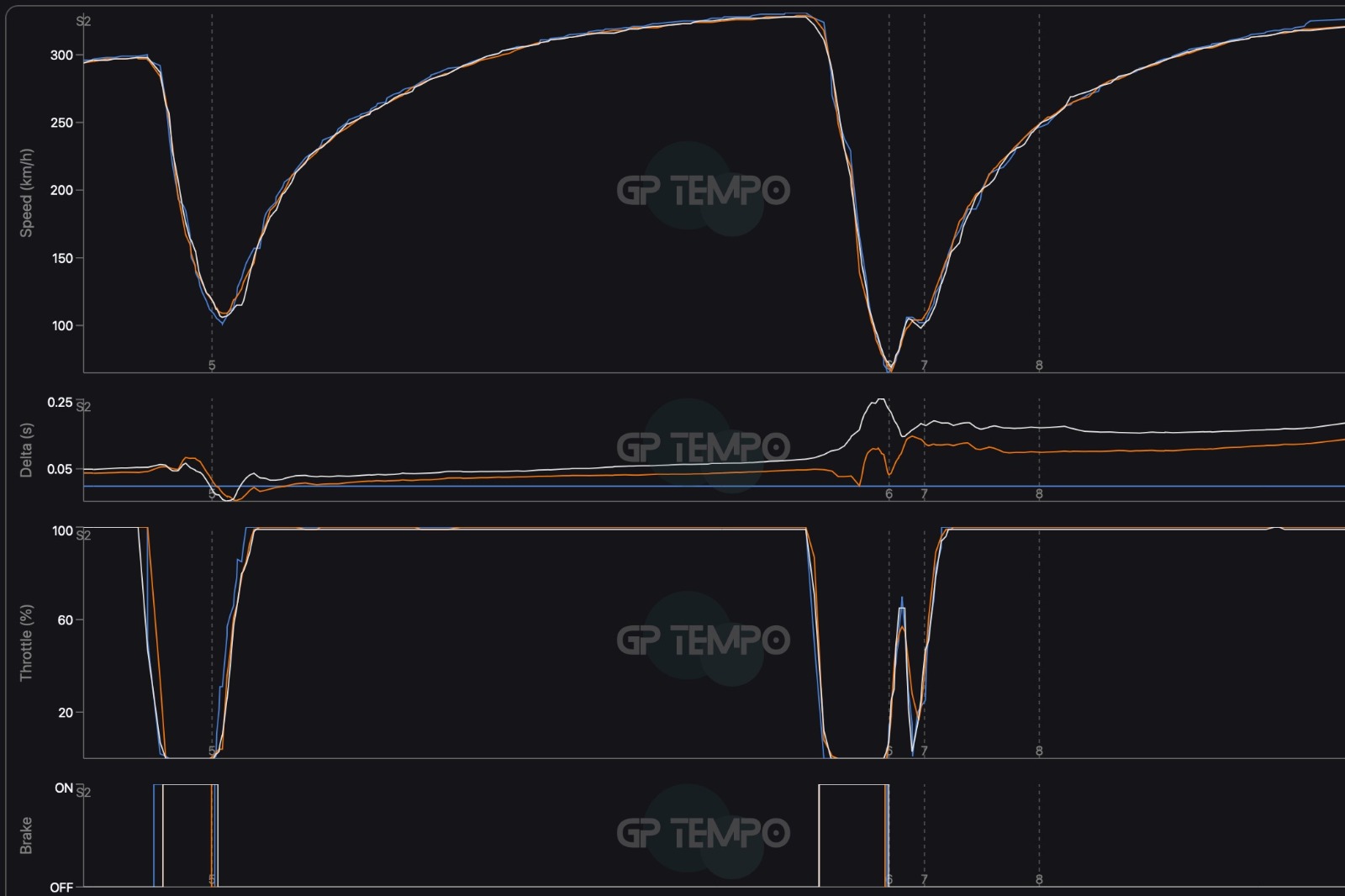
It was at the entry to Turn 6, the left-hander at the end of the second key straight, where Max did the most damage, carrying more speed into the short chute between Turns 6 and 7. A nuance invisible on television here is that the track has a small uphill gradient at this point, and both Piastri and Verstappen were slightly more aggressive in blipping the throttle before turning hard right into Turn 7.
Both McLarens had scrubbed off more speed than Verstappen as they threw their cars into Turn 6, though, and this was where Verstappen built his advantage. Piastri’s sharper throttle profile in the chute recouped some of what he had lost to his team-mate, but not enough to Verstappen, and the gap then opened again on the following straight.
At the end of that, Verstappen gained around 6km/h on the McLarens as a result of briefly getting a tow from team-mate Tsunoda, but the effect was marginal at best compared with the gap which already existed.
No way back
Into sector three and the McLarens were predictable quick through Turn 9, able to pick up the throttle earlier as Verstappen again tried to offset brake and throttle to tweak his RB21’s tail slightly. But as the corner opened out and he released the brake, he had to quell a costly twitch of oversteer – and then briefly feather the throttle again as he gathered it up.
Norris turned in to the corner later and at a more acute angle to get a straighter angle out, briefly costing himself momentum to his team-mate – but Piastri had to feather the throttle at the exit and Norris’s better traction gave him momentum into the final sequence of bends.
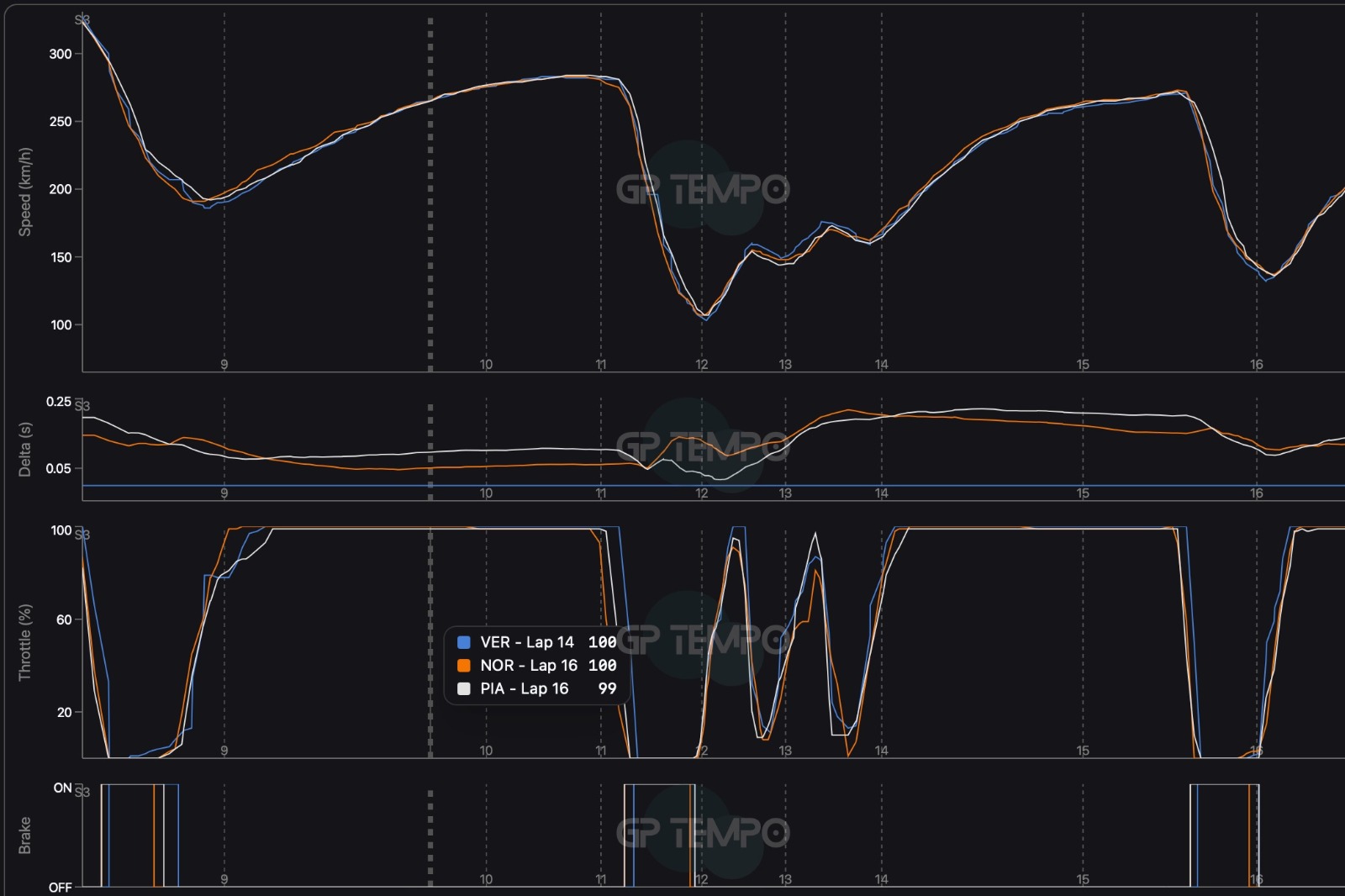
Again, Norris was a little cautious, earlier off the throttle rounding Turn 11. Piastri and Verstappen preserved more speed through the sharp right-hander at Turn 12 – indeed, Piastri, came tantalisingly close to drawing level with Verstappen’s time. But the Dutch driver was able to get to full throttle between here and Turn 13, proving decisive as both McLarens fell back. It was an advantage he would preserve, despite running too far over the kerb and losing some momentum at the final corner.
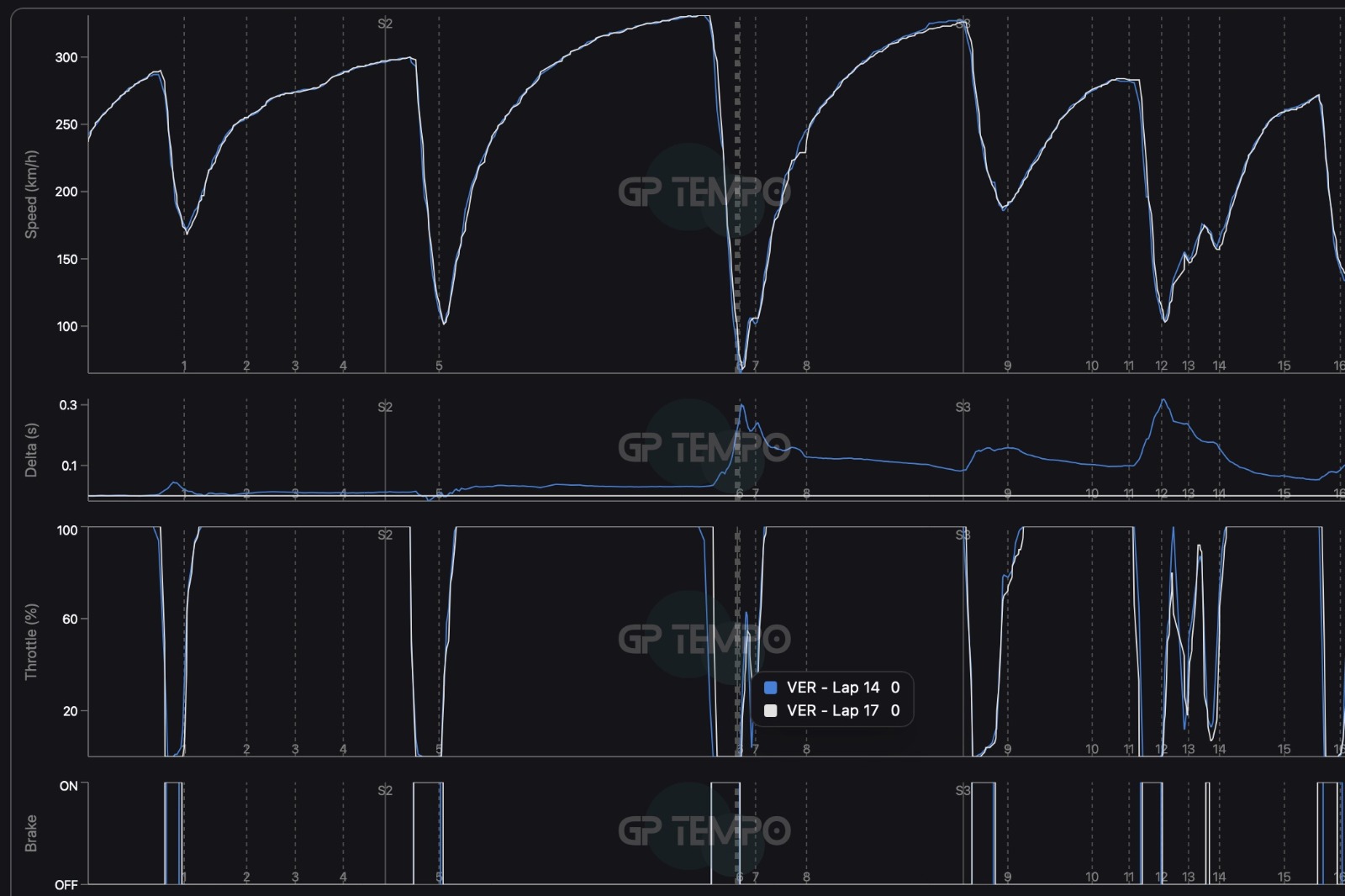
Comparing Verstappen’s two fliers throw up the interesting question of how fast the second lap might have been if Tsunoda had towed him on that one too – and perhaps done a less perfunctory end-of-straight job. Verstappen’s key gains (in white, above) over his earlier lap (in blue) came in Turns 6 and 12, at the former by being later and more sharply off the throttle, briefly carrying 18km/h more speed towards the apex, then carrying a more aggressive angle through Turn 11 to carry fractionally more speed into Turn 12 – and a neater path through the final corner.
The net result was 0.088s he ultimately didn’t need to find.
We want to hear from you!
Let us know what you would like to see from us in the future.
Take our survey
– The Autosport.com Team
Read the full article here


