






Have you recovered from last night yet?
I wouldn’t blame you if you haven’t.
Wednesday night’s Game 4 — a 107-106 victory for the New York Knicks to take a commanding 3-1 series lead — was either one of the most thrilling or heartbreaking experiences in recent memory.
There was something poetic about this one. The Knicks had their historic 13-game win streak snapped in Game 3 to set the stage; the San Antonio Spurs had a historic 3-point binge in the first half of Game 4, leading by as many as 29 points with a little over three minutes to go in the second quarter. The Knicks had to make even more history to erase that deficit and ultimately put themselves a win away from achieving their ultimate goal.
There are plenty of storylines to follow here — Brunson’s shot-making from the second quarter onward, OG Anunoby’s heroic two-way effort that culminated in the game-winning tip-in, Jose Alvarado’s we-need-everything-you-do run in the second half for starters — but I want to, once again, centralize things with the 7-foot-4 guy.
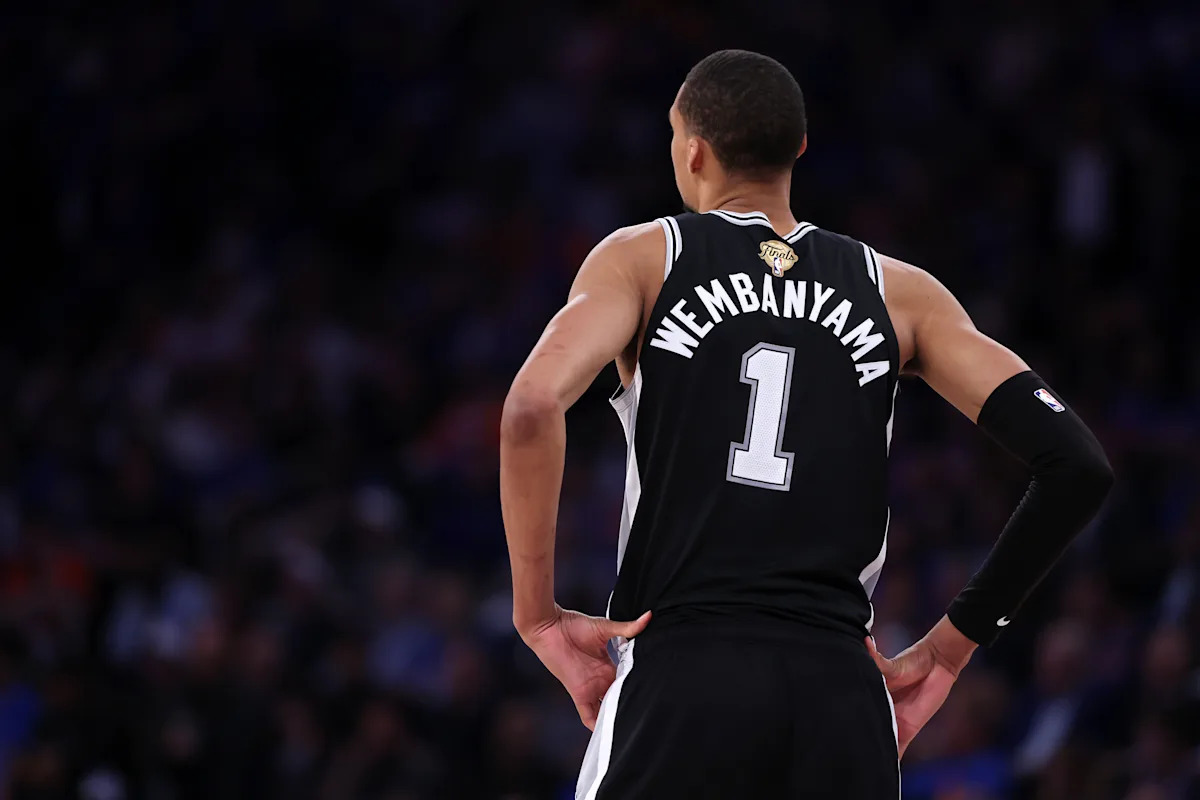
The Knicks didn’t just find their offense in the second half: for large stretches, they actively looked for Victor Wembanyama — the game’s most impactful defender, utmost rim deterrent, and general freak (complimentary) of nature — to do so.
This is not going to be a “Wemby is a FRAUD” piece — you can click the “X” now if that’s what you’re looking for — but it is fascinating how, and how often, the Knicks landed on Wemby as the answer to their earlier offensive ills.
There’s a general choose-your-poison when it comes to Wemby. If you leave him alone, you may be able to get into your action easier, but that action may only go so far while Wemby works to wall off the rim — my guy Steve Jones has been on it from the jump about his presence and communication.
If you choose to attack him directly, you have to navigate all 7-4 and however-long-the-wingspan-actually-is of him. But if you’re able to engage him high enough on the floor, you can potentially open things up behind him.
Teams just haven’t been able to consistently poke at him in either regard. He was the unanimous Defensive Player of the Year for a reason, folks. Not only do you have to win whichever path you choose; you need to win enough times to make the Spurs feel like they have to do something different.
That’s what made Game 4, particularly the second half, so shocking to absorb.
We’ll start here: Per Second Spectrum, the Knicks generated an eye-popping 1.41 points per possession on trips featuring a pick-and-roll defended by Wemby.
That’s right: 34 picks, 1.41 PPP. Both numbers are anomalies within the Wemby Experience.
2026 Soccer Pick ‘Em with FOX One: The group stage is here, make your picks now!
Of the 202 career games (regular season and playoffs) that Wemby has played, only 38 times (18.8%) has he been tasked with defending at least 30 on-ball picks. Of those 38 instances, Wednesday’s Game 4 was the second-worst performance he’s been part of.
The only game worse? The Spurs’ 111-106 loss to the Charlotte Hornets on Jan. 31, affectionately known as the Moussa Diabate Game. The Hornets generated an absurd 1.48 points per possession when Wemby defended a ball screen in that one. These are the only two games where Wemby has ever defended that many screens, and the offense had a success level above 1.4.
Things were even worse in the second half: 22 picks defended by Wemby, an even more insane 1.82 points per trip from the Knicks.
Game 4 started much like Game 3 did, with high ball pressure and pristine screen navigation making life tough for the Knicks early in the clock. Wemby was, in a literal sense, all over the place.
He started possessions on a big — Karl-Anthony Towns before his foul trouble, Mitchell Robinson and others once that foul trouble kicked in — before ultimately finding his way back to the paint to bark out orders. He’d “defend” Josh Hart so he could roam around the basket. On other trips, he’d just start in the corner, independent of who the Knicks had spaced there, to stalk around the rim.
This example ultimately ends in a shooting foul, but look at where Wemby starts, and how deep into the clock the Knicks have to work to generate anything fruitful:
As the Knicks searched for answers — and while the Spurs bombed away from deep on the other end — they weren’t able to truly get to Wemby in the first half. He defended 12 on-ball screens all half, with the Knicks generating a paltry 0.7 points per trip.
The Knicks ramped up the volume not even a minute into the third quarter. In a possession that mattered more than I knew at the time, a seed was planted: Let’s set screens higher, get the Wemby switch, and see if we can play out of that.
Brunson attacked Wemby after a switch, forcing a rotation from Julian Champagnie, and eventually generated a catch-and-shoot 3 for Anunoby:
The Spurs countered that plan shortly after. Brunson received another high screen to get the Wemby switch, but Stephon Castle lingered and ultimately took the matchup back from Wemby. That set off a chain of rotations that led Wemby to the opposite corner, where, to his credit, he did a solid job of containing an attack from Mikal Bridges:
That wasn’t a new tweak from the Spurs at all, but it was noteworthy. To that point, we’d seen the Spurs live with Wemby in a drop and mix in some switches. The Spurs even lightly tapping the “switch and double/scram” button clearly set off some sort of signal to the Knicks.
A little bit later, Brunson called up Wemby in action again. Instead of an outright switch, Wemby held his line to give Dylan Harper time to recover before “releasing” the assignment. Brunson drained a HORSE shot for the and-1, but it was again notable that the Spurs didn’t want to switch it cleanly:
Roughly a minute later, the Knicks tweaked their approach for a possession. Instead of running another high ball screen near the sideline, they ran the action in the middle of the floor from a “flat” spacing alignment. Paired with Landry Shamet’s lift to the right wing, there was nobody behind Wemby to provide real help:
To that end, I hope the Knicks and their coaching staff get the love they deserve for the spacing principles they exhibited during that second half. The Shamet lift in the example above is a subtle-but-smart one. One thing that also popped for me, particularly in the fourth quarter, were the corner-to-corner relocations the Knicks were sprinkling in.
Watch Anunoby on this possession:
Alvarado deserves a lot of credit for his willingness to screen, as well as the lumber he laid on the actual screen to force the initial switch. He also deserves credit for darting to the wing after setting the screen.
Not only does it put Towns one pass away from Brunson, it also puts Alvarado in a position to maintain the numbers advantage — either with a quick swing to Hart to his right or, as we saw in the clip, by attacking from the wing. To the Hart portion, it’s why we see Julian Champagnie making a beeline to the opposite corner as Wemby is dropping back:
Knicks vs. Wemby
The Knicks wouldn’t let up. Alvarado certainly wouldn’t let up. Shortly after, he was once again called up to screen in an effort to bring Wemby into the action. And once again, he ended up making the possession-ending play:
It became such a problem that the Spurs went back to switching Wemby outright to avoid being put in rotation. Naturally, Brunson responded by draining a ridiculous pull-up 3 over Wemby to bring the game within one:
While the Knicks didn’t go to pick-and-roll on their final possession, it seemed fitting that Wemby found himself off-ball switching onto Brunson, with De’Aaron Fox coming with a double team:
The Spurs have a lot to consider heading into a potential season-ending Game 5 on Saturday. Chief among them: How much of the success against Wemby in pick-and-roll was due to the Knicks’ understanding of the Spurs’ rotations and the counters they presented, a lack of execution and drive containment from the Spurs’ end, and general fatigue from Wemby himself?
Remember, Wemby logged nearly 44 minutes in this game. He’s logged 40 or more minutes in three of his last five games, averaging 40.6 over this stretch — that’s a pretty big uptick from the 29.2 minutes he averaged during the regular season. That, combined with the fact that this is Wemby’s first playoff run (still wild to me), would help explain some of the slippage; it’d definitely help explain his jumper-heavy second half.
For now, though, we should marvel at what the Knicks put together in Game 4. It was a comeback for the ages, one that should officially stamp them as an all-time playoff team if the 13-game win streak and historic point-differential wasn’t enough to do the job.
Read the full article here


