




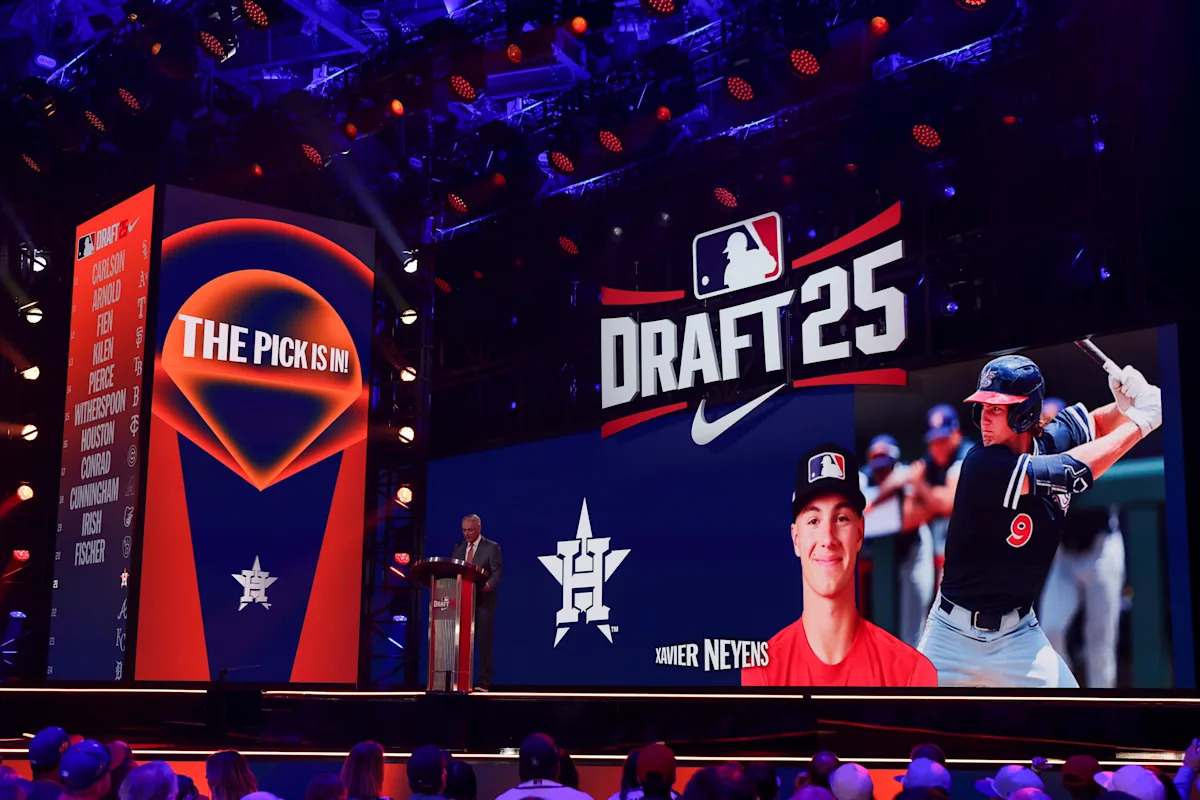
As Major League Baseball and the players’ association near the end of their collective bargaining agreement in less than 6 months on December 1, questions over a potential lockout loom. It was reported today that the MLB has proposed widespread changes to it’s annual draft.
The likelihood of the proposition being accepted as-is may not be high, but it confirms the rumors that sweeping changes could be made to players’ entry in to professional baseball and it could have massive effects on the future of college baseball.
First, the MLB wants to institute a separate international draft. Currently, international players are allowed to sign with whichever Major League team offers them a contract, with bonus pool limitations for spending, similar to the current draft. The signing period runs between January 15 and December 15, with prospects being required to be at least 16 years old to sign and turn 17 by September 1 of the next year. It’s basically free agency. An international draft would require players to be 18 and consist of 12 rounds.
How could that affect LSU? Well, instead of the process being essentially open game, it could bottleneck crops of players in particular drafts. It likely would not matter much to the top-end talent who will get paid on the higher end of slot values, but with middle-to-lower talent, prospects could choose to go to school for two years, earn NIL, and hope to develop within collegiate baseball programs to improve their abilities and, eventually, their draft stock. It would be fairly similar to the decision that high school players are faced with, although they are not only competing with their peers for draft positions, they’re also in the same crop as college players. Is it likely that college baseball sees a large influx of international players come to America to play college baseball? Probably not, but changes like this could certainly matter so some players from outside of the country.
You may have noticed that I mentioned that the international players could choose to go to college for two years. That’s because part of the proposed changes to the typical MLB draft entail changing the eligibility requirements to simply two years in college. Currently, players that attend four-year colleges are eligible upon finishing their junior year or turning 21 years old within 45 days of the draft. Although they’re the vast minority, there are some sophomores that make the cut for the age requirement, often referred to as “draft eligible sophomores” or “super sophomores”. Derek Curiel is a prime example.
The two year rule would go along with the most impactful change that would immediately affect NCAA Baseball. High school players would no longer be eligible to enter the MLB Draft. Every graduating senior must attend college and would be eligible after their sophomore season. In the 2025 draft, 96 high school baseball players signed professionally after being drafted. With the rule change, all of that top-end talent would enter the collegiate ranks, bettering college baseball as a whole.
While the entire sport would benefit from more high-level players taking the field from the SEC to the mid-majors, LSU, specifically, would be ecstatic to actually land all of the commitments that they receive. Over the years, they have been gutted by the MLB draft and, at times, forced to turn to the transfer portal as a saving grace. This past season was a perfect example. Jay Johnson lost 8 signees to professional baseball, a few of which were slight surprises. With a change like the one proposed, coaching staffs would have a much better idea of who will make it to campus, much like football and basketball.
To further illustrate the immense amount of talent that has skipped over LSU, here are the commits from Jay Johnson’s first four classes that signed professionally. Four have already made it to the MLB, three of which are everyday players (or in the rotation in Misiorowski’s case). For the others, their current level in the minors and their prospect rankings in their respective organizations are included, along with when they were drafted.
2022
OF Justin Crawford (1st rd, Phillies) – Made his MLB debut this season, playing in 69/75 games so far in 2026 with 200+ at-bats as Philadelphia’s center fielder.
RHP Jacob Misiorowski (2nd rd, Brewers) – After bursting on to the scene and making his Major League debut in 2025, Misiorowski has started 28 games over the past two seasons and has dominated. His ERA this season is 1.34 through 87.0 innings pitched and he has topped out at 104.5 mph just days ago.
LHP Robbie Snelling (1st rd, Padres) – Made his MLB debut in May for the Marlins with one start where he threw 5.0 innings. Currently ranked as Miami’s #2 prospect.
3B Tucker Toman (2nd rd, Blue Jays) – High-A/#40 Toronto
SS Mikey Romero (1st rd, Red Sox) – AAA/#11 Boston
LHP Michael Kennedy (4th rd, Pirates) – High-A/#18 Cleveland
2023
C Blake Mitchell (1st rd, Royals) – High-A/#1 Kansas City
2024
SS/OF Konnor Griffin (1st rd, Pirates) – Called up to make his MLB debut for Pittsburgh early in the season on April 3rd. Has played in 51 games and is hitting .270 with just under 200 at-bats while typically starting at shortstop.
LHP Cam Caminiti (1st rd, Braves) – High-A/#1 Atlanta
LHP Boston Bateman (2nd, Padres) – High-A/#9 Baltimore
3B Kale Fountain (5th rd, Padres) – A/#18 San Diego
2025
SS Brady Ebel (1st rd, Brewers) – A/#13 Milwaukee
SS Quentin Young (2nd rd, Twins) – A/#12 Minnesota
OF Dean Moss (2nd rd, Rays) – A/#29 Tampa Bay
SS Jaden Fauske (2nd rd, White Sox) – A/#7 Chicago White Sox
RHP Miguel Sime (4th rd, Nationals) – High-A/#17 Washington
LHP Briggs McKenzie (4th rd, Braves) – High-A/#6 Atlanta
C Landon Hodge (4th rd, White Sox) – Rookie ball/#19 Chicago White Sox
RHP River Hamilton (11th rd, Tigers) – Injured list/Ranking NA
It’s clearly visible how impactful just a fraction of these players could have been for the Tigers. Although the current state of the MLB Draft has not prevented Johnson from bringing two national championships home in his first five seasons in Baton Rouge, it’s hard not to imagine how incredible a few of these players could have been in purple and gold. Can you imagine a rotation in 2023 that included both Paul Skenes AND Jacob Misiorowski? Konnor Griffin and Steven Milam could have been one of the best middle infield in college baseball history. Briggs McKenzie and Miguel Sime would have been a revelation as starting pitching options as LSU’s entire rotation was injured at some point in 2026.
Johnson has been very vocal about how impossible it is for colleges to compete with the inflated amounts of money that MLB teams are offering high school prospects nowadays. They do their best, but when you have to get through 82 selections in the draft before the slot value drops below seven figures, it’s an uphill battle that they’ll never win.
Taking the option to sign professionally away from high school graduates would change that, though, and LSU would be set to benefit as much, if not more than anyone.
Read the full article here


