

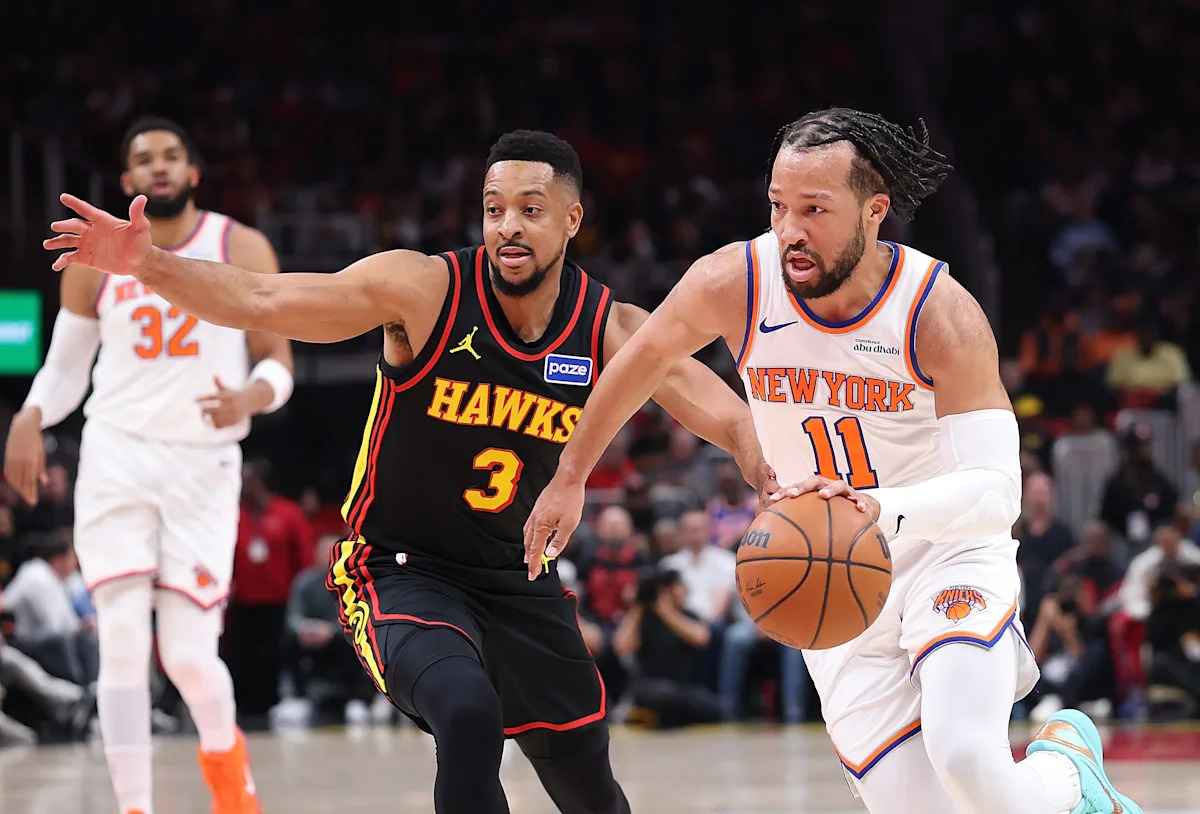
The Eastern Conference’s third-seeded New York Knicks will take on the sixth-seeded Atlanta Hawks in the first round of the 2026 NBA playoffs. The two franchises last faced off in the postseason in 2021, with the Hawks slicing up New York’s defense en route to a 4-1 opening-round win, punctuated with a perfectly villainous Trae Young bow at center court in Madison Square Garden.
Only one person who played in that series will play in this one, though: Hawks big man Onyeka Okongwu, who logged a grand total of 31 minutes. So it’s probably not THAT predictive. (Knicks fans hope it isn’t, at least.)
What we know about the Knicks
The Knicks return the core of last year’s Eastern Conference finals squad, led by All-Star bookends Jalen Brunson and Karl-Anthony Towns, 3-and-D+ wings OG Anunoby and Mikal Bridges, and dirty-work difference-makers Josh Hart, Mitchell Robinson and Deuce McBride. They have been something like the fifth-best team in the NBA this season; whether you believe that’s cause for celebration or an existential crisis likely depends on how many phone numbers with 718, 212 and 917 area codes are saved in your contacts.
Mike Brown was brought in to squeeze more toothpaste out of the tube than Tom Thibodeau did — and, broadly speaking, so far, so good. The Knicks’ 53 wins are the franchise’s most since 2013, and heading into a season finale where they rested everybody besides Bridges (who played 23 seconds), they had a better offensive rating, defensive rating and net rating than the previous season, while generating 3-pointers and free throws at a higher rate, getting out in transition more and grabbing a higher share of available rebounds. Brown managed that while reducing the minutes workload for every starter save Brunson; providing increased opportunities for the likes of McBride, Landry Shamet and youngers Tyler Kolek and Mohamed Diawara; and navigating a (voice hushes to a whisper) load-management plan (back to full volume) for Robinson that has kept the offensive-rebounding goliath healthier than he’s been in years.
(He also won the NBA Cup. So, y’know, he’s got that going for him. Which is nice.)
New York is balanced and experienced, with stars and shooting, physicality and poise, and arguably the best fourth-quarter and crunch-time résumé in the league. This is a team that doesn’t back down from a fight … which is good, because it’s about to get one.
What we know about the Hawks
Atlanta fundamentally changed its identity in January, trading longtime franchise cornerstone Young to the Wizards in favor of reorienting its offensive philosophy and reducing its defensive vulnerability. The result: one of the NBA’s best teams over the past three months.
After dealing Young, the Hawks went 28-15, a 53-win pace, with the NBA’s No. 12 offense and No. 6 defense. Their shuffled-up starting lineup — Jalen Johnson, Nickeil Alexander-Walker, Dyson Daniels, Onyeka Okongwu and new arrival C.J. McCollum, the primary piece returning in the Young trade — went 14-4 and blitzed opponents by more than 20 points per 100 possessions, the second-highest mark among big-minute lineups, behind only the Charlotte Hornets’ starting five. (On the other hand, New York’s high-priced, much-ballyhooed starting five has — for the second straight season — posted an underwhelming net rating for the full season and has actually been outscored since the trade deadline.)
Today’s Hawks place more scoring and playmaking responsibility in the hands of Johnson, who may well earn his first All-NBA selection after averaging a career-best 22.5 points, 10.3 rebounds and 7.9 assists per game, and Alexander-Walker, a Most Improved Player candidate who averaged 22 points per game on scorching 50/44/95 shooting splits after the trade deadline. It’s a more multifaceted attack, predicated on moving the ball and their bodies — the Hawks led the league in assists and points created via assist, and finished fourth in total distance traveled on offense per game and third in average speed traveled on offense per game — that leverages the fact that virtually every member of their rotation can serve as either the ball-handler or screener in the pick-and-roll to tax opposing defenses and drag vulnerable defenders into the action, no matter where they might be hiding.
The caveat in Atlanta’s second-half surge is mostly competition-based. Fourteen of their 28 post-Trae-trade victories came against what my colleague Tom Haberstroh calls the “B League” — tanking teams that haven’t been trying to win for months — and 10 more came against opponents missing at least one star-level starter; in that span, they went just 5-9 against opponents with a top-10 point differential.
You don’t have to apologize for winning the games you’re supposed to win. Beating a healthy high-end opponent four times in seven games, though, represents a steeper challenge.
Head-to-head
New York won the season series, 2-1. The Knicks, yet to plunge into their post-NBA Cup swoon, came away with a 128-125 win on Dec. 27, spurred by Brunson and Towns combining for 70 points:
The Hawks returned serve the following week, notching a 111-99 win on Jan. 2 behind a balanced effort, with six players scoring in double-figures and Johnson turning in 18 points, 10 rebounds and 11 assists — one of his 13 triple-doubles on the season, more than anybody besides Nikola Jokić:
As ever, though, your mileage may vary on how much to take from those first-half contests. For starters, both came before the Young trade. Hart and Shamet missed both games for the Knicks, and both Towns and Robinson missed the loss. For Atlanta, Young and Kristaps Porziņģis — both since dealt — each appeared in one of those games, and Zaccharie Risacher and Asa Newell both played rotation minutes in both; neither’s likely to play significant minutes in Round 1.
The one time the teams have played since Atlanta’s midstream reformation, and with both teams at roughly full strength, came last week, with the Knicks eking out a 108-105 win, thanks largely to a monster close from Brunson, who scored 17 of his 30 points in the fourth quarter …
… and in part to McCollum’s would-be-overtime-forcing three-quarter-court heave coming off his fingertips just a tick too late:
Matchup to watch
How the Hawks defend KAT.
The book on how best to deal with Towns — and to defang the Brunson-Towns two-man game, which has shown promise at times since Leon Rose paired them, but hasn’t been nearly as ubiquitous as Knicks fans hoped — has been to juggle the defensive matchups, stationing a smaller wing defender on Towns and your center “on” (but, really, a considerable distance off) Hart.
Do that, and you put yourself in position to prevent Towns from getting a steady diet of pick-and-pop looks against a big man playing drop coverage, and to switch the Brunson-KAT pick-and-roll without granting Brunson a mismatch against a lumbering center. You also might induce the Knicks to funnel more shots to Hart, a 35% career 3-point shooter whom you’d much rather see firing than New York’s two All-NBA offensive aces. (Expect the Knicks to pull a similar “ghost coverage” gambit with Daniels, who shot just 18.8% from 3-point range on 1.5 attempts per game this season — though he did make at least one 3 in seven of his final 10 appearances.)
Atlanta, though, has largely eschewed such cross-matching, preferring instead to keep starting center Okongwu on Towns while putting its weakest starting-lineup defender elsewhere — Young on Bridges back in December, McCollum on Hart last week — and otherwise playing things straight. Towns has mostly torched that coverage, scoring 57 points in 62 minutes on 63% shooting against Atlanta and routinely either getting clean looks beyond the arc or free releases on rolls to the basket with little-to-no secondary rim protection behind Okongwu:
If New York is able to punish straight-up coverage on Towns in a way that proves untenable for Atlanta — whether by KAT finishing himself or by Brunson getting going off the ball in a two-man game that’s looked better and better of late …
… how will Hawks coach Quin Snyder respond? Does he want to chance entrusting Johnson with that defensive responsibility while also needing him to serve as Atlanta’s top creator and finisher? He surely wants to keep Daniels on Brunson at every opportunity; if Towns is on fire, though, does he gamble on sliding his best defender into the matchup, cycling Alexander-Walker over to Brunson, and daring the Knicks to make the likes of Anunoby, Bridges and Hart beat them?
Or does he just stay the course, trusting that even if Towns goes off, the Hawks will be able to make it up on the other end — where they’ve scored a scorching 123.3 points-per-100 against New York in KAT’s minutes this season?
Key question
Can the Hawks turn this into a track meet?
The Hawks finished the regular season fifth in possessions per 48 minutes; the Knicks were 25th. The Hawks were second in the NBA in average time to shot, according to Inpredictable; the Knicks were 24th. The Hawks had the second-quickest average offensive possession, according to PBP Stats; the Knicks had the fourth slowest. The Hawks were fourth in the league in transition frequency, with nearly 17% of their offensive plays coming on the fast break, according to Cleaning the Glass; the Knicks were 16th, at just over 15%.
It all tracks, from a “styles make fights” perspective. With Brunson at the controls of the offense, and Anunoby, Bridges and Hart to turn perimeter assignments into a wrestling match, New York prefers a half-court game. With all the length and athleticism that Atlanta has on the wing — Johnson, NAW, Daniels, newcomer Jonathan Kuminga off the bench — playing uptempo before an opponent can get its defense set favors the Hawks. Whichever team sets the speed limit has the best chance of setting the terms of engagement for what ought to be a tough, hard-fought series.
(One X-factor to watch there: The possession-controlling play of Robinson, who rebounded an absurd 23.9% of New York’s missed shots during his floor time this season, and whose length and quick hands make him a shot-blocking and steal-grabbing menace. Across two matchups with the Hawks this season, Robinson grabbed eight offensive rebounds, four blocks and four steals in 38 total minutes, which New York won by 14 points; his physicality could overwhelm an Atlanta front line that really lacks size, especially if reserve Jock Landale isn’t ready to go after suffering a right high ankle sprain against the Magic two weeks ago.)
New York Knicks (-300)
Atlanta Hawks (+240)
Prediction: Knicks in six.
The Hawks are tough, talented, versatile and athletic, with enough experience (McCollum, Alexander-Walker, Gabe Vincent, et al.) that it’s unlikely they’ll wilt in the postseason hothouse, despite it being this core’s first trip as a unit. But these Knicks have won at least one road game in the opening round in each of the last three postseasons — and, in fact, eliminated the Cavaliers, 76ers and Pistons all away from MSG. I expect the trend to continue, with Brunson and Towns having big series en route to New York’s fifth series win in the last four postseasons.
Series schedule (all times Eastern)
Game 1: Atlanta at New York on Saturday, April 18 (6 p.m., Prime Video)
Game 2: Atlanta at New York (TBD)
Game 3: New York at Atlanta (TBD)
Game 4: New York at Atlanta (TBD)
*Game 5: Atlanta at New York (TBD)
*Game 6: New York at Atlanta (TBD)
*Game 7: Atlanta at New York (TBD)
*if necessary
Read the full article here