




Canelo Alvarez’s decline did not begin with Terence Crawford. Crawford removed the remaining doubt after Jaime Munguia, Edgar Berlanga and William Scull demonstrated that Canelo was losing the speed, activity and aggression that separated him from ordinary champions.
Those opponents suited Canelo, yet none fell before the final bell. He fought in brief spurts, leaned on single power punches and allowed long stretches to pass without forcing the action. His last stoppage occurred against Caleb Plant in November 2021.
The deterioration shows clearly in Canelo’s jab. During peak campaigns against Gennadiy Golovkin and Callum Smith, he drove an authoritative lead hand to dictate distance, split high guards and create openings for hooks. That punch has deteriorated into a lazy pawing motion that opponents parry with little concern.
Without an authoritative jab collecting a toll at the perimeter, aggressive opponents march straight into pocket range. That grants Christian Mbilli direct access to unload combinations without having to solve a layered defense first.
Canelo’s multi-punch body combinations vanished as well. The classic left hook downstairs doubled with a hook upstairs demanded explosive torque from his hips. He now settles for isolated overhand rights and looping hooks. Opponents brace for those solitary attempts and fire back before Canelo reorganizes his guard.
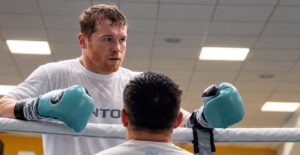
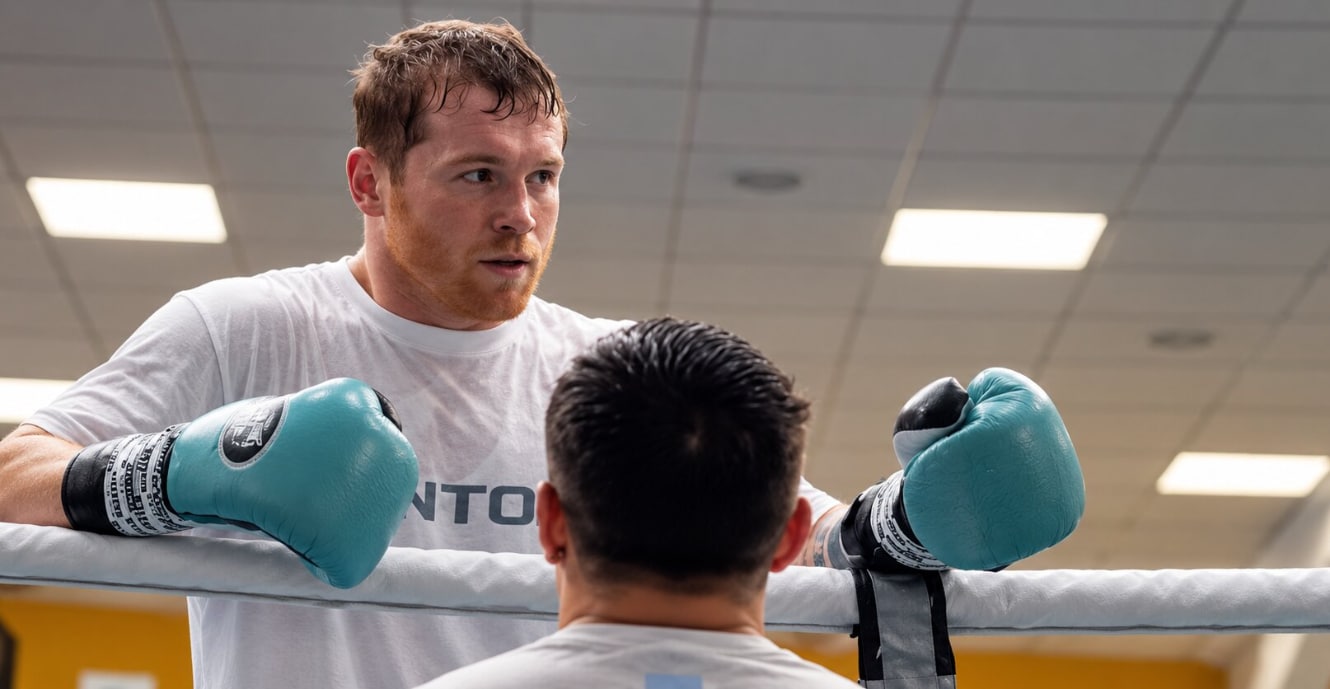
Scull exposed another troubling pattern. Once the Cuban gained confidence and let his hands go, Canelo spent long stretches parked against the ropes. That was not the slick baiting technique Canelo displayed in his prime.
A younger Canelo rested dynamically through trunk movement while keeping his base centered. The current version retreats straight back, physically resting his weight on the cables to catch his breath. That passive posture hands opponents ring generalship, influences judges, and gives away rounds on sheer inactivity.
Crawford dismantled those exact tendencies. Canelo chased him flat-footed in straight lines, loaded up on telegraphed blows and lacked the sustained output needed to flip the narrative. An elbow ailment provides an easy excuse, but that physical issue fails to explain the missing fire against Munguia, Berlanga and Scull.
Working alongside Oleksandr Usyk brings plenty of promotional chatter. Usyk provides tactical insights and conditioning drills, yet he cannot turn back the clock on Canelo’s legs or reflexes. Canelo started fighting professionally as a teenager in 2005. Over twenty years of prize fights, hard gym wars and brutal training have ground down his joints, leaving wear on his shoulders, knees and arms that no single training camp can scrub away.
Mbilli’s relentless tempo presents severe danger. The contender attacks in waves, pounding the torso, arms and shoulders when clean head openings close up. An aging veteran hunting for breathers between thirty-second charges struggles when confronted by someone who ignores the referee’s breaks and pushes the pace.
Canelo retains the superior boxing brain, but Mbilli meets him when the physical engine can no longer execute those master plans over twelve exhausting rounds. Spending over twelve months on the shelf following joint surgery rarely produces a fountain of youth. It often produces a slower fighter burdened with ring rust and relying on lucky one-shot counters. The debate no longer centers on how prime Canelo handled crude swarmers. The issue is how little of that elite operator walks into the ring tonight.
Canelo built his entire hall of fame run on intimidating guys into low-output chess matches. When opponents feared the return fire, they stayed on the outside, threw tentative jabs, and let Canelo dictate a glacial pace where his limited gas tank never became a liability. He could sit in neutral for two minutes of every round because thirty seconds of explosive, flashy counter combinations were enough to bank the frame on the cards.
Mbilli completely breaks that formula. He is the ultimate volume merchant. He does not possess top-shelf technical defense, but he does not care to. He enters the pocket like a bowling ball, throws 70 to 80 punches a round, and beats fighters around the collarbones, biceps, and ribcage until their guard drops from sheer exhaustion.
If Canelo cannot make Mbilli taste severe, concussive power in the opening three rounds, he is in for a horrific night. Without blazing hand speed, Canelo’s single-shot counters will bounce off Mbilli’s forehead while the Frenchman keeps driving forward.
Once Canelo gets forced into the ropes, the fight transforms from a technical boxing match into an attritional brawl. An aging fighter with twenty years of wear, a surgically repaired elbow, and a shallow engine cannot survive being battered along the cables for twelve continuous rounds. If Canelo spends the second half of the fight covering up in a high shell while Mbilli unloads hooks to his sides, the referee or the corner will be forced to save him from a punishing beating.
Read the full article here


