







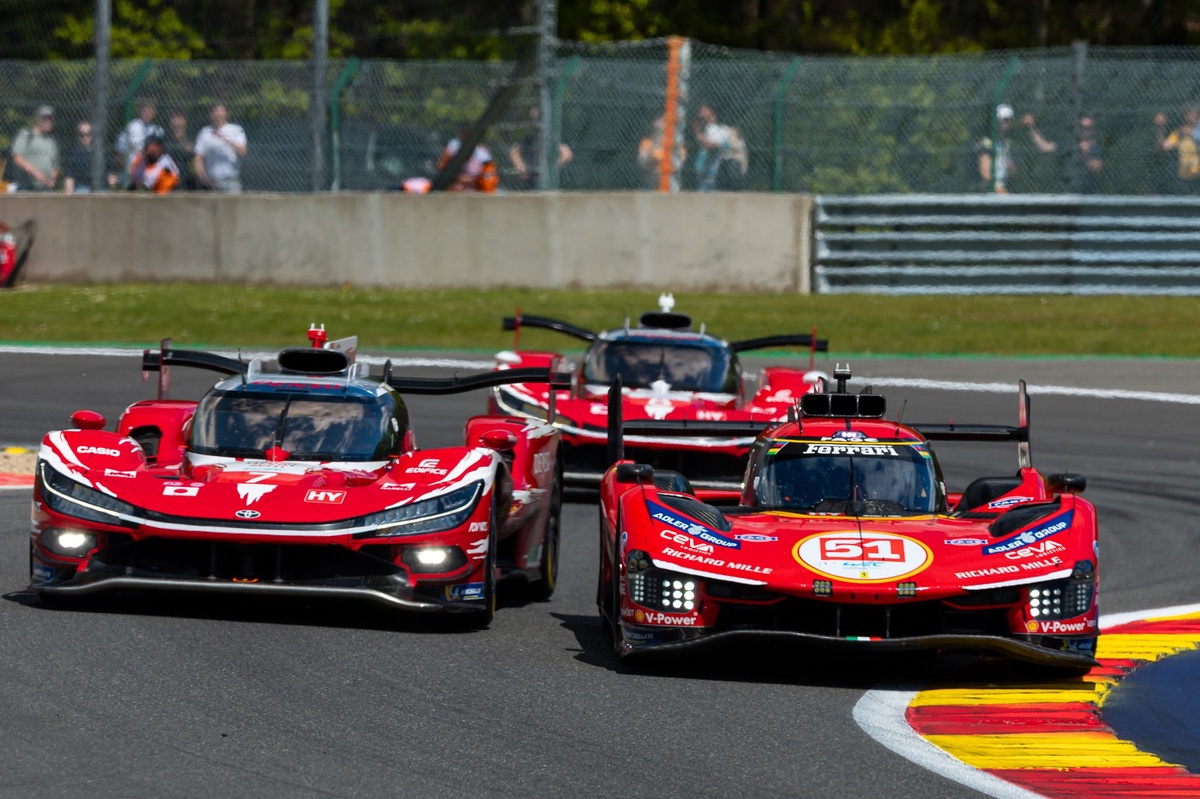
GT3’s architect Stephane Ratel says the backlash surrounding the World Endurance Championship’s decision to hide Balance of Performance data reflects the public’s “constant need for conspiracy theories”.
The WEC stopped publishing BoP figures for both Hypercar and LMGT3 classes at the start of the 2026 season, prompting criticism over the lack of transparency from some quarters.
The debate followed a 2025 campaign in which Toyota frequently pointed to BoP for its lack of competitiveness, while Porsche also cited the same system among the reasons behind its withdrawal from Hypercar.
While BoP has always been a contentious topic, it has traditionally been accepted as a necessary evil in GT3 racing. However, with the system now governing the top category of endurance racing, scrutiny around the process has intensified.
The BoP for the Hypercar class is regulated jointly by the Automobile Club de l’Ouest and the FIA, who are also the co-promoters of the WEC. However, their task is made harder by the existence of two separate regulations – LMDh and LMH – and significant design differences between manufacturers.
Ratel’s SRO organisation has pioneered the use of BoP in GT racing and remains heavily involved in balancing cars across various championships around the world. Asked for his thoughts on the WEC keeping BoP confidential this year, Ratel defended the move and stressed that each series wants to ensure close and unpredictable racing.
Stephane Ratel, CEO SRO
Photo by: Alexander Trienitz
“I’ve seen some criticism,” he told Autosport. “What does a promoter want? What is sport about? What makes sport a success? Three elements: the nationalities, the heroes and the uncertainty. The uncertainty is essential. So, we need uncertainty and BOP has no other object but to balance and to create uncertainty.
“If you have the upper hand, you have the best car and you win all of the time, which happened to Formula 1 in the time of the Ferrari ultra-domination, the ratings go down, and everything goes down.
“So, the objective of each promoter, SRO, ACO, IMSA and DTM, is to have uncertainties. And we can only have uncertainty if we are sure to balance to the best of our ability. So, whether it’s public or not public should be irrelevant. It’s unfortunately the public’s constant need for conspiracy theories. There is no conspiracy.
“Our goal, our pride, our success comes from having every… if we could have every car within one tenth of a second, we’ll be superheroes. What we want is all the cars to be equal to create very close competition, which is more exciting to watch, offers different winners and creates uncertainty, which is needed for the sport.
“So, it’s why the question of whatever is published or not published is of no interest to me.”
We want to hear from you!
Let us know what you would like to see from us in the future.
Take our survey
– The Autosport.com Team
Read the full article here


