






The FIA stewards have upheld Alpine’s appeal against the Formula 1 Monaco Grand Prix results, with Pierre Gasly reinstated in third.
Gasly crossed the finish line in third but was handed two five-second time penalties for pitlane speeding, one of several drivers to do so, which demoted him to seventh.
Alpine immediately lodged a right of review bid after the race, because it had evidence Gasly had not crossed the 60km/h limit at any stage and had even taken additional margin to stay below the limit.
During Thursday’s right of review hearing F1’s timekeeper FOM admitted that there had been an error with the distance measurement in the pitlane from which speeds are taken, causing average speeds to be overreported. The stewards accepted the error as evidence that Gasly should have his two time penalties rescinded.
Red Bull’s Isack Hadjar has now lost his podium as a result, as he is demoted to fourth behind Gasly.
What actually happened in pitlane
In F1, pitlane speed is not measured by speed guns, but by calculating an average speed between a series of consecutive timing loops. According to timekeeper FOM, these distances, which are determined by GNSS (Global Navigation Satellite System) and verified through a survey on track, are accurate to within 1cm, and the time should be accurate to 1ms.
Pierre Gasly, Alpine
Photo by: Sam Bagnall / Sutton Images via Getty Images
In Monaco there are nine sets of timing loops ranging in length from around 10 to 40 metres. Because the Monaco pitlane is curved, the shortest distance between any two loops is used to calculate pitlane speeds.
All alleged pitlane speed infractions in Monaco occurred in the very first timing loop at the start of pitlane. Compared to last year, the barriers at pit entry were moved allowing drivers to take a tighter line into the pit entry, and therefore reducing the distance between the first two timing loops. As a result, their average speeds in that zone were calculated using the wrong distance, thereby overestimating the actual speeds of the cars crossing the timing loops.
To calculate speeds the timekeeper applied a measurement of 2692cm for the zone in question, but the stewards note that post-event scans brought to light the shortest distance between the first and second loops of the zone was found to be only 2615cm, so 77cm less than the distance used to calculate the averages speeds.
It is this new evidence from the timekeeper, which was only made available on Wednesday, that Alpine was able to use as new, significant and relevant evidence required for its right of review procedure to be deemed admissible.
The Stewards noted their “sole task is to determine if Car 10 exceeded the speed limit of 60 km/h in the pitlane. We determine that it did not.”
As a result, Gasly’s two time penalties have been rescinded, moving him back up to third. He and Alpine also receive the respective drivers’ and constructors’ championship points, with Alpine getting its right of revised deposit refunded.
Representing Hadjar, Red Bull sporting director Stephen Knowles argued that the measuring process had been consistent all weekend and that as a result teams had been adjusting their own systems to take extra margin, knowing that the method of calculating pitlane speeds is imperfect.

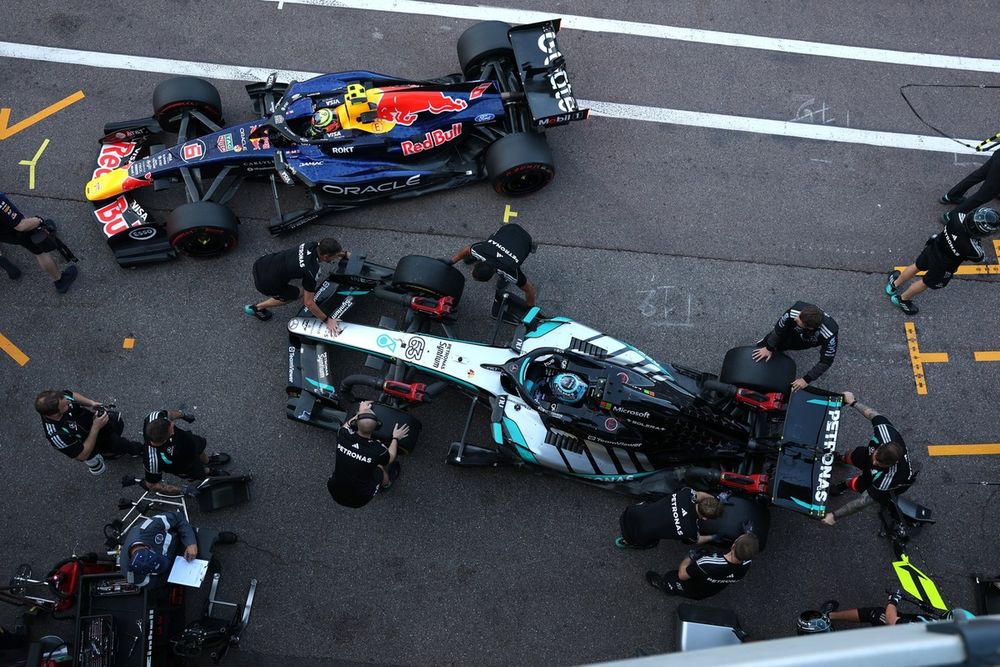
George Russell, Mercedes, Isack Hadjar, Red Bull Racing
Photo by: Sam Bloxham / LAT Images via Getty Images
What about the other breaches?
Alongside Gasly, several other drivers fell victim to the speed measurement errors, including Lewis Hamilton, George Russell, Franco Colapinto and Oscar Piastri.
But because they all served their penalties during the race, or at least acknowledged it failed to in Russell’s case when he pitted, there is no mechanism within the regulations to undo their penalties, and their respective teams also didn’t lodge a right of review appeal anyway.
“The Stewards note that in relation to other cars that were penalised, some served their penalty and this regrettably, impacted their race strategies and therefore their race result,” the stewards added.
“There will undoubtedly remain questions as to whether those breaches were genuine. There is no regulation that gives the Stewards the power to ‘undo’ a served penalty. In any case, it is impossible to imagine how such power could be applied. Notably, no other party petitioned for a Right of Review within the allowable time frame.”
We want to hear from you!
Let us know what you would like to see from us in the future.
Take our survey
– The Autosport.com Team
Read the full article here


