



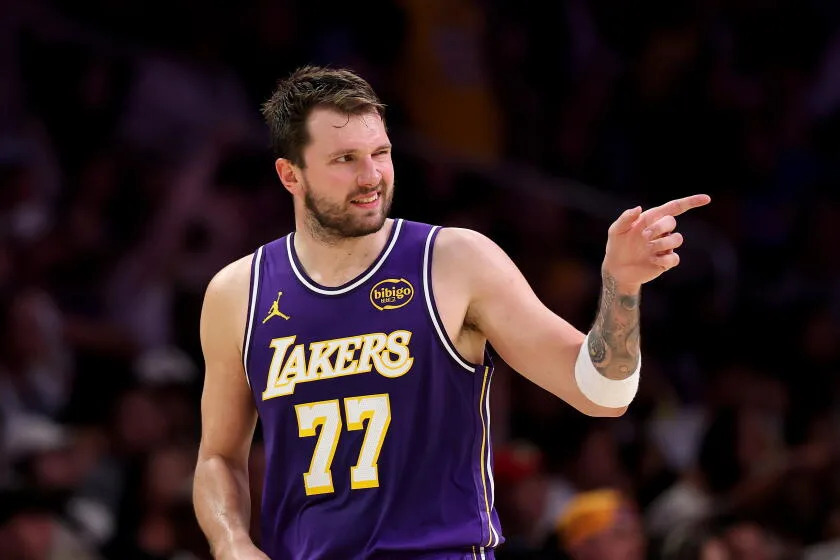
More than half of the Lakers roster is new. Two starting spots are still up for grabs. The Lakers have a lot to evaluate in the next month.
After one of the busiest offseasons in the NBA, the Lakers begin their Luka Doncic-led era this week. Here are five storylines for the Lakers as they begin training camp this week:
What does Luka Doncic’s team look like?
The crown has been passed.
After sharing the spotlight with LeBron James, Doncic now takes center stage for the Lakers. The two-time scoring champion is coming off 33.5 points per game last season and was the focal point for the franchise’s offseason of change.
“Luka is the world’s greatest offensive player,” general manager Rob Pelinka said at his preseason news conference on Thursday. “For us to be able to have an opportunity as a franchise to have that player in our building every night … is special. And it requires us to do special things to build the team around him.”
The Lakers brought in eight players through free agency or trade to remake their roster. For the first time in JJ Redick’s three-year tenure, “I feel like the pieces actually fit together,” the head coach said. Doncic and returning guard Austin Reaves are the glue that holds the puzzle together.
Read more: Lakers’ new era opens with a thanks for the LeBron James era
“This team is their team,” Redick said of the star guards.
Redick praised how Doncic planned a team minicamp in Slovenia where players and some assistant coaches participated in basketball practices while enjoying team-bonding activities such as golfing, rowing and sightseeing in Doncic’s hometown of Ljubljana. Players were so appreciative of Doncic’s hosting efforts that they all presented him with handwritten thank-you notes after, Pelinka said.
In a 30-minute vlog sharing highlights of the trip, Doncic was asked what matters to him now that didn’t five years ago. During that time, Doncic has become a father to two daughters and changed teams in one of the league’s most shocking trades ever. His basketball priorities have shifted.
“Five years ago, I was third year in the league,” Doncic said in the video. “I wasn’t the leader I was supposed to [be], so I think the leadership is an important part of my case now.”
Redick said he plans to use Kessler similarly to how the San Antonio Spurs deploy defensive player of the year Victor Wembanyama: low and near the basket. Kessler’s elite rim protection — 2.4 blocks per game in his NBA career — can open a new defensive style for the Lakers, who can afford to be more aggressive on the perimeter knowing Kessler can hold down the post.
New Lakers center Walker Kessler reacts after throwing out the first pitch before a Dodgers game earlier this month. (Eric Thayer / Los Angeles Times)
“I know we have switched a lot one through five over the years; that has been by necessity,” Redick said. “We look at him as someone we want close to the basket, protecting the rim. He’s been an excellent rebounder throughout his career, both offensively and defensively.”
Despite costing four first-round picks, Kessler is still unproven in the NBA. He showed flashes of brilliance, but is coming off a season in which he played only five games because of a shoulder injury. Pelinka said after a “deep dive” into Kessler’s medical history, the organization is not concerned the injury will linger.
The 25-year-old center’s age aligns well with Doncic, 27, and Reaves, 28, creating a potent trio that could define the franchise’s new era.
“If you canvassed the league and looked at age groups, even the ability to acquire someone, [Kessler] is just the perfect fit for those guys and building out the next phase of the Lakers,” Redick said.
How will Austin Reaves handle the jump to being a max player?
Before completing their new “Big Three” with Kessler, the Lakers needed to bring Reaves back. The former undrafted free agent was one of the highest-profile free agents this summer, but told reporters in July that his “heart was in L.A. the whole time.”


Lakers guard Austin Reaves runs onto the court before a playoff Game 3 against the Thunder. (Robert Gauthier / Los Angeles Times)
Reaves is coming off 23.3 points and 4.7 rebounds per game, both career highs. He scored 51 points in a game against Sacramento and provided one of the highlights of the regular season with a perfect missed free throw and offensive rebound that helped the Lakers survive with a thrilling overtime win over the Denver Nuggets.
But Reaves also played in a career-low 51 regular-season games, missing significant time because of injuries. He missed the beginning of the playoffs because of an oblique injury, and despite returning sooner than expected from the Grade 2 strain, Reaves struggled to get back to form consistently in the postseason.
No longer just the feel-good story, Reaves is now the second-highest paid player on the Lakers after signing a four-year, $185-million contract this summer. He is living up to his superstar status already in the offseason, being “a leader in the gym every single day,” Redick said.
Who will survive the training camp cut down?
The Lakers have 16 players on guaranteed contracts entering training camp and must get that number down to the league maximum 15 by the season opener on Oct. 21. While the Lakers figure out the two open starting roles alongside Doncic, Reaves and Kessler, the next month will also feature competition for the final roster spots.
Pelinka mentioned a consolidation trade that ships two players out for one as a possible solution to the overcrowded roster. The Lakers have wing depth, but could bolster their center options beyond Kessler and backup Kevon Looney, and are unsettled at power forward.

Lakers’ Jake LaRavia, right, attempting to strip the ball from Warriors forward Charles Bassey, is one of several forwards who will vie for playing time this season. (David M. Barreda / Los Angeles Times)
Jake LaRavia, Ziaire Williams, Sandro Mamukelashvili and Jarred Vanderbilt are among the logjam of options at forward, along with wings Adou Thiero and Matisse Thybulle. Vanderbilt and Dalton Knecht, the embattled third-year guard who has never found a solid role with the team after he was traded and returned in 2025, could be trade pieces.
“Building a championship roster is an evergreen process,” Pelinka said. “You’re never done with the work.”
What’s up with the ownership situation?
For the second consecutive season, the Lakers have an ownership change hanging over the organization.
Mark Walter’s sale of his controlling stake of the team is still pending, with Bob Iger and Joshua Kushner prepared to step in after purchasing the majority stakes at a $12.5-billion valuation.
While unable to comment fully on the ownership change because the sale hasn’t been approved, Pelinka said he has had “preliminary discussions” with Iger and Kushner that have been “really, really positive.”


Lakers general manager and president of basketball operations Rob Pelinka, left, speaks to reporters as coach JJ Redick watches on during a news conference Thursday. Pelinka said that the new ownership group has had preliminary discussion with him about moving forward. (Allen J. Schaben / Los Angeles Times)
“In terms of day-to-day, nothing’s changed,” Pelinka continued. “We’re operating with Lakers excellence.”
During his short tenure, Walter worked to overhaul the front office and business operations. The changes did not stop with Walter’s ownership now in limbo.
The Lakers have added more than 15 people in the front office, Pelinka said, including Rohan Ramadas and Eric Amsler in new assistant general manager positions. Pelinka said the organization “rebuilt our entire player experience and player development arm,” led by the promotion of Zach Guthrie, the former G League affiliate head coach, to the head of player development. The team has added new equipment for recovery and treatment and hopes to bring in more scouts.
“The goal, as the Lakers brand, is not just to be at the same level as all the other 29 teams in those areas,” Pelinka said, “but to be the leader.”
Sign up for our weekly newsletter on all things Lakers.
This story originally appeared in Los Angeles Times.
Read the full article here


