



We examined several hitter skill and luck factors last week. To identify the players to discuss, we’ll use the Yahoo player rater for the past two weeks to provide a small sample to choose from. Besides those hot hitters on the player rater, we’ll discuss other hitters generating plenty of buzz throughout the fantasy baseball community.
We’re analyzing five hitters to research the advanced stats on whether we should buy, sell or hold them moving forward.
Reach out if you have a player you would like me to examine on X/Twitter, @corbin_young21.
Ozzie Albies, Braves (96% Rostered)
Albies has been earning close to first-round value with zero stolen bases. That’s mainly because Albies’ .329 batting average would be a career high, supported by a .328 BABIP. Both Albies’ BABIP and batting average in 2026 would be 40-60 points higher than his career norms. That suggests luck factors have been in his favor.
Albies’ plate discipline remains similar to recent seasons and career averages, with a 78-81% contact rate and 10-11% swinging-strike rate. His power tends to be mediocre or slightly below, given his 69.1 mph bat speed and career 4.9% barrel rate per plate appearance. Interestingly, Albies’ pull rate dropped to 41.7% in 2026 from 48-50% over the previous four seasons (2022-2025). Meanwhile, Albies maintained his flyball rate, which hovered around 42-43% throughout his career.
Ozzie Albies’ rolling pull- and fly-ball average rates. (Photo by Corbin Young/FanGraphs)
When Albies pulls the ball into the air, it typically translates into high-end outcomes with supporting skills. That’s evident by Albies’ 95 mph average exit velocity, 14.3% barrel rate, 71.2 mph bat speed and 88.5% ideal attack angle in 2026 on pulled batted balls in the air. That’s slightly better than the advanced stats on his pulled batted balls in the air in recent seasons. A reminder that the ideal attack angle is the percentage of swings between 5 and 20 degrees, which theoretically translates to optimal launch angles. That said, Albies needs to tap into the pull side power to reach average power, but seems to need luck via home run rates (HR/F) in the double digits to reach peak home runs.
It’s early, but Albies’ stolen-base opportunity rate dipped to 6% in 2026, down from 9-10% over the past two seasons. He had a 79% career stolen base success rate, hinting that he’ll need volume in his favor to reach 15+ steals.
Volume matters in deeper leagues, but Albies might be a player to sell if the 2025 season with a higher batting average is a likely outcome in 2026.
Byron Buxton, Twins (94% Rostered)
When healthy, Buxton is fun to root for. He had his best season in 2025, with 35 home runs, 24 stolen bases and a .264 batting average. Buxton hits in the leadoff spot for the Twins in a somewhat depleted lineup that’s top-heavy. He struggles with plate discipline, given his 69-70% contact rate throughout recent seasons, but he makes loud contact.
That’s evident in Buxton’s 73.3 mph bat speed and a 13.1% barrel rate per plate appearance in 2026. Interestingly, Buxton’s bat speed fell from 75 mph in 2025 and the barrel rate sits nearly six percentage points above his career average. For context, Buxton’s bat speed fell by over 1 mph (73.3 mph) and a career 7.6% barrel rate per plate appearance. He uses a pull-heavy (50.5%), flyball (60.2%) approach, though there can be diminishing returns when hitters hit too many flyballs. For context, Buxton’s career flyball rate is 46.3%.

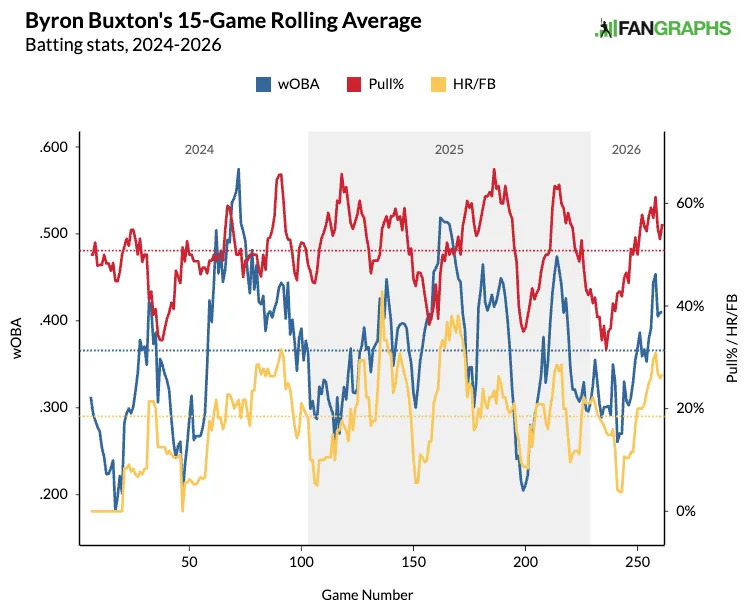
Byron Buxton’s rolling average pull, flyball and HR/FB rates. (Photo by Corbin Young/FanGraphs)
We’ve seen Buxton’s Exit Velocity 50 (or EV50) drop from 103.6 mph (No. 27) in 2025 to 100.6 mph (No. 116) in 2026. EV50 is the average of the hardest 50% of a player’s batted ball events, helping us have a more reliable exit velocity metric besides barrels. Since Buxton continues to barrel the ball and has an above-average EV50, we probably shouldn’t worry unless an injury pops up. In the World Baseball Classic, Buxton was hit by a pitch in his right forearm area, then he was hit on the same forearm again in early April. That’s something to monitor. Though Buxton’s power skills should lead to 30+ home runs again in 2026.
It’s mainly because of injuries, but Buxton hadn’t reached double-digit stolen bases since 2019 before 2025. His stolen base opportunity rate skyrocketed to 22% in 2025, compared to a career average of 20%. However, Buxton’s stolen base opportunity rate plummeted to 7% in 2026. With plenty of lower-body injuries throughout Buxton’s career, it would make sense to maintain health via fewer stolen base chances.
If we regress Buxton’s stolen bases from 2025 to 10-12 like most projections expect, with 30+ home runs and a .250-.260 batting average, fantasy managers will likely accept that outcome across 550 plate appearances. Hold Buxton in case the steals come back, because he’s a must-start player when healthy.
Otto Lopez, Marlins (86% Rostered)
I wrote about Lopez as one of the hitters who could be one skill away from a breakout during the offseason. Though Lopez hasn’t increased his bat speed, he maintained it in 2026 (71.9 mph), nearly identical to 2025. He has been fortunate from a BABIP standpoint, evidenced by .391 BABIP fueling his .333 batting average. For context, Lopez’s BABIP and batting average have been 60-80 points above the career norms.
Lopez’s overall contact rate fell to 78.5% (2026) from 83% (2025), but he maintained his elite zone contact around 90-91% over the past two seasons. Since Lopez hardly walks (career 6.4% walk rate), he likely doesn’t fare well in points leagues, though his BABIP boosts the career-high OBP (.367). That tells us Lopez’s batting average will regress, though it should be something near his career BABIP.

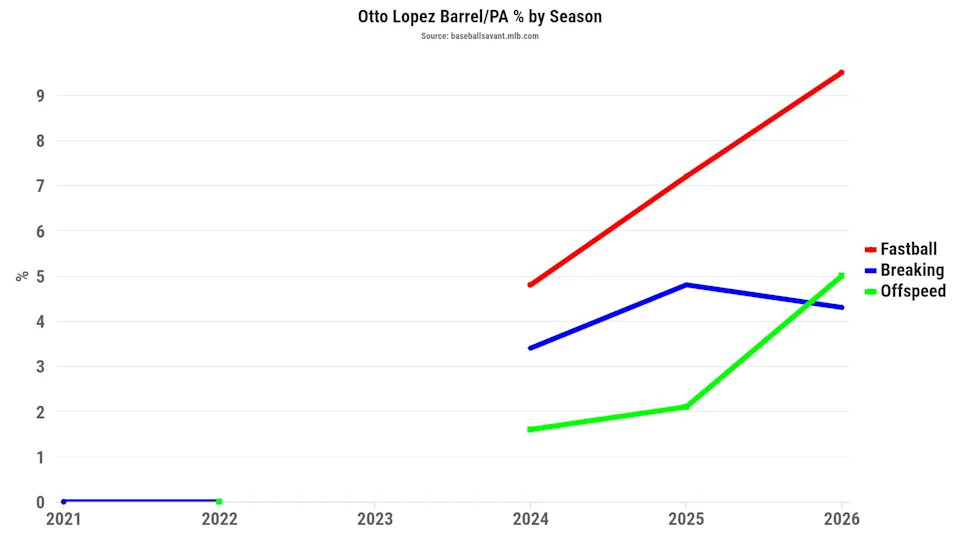
Otto Lopez barrel/pa percentage by season/pitch type. (Photo by Corbin Young/BaseballSavant)
Interestingly, Lopez has been flashing a higher barrel rate per plate appearance at 7.3% in 2026 from 5.6% (2025), yet continuing to hit tons of groundballs (50.7%) in his career. Lopez’s power metrics have been legitimate, evidenced by a 102 mph EV50 (No. 56), similar to Christian Walker, Sal Stewart and Pete Crow-Armstrong. For context, Lopez’s EV50 is over two mph higher in 2026 than in 2025 (99.9 mph). That aligned with Lopez’s average exit velocity on flyballs and line drives increasing from 92.4 mph (No. 174) in 2025 to 94.1 mph (No. 109) in 2026.
If Lopez can increase his launch angle, we could see 20-25 home runs with that type of EV50 and barrel rate, though that’s easier said than done. Thankfully, Lopez’s stolen base opportunity rate remains high at 17%, up from 14% in 2025. If he converts 75-80% or more like in 2026 (75%), Lopez could set a career high in steals.
Breakout seasons come from players with a mixture of luck and skill. Lopez checks the boxes for plate discipline, power and speed. Expect Lopez to join the 20/20 club with a quality batting average, making him a high-end fantasy asset. I have Lopez on several rosters, and I would be buying where available.
Heliot Ramos, Giants (48% Rostered)
The Giants offense ranks 29th in wRC+, sandwiched between the Red Sox and Mets. The latter two surprise us, especially considering their roster and preseason expectations. Among Giants’ hitters, Casey Schmitt, Luis Arráez and Jung Hoo Lee lead the team with a wRC+ over 100 in 2026. Ramos has been ranking highly on the Yahoo Player Rater, mainly because he’s boasted a .352 BABIP.

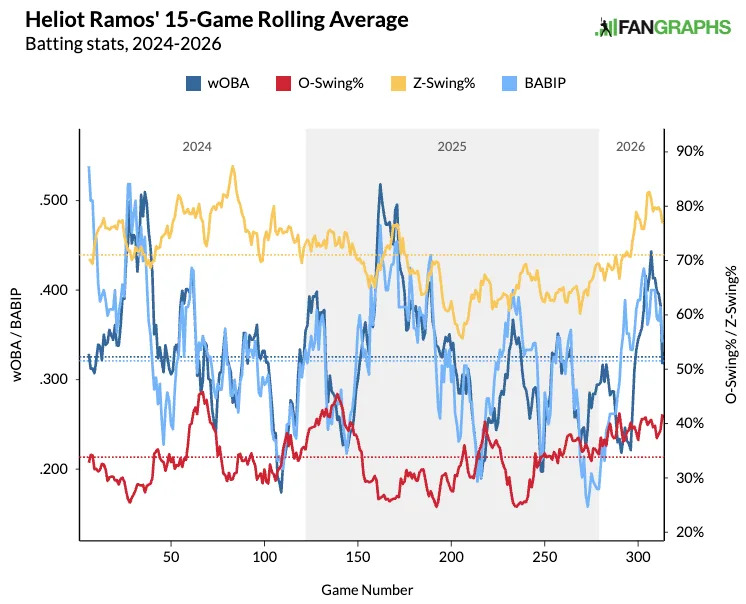
Heliot Ramos’ rolling BABIP, chase and zone swing rates. (Photo by Corbin Young/FanGraphs)
Ramos’ BABIP has been boosting his batting average (.262), significantly above his career BABIP (.316). Interestingly, Ramos’ actual batting average hasn’t been higher with a massive BABIP spike. After a 10.4% swinging-strike rate in 2025, Ramos’ swinging-strike rate increased back to 13.1% (2026), near his career norm (12.1%). He has been chasing (36.1%) outside the zone and swinging more inside the zone (75%) in 2026, with both metrics being around five percentage points above his career average.

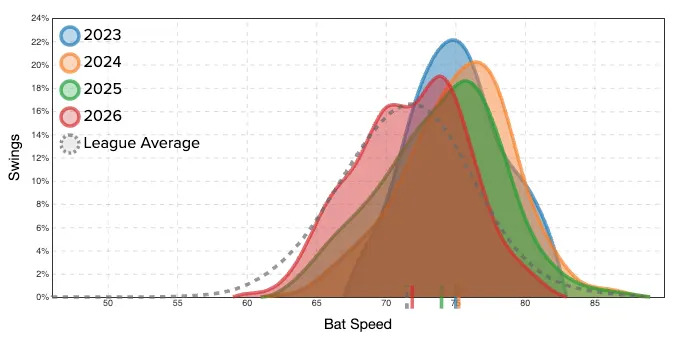
Heliot Ramos’ bat speed distribution. (Photo by Corbin Young/Yahoo Sports)
Meanwhile, Ramos’ contact rates have remained similar, though it looks like the career-low swinging-strike rate and strikeout rate in 2025 might have been the outlier. Ramos’ bat speed took a significant decline to 71.9 mph with a 21.3% fast-swing percentage (percentage of swing at 75 mph or higher) in 2026. That’s significantly lower than Ramos’ career bat speed (74.3 mph) and fast-swing rate (46.1%).
Bat speed is a power input that should translate to strong exit velocities, but it’s positive to see Ramos maintain the exit velocity and barrel rate data. Ramos boasts a high-end 9.4% barrel rate per plate appearance, supported by an elite EV50 at 104.2 mph (No. 17), similar to Junior Caminero and Ketel Marte’s EV50. He typically had above-average barrel rates, with a high-end EV50 in 2025 (102.5 mph) and 2024 (102.6 mph).
There’s no denying Ramos’ power and exit velocity metrics being in the above-average range. The lower bat speed is weird and could regress closer to the career norms. Unfortunately, the Giants’ home park doesn’t favor right-handed hitters for home runs, ranking 28th in home run park factors. Put Ramos in a more hitter-friendly park for righties, and 25 home runs would be probable.
Since Ramos doesn’t contribute tons of steals, this type of profile can be churned and streamed in shallower leagues. It feels like the Giants’ team context might remain below average to poor, so don’t be attached to Ramos or expect another step forward in fantasy value. It might be worth selling and shopping Ramos if possible.
Jeremiah Jackson, Orioles (44% Rostered)
After a four-home-run week with a .333 batting average, Jackson was a popular waiver wire target in shallow and deep formats. Jackson has been playing second base and batting toward the bottom third of the Orioles’ lineup. In the minors, he showed some power and speed, with 15/11 in 2026 across Double- and Triple-A in 2025 and double-digit home runs and steals in previous seasons. It’s a small sample of 287 career plate appearances, but Jackson only stole one base throughout his brief MLB career.
Plate discipline remains a challenge for Jackson, with a below-average contact rate (73.5%) and a high chase rate (41.1%). Jackson chases nearly 13 percentage points more than the league average, mainly because he swings 61.1% of the time, nearly 15 points higher than the league norm. That indicates Jackson uses an uber-aggressive approach from a swing standpoint, which means balls in play and whiffs.

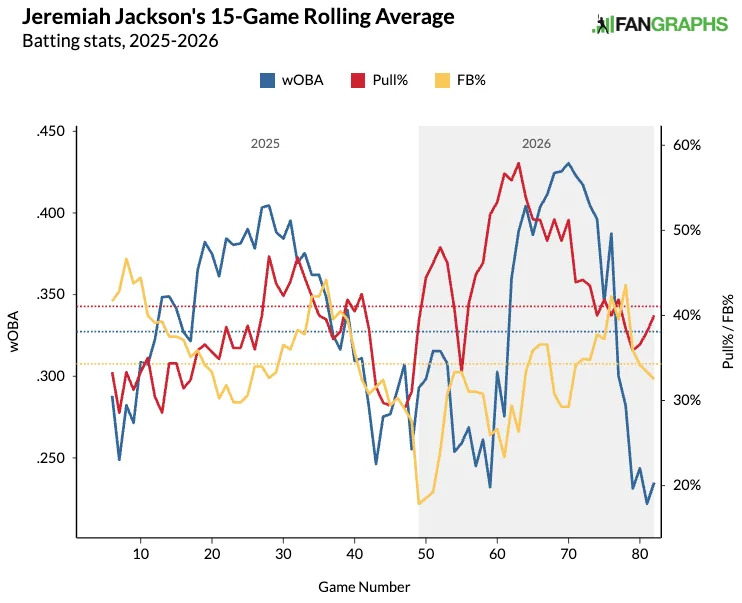
Jeremiah Jackson’s 15-game rolling pull and FB rates. (Photo by Corbin Young/FanGraphs)
Jackson’s pull rate jumped to 47.1% (2026) from 36.7% (2025). He still often hits the ball on the ground (51.7%) and hits a decent chunk of flyballs (34.3%) in his career. When Jackson pulls the ball, it’s typically in the air, evidenced by a 19.5% pulled air rate, nearly three points higher than the league average. That helps Jackson have above-average barrel rates per plate appearance (6%) in 2026. However, Jackson can be inconsistent in hitting the ball at optimal launch angles.
The Orioles rank bottom 10 in stolen bases (No. 23) and stolen base opportunities (No. 21), and it could be a philosophical approach to not steal often. Jackson’s lowly 6% stolen base opportunity rate throughout his brief MLB career suggests that we can’t bank on steals for his fantasy profile.
Jackson Holliday has been recovering from a broken hamate bone, but was removed from his rehab assignments twice due to ongoing soreness in the hand where he had hamate bone surgery. That allowed Jeremiah Jackson to continue earning regular playing time.
Jackson possesses the power skills to hit 20-25 home runs over a full season, but playing time will be questionable when Holliday or Jordan Westburg return. Hold Jackson in deeper leagues (15+ teams), but fantasy managers can cut and stream in shallower formats.
Read the full article here


