



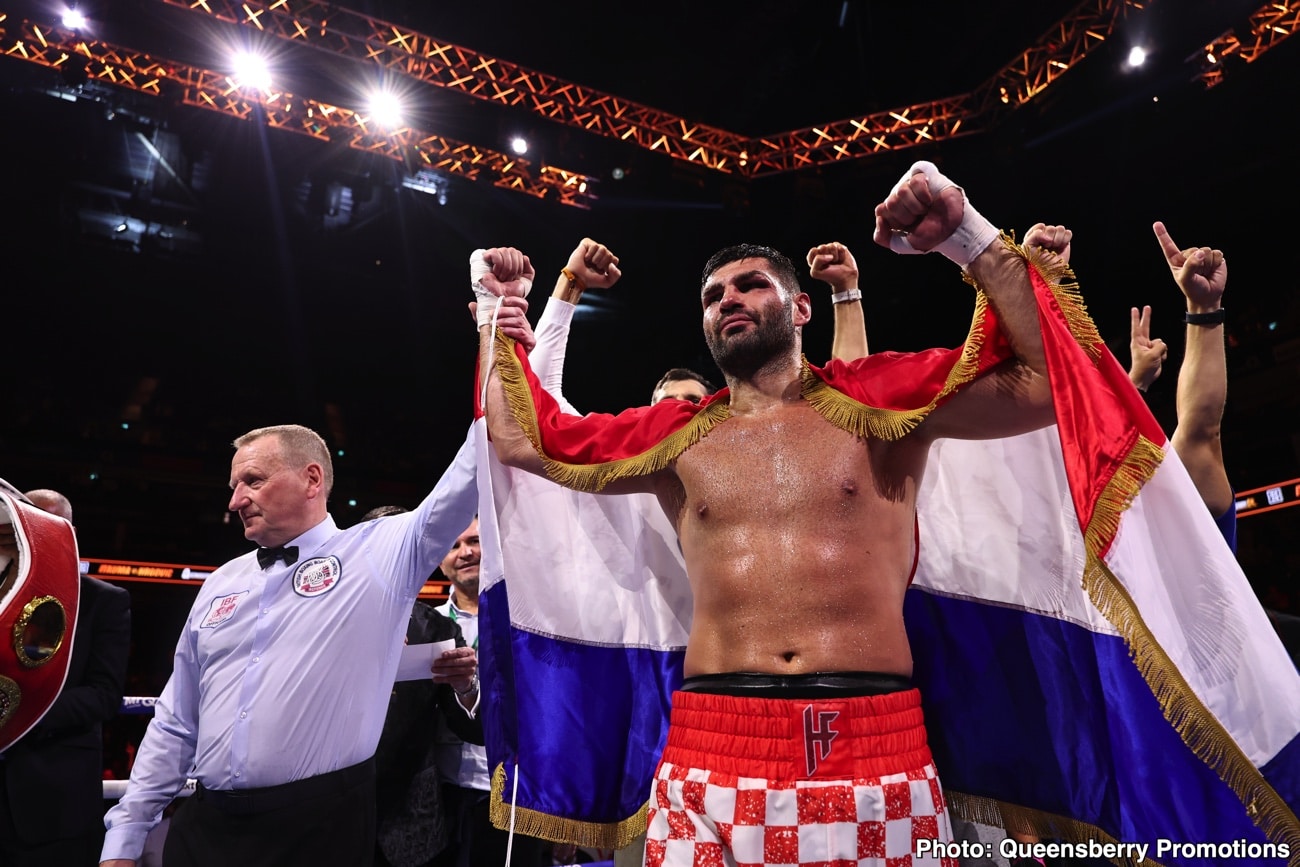


Itauma owned the faster hands and greater early explosion, but Hrgovic took away his punching room through collar ties, short right hands, and physical work inside. Those tactics forced the younger fighter to wrestle for space while already burning energy. Itauma’s previous early knockouts had never required him to solve that type of problem under fatigue.
Hearn’s use of the Dubois loss as proof of Hrgovic’s limitations is also unconvincing. Severe cuts ended their competitive 2024 fight after eight rounds, although Dubois had hurt Hrgovic late in the seventh. Dubois later knocked out Joshua, validating his place among the division’s leading heavyweights. Going eight hard rounds with him hardly makes Hrgovic an ordinary contender.
Hearn had nine years to match Joshua against the 2016 Olympic bronze medalist. Joshua instead fought Jake Paul, Otto Wallin, Francis Ngannou, Robert Helenius, Jermaine Franklin, Kubrat Pulev, Andy Ruiz Jr., Kristian Prenga, Oleksandr Usyk, and Dubois.
That matchmaking history makes the promoter’s dismissal difficult to accept. Joshua faced crossover opponents, late replacements, and heavyweights with less ability than Hrgovic, but never the Croatian. Avoiding him was a wise business decision because Hrgovic brought serious physical risk without offering a comparably large payday.
He fits boxing’s familiar high-risk, low-reward category: an Olympic medalist with heavy hands and a reliable chin who lacks the domestic following needed to guarantee a major event. Fighters in that position are often left waiting while promoters select safer or more profitable alternatives.
Calling Hrgovic something less than a “terminator” is fair. Treating him as ordinary after he stopped a fighter many considered a can’t-me future champion is not.
Read the full article here


