





“[He] is one of the most accomplished and innovative basketball minds and leaders in the entire game. He has a unique ability to create an outstanding culture that will promote the development of young players and provide a solid structure to the entire program; not to mention the fact that [he] wins everywhere he goes.”
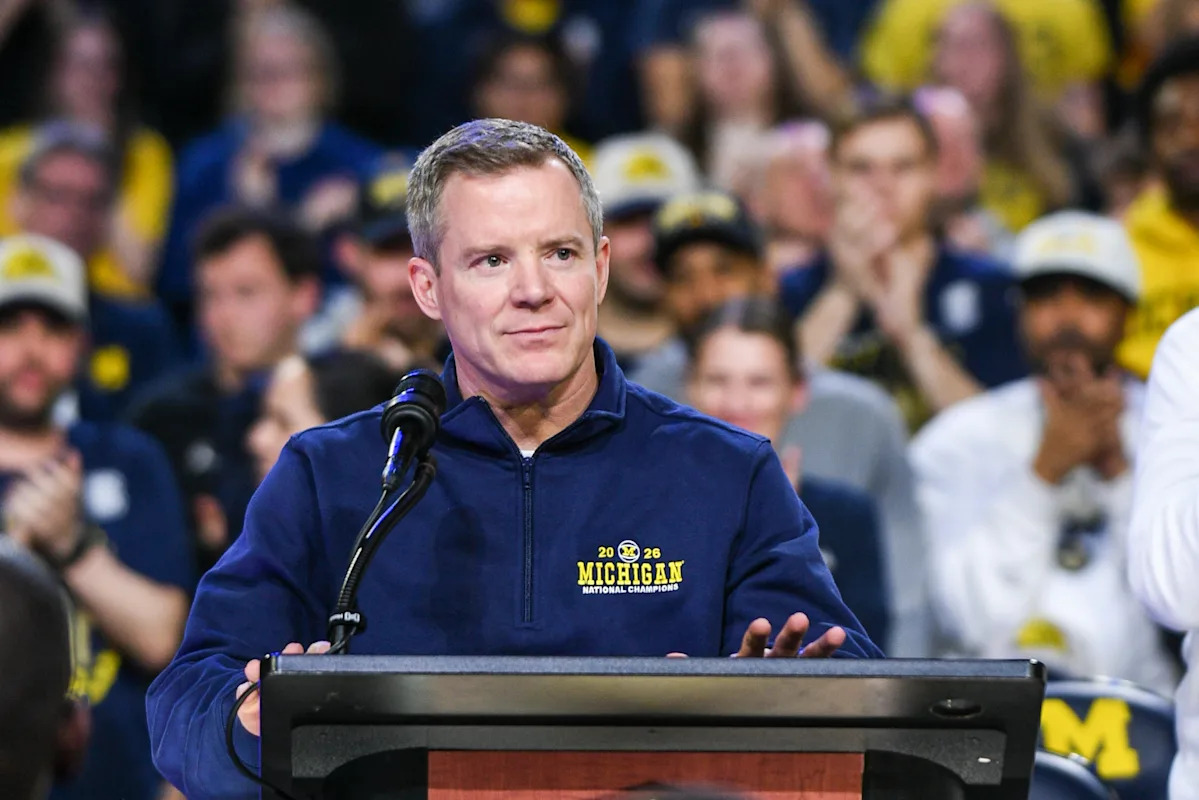
That’s the broad strokes of the framework of the argument for reaching down into the college ranks to pluck Dusty May out of Ann Arbor, hiring the University of Michigan head basketball coach to take the reins of the Dallas Mavericks. It’s a pursuit that was first reported earlier this month by Marc Stein and Jake Fischer, and one that was reportedly consummated Monday morning, with new Mavericks president Masai Ujiri and general manager Mike Schmitz filling the head-coaching vacancy created by the departure of Jason Kidd last month.
And if it sounds familiar to you, it might be because it was the framework of another argument — one made more than seven years ago, when Dan Gilbert and Koby Altman handed over the moon, the stars and a five-year contract with “an average annual value of more than $4 million” to pluck John Beilein out of Ann Arbor to take the reins of the Cleveland Cavaliers.
“He’s considered one of the elite offensive tacticians and teachers in basketball,” Adrian Wojnarowski, then of ESPN, wrote of the Cavs’ 2019 pursuit of “culture driver” Beilein.
“He takes players right out of high school and turns them into lottery picks,” a “source close” to the Beilein hire told Chris Fedor of cleveland.com.
“It is no surprise that Koby and his team landed on John Beilein, as great cultures attract others who hold the same values as the foundation for everything they do,” Cavs owner Gilbert wrote in a team statement. “I can’t wait for next season to begin.”
As it turned out, he probably would’ve been fine waiting.
Beilein opened his pro account with 15 losses in his first 20 games and totaled more defeats by mid-January than he’d had in his final three years in Ann Arbor. The tactical excellence that produced so many wins across 27 years on campus failed to translate at the next level, producing the NBA’s sixth-worst offense and second-worst defense at the All-Star break.
NCAA representative Keith Gill presents the trophy to Dusty May after winning the national championship at Lucas Oil Stadium on April 6, 2026, in Indianapolis. (Photo by Mitchell Layton/Getty Images)
(Mitchell Layton via Getty Images)
The college lifer struggled to connect with the young roster he was hired to develop, engaging in “several skirmishes in public and private with players” — most notably the January film session in which he said they were no longer playing “like a bunch of thugs.” He’d later insist he misspoke, intending to say “slugs” — “We weren’t playing hard before, and now we were playing harder. I meant it as a compliment” — and apologized to the team.
Neither morale nor play improved, though, and a “miserable” Beilein — a March mainstay during his decades of college coaching — couldn’t make it to the end of February. He stepped down during the All-Star break, with a 14-40 record and the Cavs in last place in the East; in the six coaching cycles since Beilein’s exit, no NBA team had gone back to the college ranks to fill its top vacancy. Not until Monday.
That’s not to say that May can’t succeed in Dallas. At 49, he’s 17 years younger than Beilein was when he made the jump, with Michigan’s 2026 national championship, three projected first-round picks and incoming top-10-recruiting class offering support for his bona fides as someone who can connect with modern NBA-ready talent. That surely figured into Ujiri’s thinking as he sought a coach who’ll be responsible for shepherding Rookie of the Year winner Cooper Flagg through his hoped-for ascent to All-Star and All-NBA status.
May is widely viewed as a sharp tactician whose commitment to pace, spacing, ball movement and eschewing isolation play produced one of the NCAA’s most efficient offenses last season. He’s also seen as a coach capable of finding the most effective way to deploy the talent he’s got on hand, whether it’s leading Florida Atlantic to consecutive NCAA tournament berths and the first Final Four appearance in school history or zagging on small-ball trends by playing huge with Michigan this season en route to the nation’s top-ranked defense, a 37-3 record and the national title.
If May does manage to contend for NBA championships to match the NCAA title in his trophy case, though, he’d be much more the exception than the rule.
Rick Pitino won 52 games and a playoff series in 1988-89 after making the jump from Providence to the Knicks before promptly going to Lexington. His attempt to repeat the feat when moving from Kentucky to the Celtics didn’t work out nearly as well; he didn’t top 37 wins in parts of four seasons in Boston before returning to college.
Pitino’s former point guard and assistant, Billy Donovan, won 55 games and two postseason series in his first year in Oklahoma City — the dream job he’d waited to seize after winning back-to-back titles in Florida nearly a decade earlier. But after letting a 3-1 lead over the Warriors slip away in the Western Conference finals, and seeing Kevin Durant slip away shortly thereafter, Donovan hasn’t won big since, presiding over good-but-not-great teams in OKC and Chicago that haven’t advanced past the first round.
Donovan took over in Chicago — following the brief, deeply entertaining, wildly unsuccessful Jim Boylen interregnum — after another college-to-pros hire didn’t pan out. Bulls brass targeted Fred Hoiberg, who’d spent four years as a player in Chicago, after he’d built Iowa State into a top-10 team. (Then-Bulls general manager Gar Forman had been an assistant on the Cylones’ coaching staff while Hoiberg was a star player at the school and later bought Hoiberg’s Chicago-area house.)
But Hoiberg, considered so widely affable throughout his playing career that his nickname was “The Mayor,” couldn’t secure the vote of the most important constituent on the mid-2010s Bulls roster …
… and was out early in his fourth season after posting just one above-.500 season and one playoff appearance. (We’ll always have the Three Alphas, though.)
Hoiberg wasn’t even the first Iowa State head coach to flame out in Chicago. Tim Floyd, fresh off three NCAA tournament runs in Ames, got handed a poison chalice in the summer of 1998, when the Bulls offered him their head coaching job … provided Phil Jackson didn’t come back after a third straight championship season, the one you saw recounted in “The Last Dance.” Jackson didn’t. Neither did Michael Jordan, Scottie Pippen nor Dennis Rodman. Floyd’s Bulls went 13-37 in the lockout-shortened 1998-99 season; that represented the high-water-mark for his winning percentage across three-plus seasons in the Windy City.
John Calipari, Reggie Theus, Mike Montgomery and Lon Kruger didn’t make it through three seasons. Leonard Hamilton and Mike Dunlap didn’t make it to a second. Hall of Famer Jerry Tarkanian, God bless him, didn’t make it to Christmas. The leap is dark and full of terrors.
The lone legitimate success story in recent memory? Brad Stevens, whom Danny Ainge plucked out of Butler in 2013 to usher the Celtics out of the Kevin Garnett-Paul Pierce-Ray Allen-Doc Rivers era and into a new age of sustainable contention — a project that all involved anticipated might take awhile, as evidenced by Stevens getting a six-year contract’s worth of time to stand the program up. As it turned out, he didn’t need that long: Stevens had the C’s back in the playoffs in his second season, and back to winning 50 games and making the Eastern Conference finals by Year 3. Under his watch, Boston returned to the ranks of serious, consistent contenders for the NBA championship.
But while Stevens stepped down in 2021 as the fourth-winningest coach in franchise history, behind only Red Auerbach, Tommy Heinsohn and Rivers, he also stepped down without ever reaching the NBA Finals, his bids for championships ending in the conference finals at the hands of LeBron James and Jimmy Butler. He has presided over a pair of Finals runs over the past five seasons … but he’s done so after moving upstairs into Ainge’s old seat as Boston’s president of basketball operations.
It’s unclear whether May will get quite as long a runway in Dallas; the terms of his agreement have yet to be reported as of press time. (Although, considering May had reportedly been making $5.1 million a year in Ann Arbor, that he’d reportedly agreed to a new extension with the Wolverines following his national championship win, that the 10 highest-paid coaches in the NBA last season all reportedly cleared at least $9 million, and that the coach he’s replacing was reportedly on the books for more than $10 million a year over the next four years, it’s a decent bet that he’ll make a serious chunk of change to change jobs.)
While the Mavericks aren’t a perennial glamour franchise like the Lakers and Celtics, there is pressure to deliver, by elevating Flagg, the new face of the franchise, to superstar status, and by producing the kind of on-court success that can allow fans to begin to turn the page on the painful end to the Luka Dončić era. Reasonable or not, falling short can have dire, immediate consequences in the NBA; after all, May is replacing a coach who was shown the door just two seasons after making the NBA Finals.
It’s possible that May has precisely what it takes, in both tactics and temperament, to succeed where his college-to-pros predecessors have failed. If he can pull it off, though, it’ll be remarkably, historically rare. There’s only one coach ever who’s won both an NCAA championship and an NBA title: Larry Brown, who reached the top of the mountain with the University of Kansas and the 2004 Detroit Pistons.
Those titles were separated by 16 years, three resignations and a firing. Turns out, even the most accomplished and innovative basketball minds don’t really win everywhere they go.
Read the full article here


