



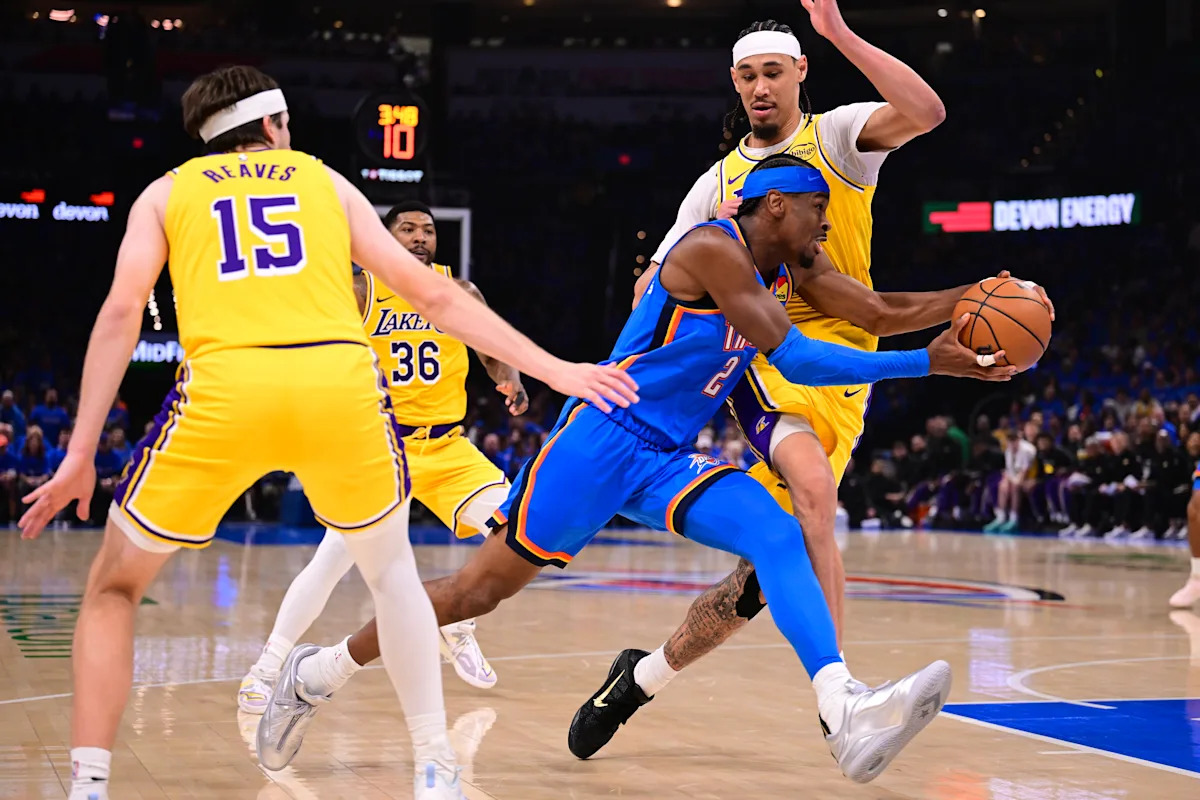
OKLAHOMA CITY — Lakers head coach JJ Redick could only look toward the sky midway through the third quarter, uttering a slew of words not suitable for a national broadcast as he watched his defense momentarily break down, resulting in a wide-open Lu Dort triple and a Cason Wallace point-blank layup.
A deficit that had been as small as four points in the second half had ballooned to double digits in the span of two minutes, a less-than-ideal swing against the best team in basketball. But Redick’s frustration, while temporarily fixated on the Lakers’ mistakes, wasn’t solely attributed to them. Tuesday night was a night rooted in opportunity cost, a successful strategy in slowing down superstar guard Shai Gilgeous-Alexander — which ultimately is their best path to an upset — but also a display of Los Angeles’ offensive woes, sponsored by a combined 7-of-31 shooting night from Austin Reaves and Marcus Smart.
“You’re playing the world champs, your margin for error in terms of mistakes is not that high,” Redick said following the Lakers’ 108-90 loss in Game 1 of the second-round series. “You can make mistakes — basketball is a game full of mistakes — but just too many tonight. But there were some good things, we held Shai under 20 and the guys played hard. Just gotta do a better job of execution, which comes down to attention to detail. We’ll clean things up and be better.”
Gilgeous-Alexander’s output is buried within Redick’s eulogy but considering the reigning regular-season and Finals MVP’s impact on Oklahoma City’s halfcourt execution, it’s worth exponentially more than a passing statement. Gilgeous-Alexander is the best scorer in basketball on the most dangerous team in the league. A plethora of defenses have tried to stop or slow him down and many have failed.
What the Lakers were able to achieve, holding SGA to just 18 points in 35 minutes — he hasn’t scored under 20 points all season and it’s the fewest he’s scored in a game since Game 3 of last year’s conference finals against Minnesota — is more than just a silver lining. It’s probably their best shot in this series. Gilgeous-Alexander missed nearly as many shots (seven) as he made (eight) and coughed up the ball seven times, constantly being rushed into decisions and making a litany of mistakes rarely seen of a player his caliber. Gilgeous-Alexander also took just one outside shot and attempted three free throws, two key rhythm areas that were shut off. The Lakers have been one of the most stringent halfcourt defensive units in the postseason, allowing just 84.9 points per 100 plays and limited the Thunder to just 94.3 points per Tuesday night. For context, Oklahoma City came into the game averaging 112.2 points per 100, 10 points higher than its regular-season mark. Its Game 1 output was on par with a bottom-five offense.
Yahoo Sports had a unique vantage point Tuesday evening, within earshot of the Lakers bench, allowing for the unpacking of an aggressive, timely scheme aimed at delaying, denying and diverting Gilgeous-Alexander away from the action.
Let’s dig in.
Principle 1: Compactness and timing
With regard to Gilgeous-Alexander, it’s important to limit his operating window and vision. The Lakers understand that in order to control possessions like the one below, all five players need to be in a close enough proximity to be able to send help. This compact shell isn’t something Los Angeles does often — the Lakers are just 21st in frequency per Synergy tracking data — but it allows just 1.042 points per chance (ninth in the NBA) and is tops in opponent turnover rate when it uses it.
(Peacock Sports screengrab)
This play actually starts with SGA attempting to burst through the middle, a passage that is quickly sealed off due to the Lakers’ compactness, forcing him to give up the ball and relocate for an isolation. From the Lakers bench, Redick yells, “Go! Go! Go!” the moment Gilgeous-Alexander catches the ball near the deep corner. Pay attention to Luke Kennard, who gradually heads toward Gilgeous-Alexander’s direction, speeding him up as SGA unsuccessfully tries to draw a foul and throws the ball away.
Principle 2: Hedging their bets
The frequency of Gilgeous-Alexander’s pick-and-rolls may have decreased slightly from the regular season to the playoffs, but the jump in efficiency (1.20 to 1.58) is enough to cause concern — and therefore an aggressive approach. According to Second Spectrum, the Thunder scored 1.160 points per possession on passes, shots, turnovers or fouls stemming from Gilgeous-Alexander-related pick-and-rolls, which rank first among 103 players to utilize at least 500 such actions. SGA is blitzed around 7% of the time, which is league average in terms of frequency, but drops Oklahoma City’s efficiency to 1.032 points per chance, which would rank 29th — in line with teammate Ajay Mitchell’s production. The Lakers’ defense momentarily transforming Gilgeous-Alexander to Mitchell is a win, regardless of time or score (even though the latter is a good player).
Marcus Smart, who’s unsurprisingly been handed the Gilgeous-Alexander assignment, hounds him up the floor, quickly moving his arms and feet to keep SGA from establishing any sort of flow. As Dort steps up to dislodge Smart, Redick can be heard screaming from the touchline, “Hedge! Hedge! Hedge!” urging reserve center Jaxson Hayes to cover the space, and the big smartly uses his upper body strength and underrated lateral quickness to keep pace with Gilgeous-Alexander until the guard throws another ball away.
“We’re definitely going to give him different looks,” Smart said. “He’s the MVP and defending champ. He’s seen it all and that’s what makes him great, his ability to play through things that other players couldn’t and make tough buckets. You can’t give him a steady diet of one thing, so we’re going to throw some things at him. Just gotta stay within the gameplan.”
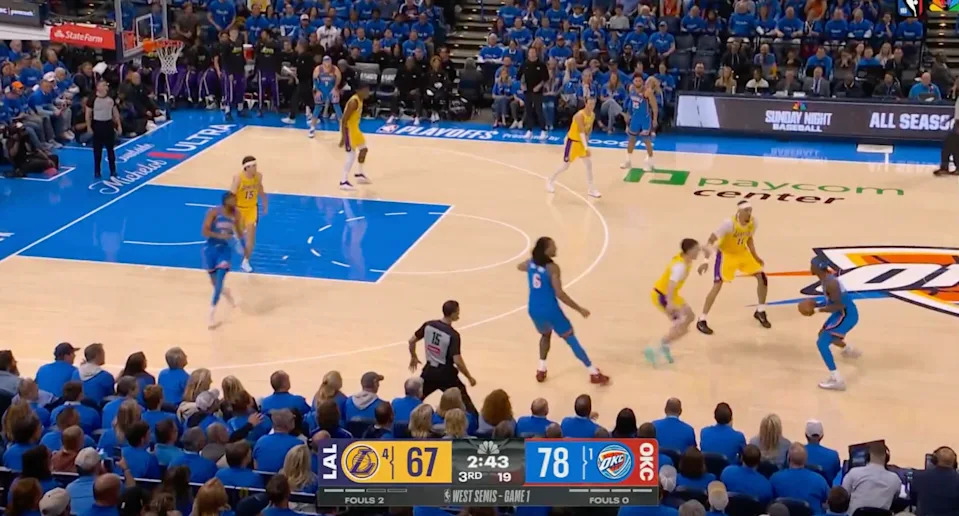
Principle 3: Traps
Similar to the Lakers’ first-round success against Houston — particularly in Game 2, the lone game Kevin Durant was present — when heliocentric players positioned themselves poorly (30-plus feet from the basket), Los Angeles is exceptional at covering space quickly, reducing the surface area and forcing quick and often bad decisions. Jaylen Williams is neither in a position to receive a pass nor spaced properly, and when the Lakers send two to trap, another turnover occurs.

(Peacock Sports screengrab)
Principle 4: Random pressure
This is purely down to the IQ of LeBron James, a Lakers defensive transitional unit that has yielded a ton of success in the postseason and pressure. Pay attention to James as he sprints back after a missed Smart 3. He’s already committed to attacking SGA once he crosses halfcourt, but motions for Rui Hachimura to watch Wallace while he changes direction. Gilgeous-Alexander notices too late and tries to find Williams, who’s not on the same page.
“It’s not gonna be perfect, but you just try to stick to the plan the coaches and guys went through to prepare for Game 1 and this series,” Smart added. “Shai’s gonna find a way to get more involved but continue to stay aggressive on both ends. Just gotta stay with it no matter what.”
Read the full article here


