






The term “meteoric rise” is a bit of a misnomer, though most people already know that. Meteors fall (And yet if you point this out, you are a pedant? The world is cruel to those brave enough to obsess over wording tell the truth). However, it is quite the fitting turn of phrase for baseball, prospects in particular.
There’s a lot of similarities between the job of scouting and identifying baseball talent and astronomers responsible for solar system object identification. Both disciplines ask the observer to work with an incredibly limited set of data points. Scouts watch children who are sometimes as young as 13 or 14 years old and based on how well they play against other kids in their general area, their physical development, their attitude, and how their coaches talk about them, they decide if this actual child might have potential to pursue a major league path in the future.
Astronomers take tiny little pinpricks of light, and from a series of still images of these pricks of light, calculate if or how much they’ve moved, and therefore, what kind of object it is, how large is it, what is it composed of, and, crucially for the meteorite/asteroid detection game, mapping the orbit of these objects to see if they are on a course to impact Earth and therefore, does it require advance action to be taken to prevent the loss of human lives.
In both cases, the answer for the vast majority of children and two-pixel lights is: No! But in some very rare cases, the answer is: Maybe! And at that point, the real digging-in commences. Is this kid playing against other talented kids, or just raking in his podunk local travel circuit? Is this asteroid going to get yoinked by another planet’s gravity well before it reaches us? Does the kid have more growth yet in him, or is that celestial body actually just a camera artifact?
And while these jobs are very much trying to read the future based on extremely imperfect information, they both are high-stakes, though on different scales. MLB teams will use this scouting information to pour vast amounts of resources into particular players. Avoiding an extinction-level event is also important.
Sometimes, though, it’s an easy Maybe. Colt Emerson has been one of the easier Maybe’s in recent history for the Mariners. Yet in a sense, Colt Emerson’s meteoric “rise” has just begun. He’s finally made it to the hard part. He’s successfully traversed the frictionless smooth of outer space/high school ball/the minor leagues, and now he begins the relentlessly, violently frictional approach into Earth’s atmosphere, just now transcending from meteoroid to become meteor, hoping to survive the approach and become meteorite.
In fact, his rise from meteoroid to meteor was so fast that he didn’t have anyone for him there at the game – he only found out about two-and-a-half hours before game time that he had to drive up to Seattle, now, for the Major League Baseball game that he would be playing in.
His family and girlfriend will be flying in for the rest of the homestand, but today was just him, 25 teammates and about 45,000 of his new biggest fans.
“I wanted to soak it all in as much as possible, that this is just the first of many days. Coming into the clubhouse, the guys were great to me, this is a really special group here, and I’m just happy to be a part of it,” Emerson said.
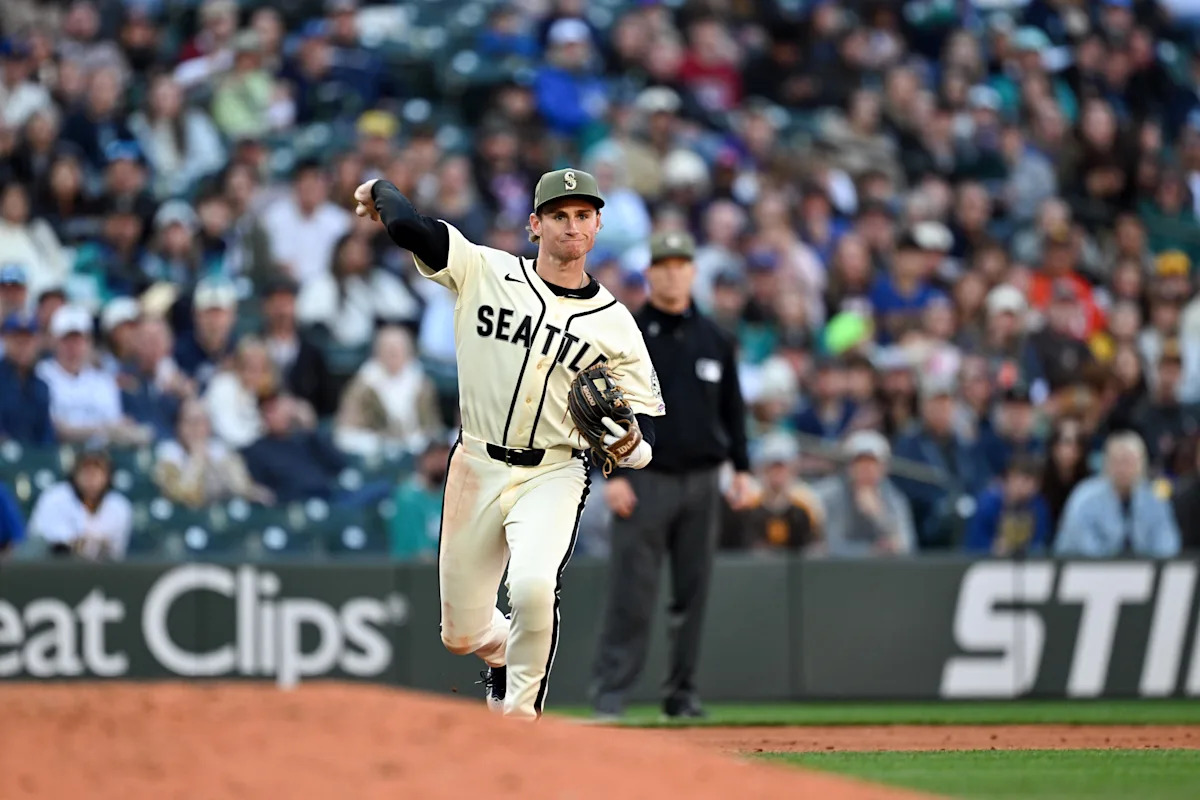
His first bit of friction was a subtly tricky pop-up in the top of the second inning. Running over his right shoulder into a spot where there could be competition for the play and there is definitely communication required, while running from the sun into the shade? Tough play for a shortstop playing third base. He took it as cool as you like.
View Link
At this point in the game, the score was 1-0.
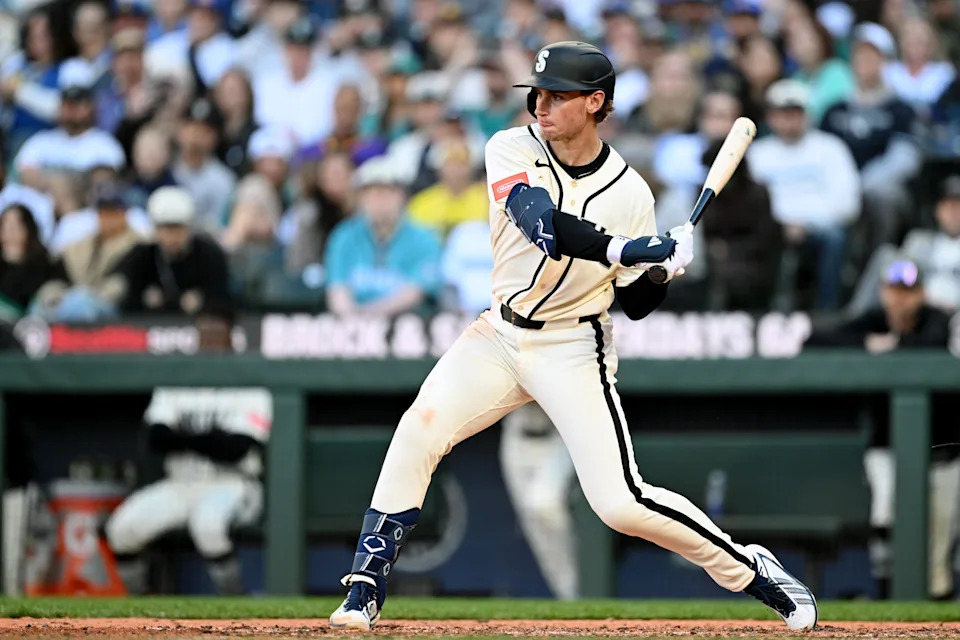
Emerson’s next bit of friction was two at-bats against a very on Lucas Giolito. Emerson said he normally prides himself on keeping his cool and his heart rate down, but the first time around, in the bottom of the third, he was eager, unable to check his swing at the first pitch he saw, a fastball at the letters.
“When I came in, I thought that was the fastest 90 mph fastball I’ve ever seen,” Emerson said.
Giolito threw another heater that Emerson swung at like he wanted to send it into the mesosphere. Finding himself down 0-2, Emerson then showed the plate discipline that got him this far, and worked the count even before making some solid contact right to Ramon Laureano in right field.
Emerson said that the nerves he felt surprised him, but his first at-bat helped him stabilize.
“I thought I was gonna go out there and maybe not even be able to swing a bat, but once I got that first fly ball out of the way, I was like, ‘Okay. This is just baseball. There’s an extra deck.’”
Giolito, like that one friend not letting go of a bit that’s outlived its humor (i’m friend), threw high fastballs to Emerson for the rest of the night, including three straight out of the zone to start his second at-bat. Colt, like a mutual friend with no grace for your first friend, spit on all of them before also ignoring a perfectly-placed changeup for ball 4, his first time getting on base in his young career.

At this point in the game, the score was 7-0.
His walk was a bit of a premonition, as Giolito seemed to lose the handle there in the sixth. Emerson moved to second base on another well-worked walk courtesy of Leo Rivas, and then to third when Giolito walked Julio.
Giolito, walking the bases loaded with no outs, would face some consequences for his actions. Colt Emerson concluded his first circumnavigation of the infield when Matsui walked Naylor, scoring his first career run. A couple of sacrifice flies and a Cole Young strikeout later, the Mariners had their most productive inning yet, without getting a single hit.
At this point in the game, the score was 7-3.
Emerson had his third at-bat in the bottom of the eighth, putting a great, compact swing on a golfy, down and in fastball. It also was, unfortunately, almost straight at Laureano, but he showed excellent bat speed on the swing, hitting 75.4 mph.
In the top of the seventh inning, Emerson almost had his first defensive gem, but the throw was just a hair off and Naylor had to bail off the bag to make the catch.
View Link
The game ended 8-3.
***
If you haven’t had the opportunity yet to read one of my favorite Lookout Landing pieces yet, Lou Fish-Sadin’s “We Love a Debut,” I highly recommend it. It captures one of my favorite things about baseball, which is how encapsulatory it is. I don’t know if it’s the sheer volume of games, the relaxed pace that gives so much room for special moments to breathe or some mystical other thing, but baseball has a way of reflecting life’s most frustrating, rewarding, gut-wrenching, joyful experiences. It’s that joie de vivre and ennui that is hard to find anywhere else. Lou’s piece captures that specific magic of baseball and that feeling of simple goodness that baseball is capable of.
Debuts are one of those moments, where you get to share and be a part of the incalculable joy of another human being achieving their life’s worth. Whether it’s a 25-year-old org guy who would only ever see 5 at-bats, or a young prodigy screaming his way into the gravity well of T-Mobile Park, these are moments to be cherished.
“I know I talked about trying not to let the emotions get to me, but [when my family gets here], that’s going to be an emotional one. I can’t say enough nice things about my parents, the amount they sacrificed. My parents would split up – my brother played travel ball and I played travel ball, so my mom would go with my brother to Indiana, and my dad would drive me down eight hours to Georgia, like that was a normal thing. Without that, I’m not here,” Emerson said after the game.
“It was surreal. You dream about stuff like that. You dream about telling your parents that you made it to the big leagues and it finally came. I’ll be remembering this forever.”
Read the full article here


