






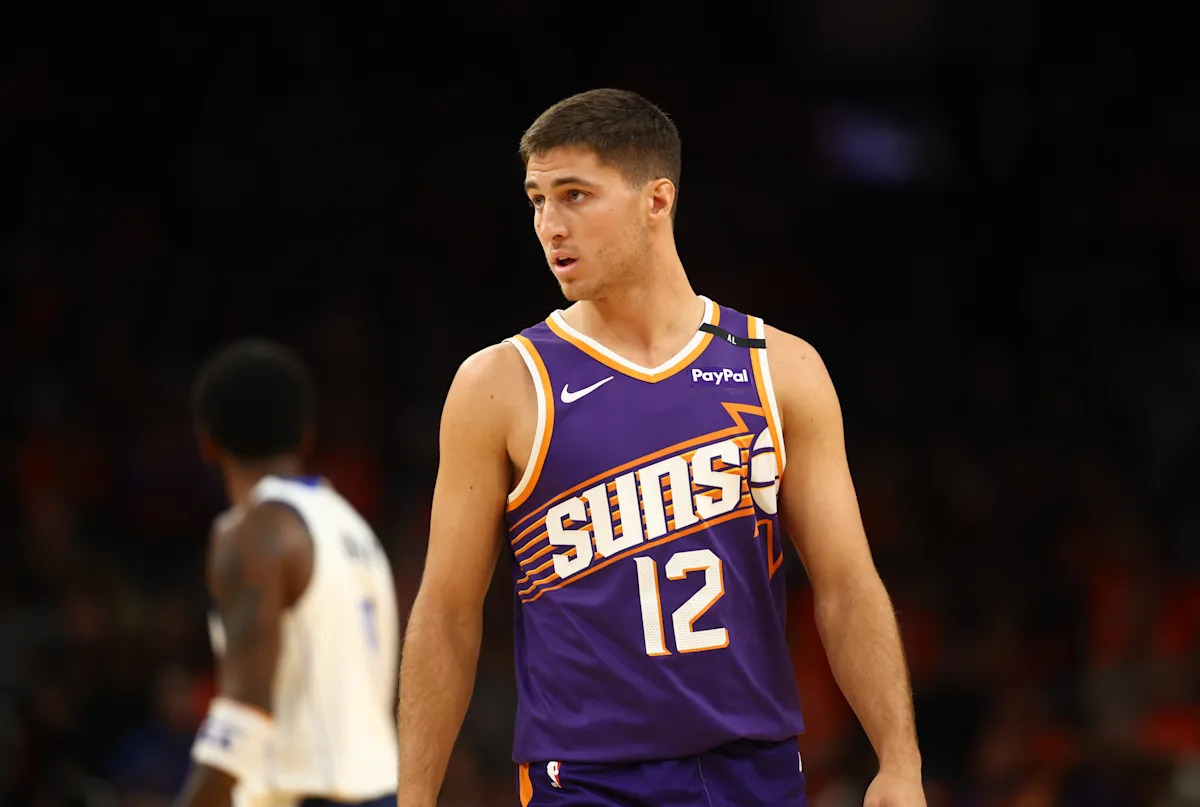
I cut my teeth on this league watching Steve Nash. That’s not a comparison I make lightly, and I’ll say up front: this isn’t one. But every generation of watching basketball needs a guy who makes you lean forward for reasons that have nothing to do with size or draft slot or highlight-reel gravity. Nash was mine. This season, heading into the Suns’ 2026-27 campaign, Collin Gillespie is the one doing it again.
That’s the whole premise of this piece. Not a preview. Not a “here’s what to expect” breakdown. Just an honest accounting of why one player’s arc has hooked me more than anything else on this roster, and why I can’t wait to see what the next chapter looks like.
Los Angeles Lakers v Phoenix Suns
The Shape of the Thing
Gillespie’s resumé resists the usual breakout narrative, and that’s precisely the point. Undrafted out of Villanova in 2022 after five college seasons, he spent three straight years on two-way paper before the Suns finally handed him a standard contract. Even then, a leg injury swallowed most of his rookie year in the Valley, limiting him to bench minutes and modest numbers. Nobody hands you a franchise piece with that kind of runway. You have to be discovered in real time, which is exactly what makes the discovery worth something.
The turn, when it came, arrived fast. A 30-point night against Portland in February. A game-winning jumper over Minnesota with 6.4 seconds left. By year’s end, he’d broken Quentin Richardson’s two-decade-old franchise record for made threes. He made 232 of them, on 40% shooting, across 58 starts in 80 games, with career highs everywhere: 12.7 points, 4.6 assists, 4.1 rebounds. I don’t need those numbers to build a case for a “next great Sun.” I need them because they’re proof the league’s read on him in 2022 was simply wrong, and I like being reminded that scouting reports aren’t destiny.
Villain Jr., Explained
The nickname is the part that travels furthest outside Phoenix, and for good reason. It’s rare for a bit invented in a training-camp scrimmage to survive an entire season intact. Dillon Brooks, long ago anointed “Dillon the Villain” for his pest-level defense, spent last fall teasing that there was a “Villain Jr.” somewhere on the roster before revealing it was Gillespie, the product of offseason pickup runs physical enough that Brooks picked up two technical fouls in what was, notionally, a non-contact scrimmage.

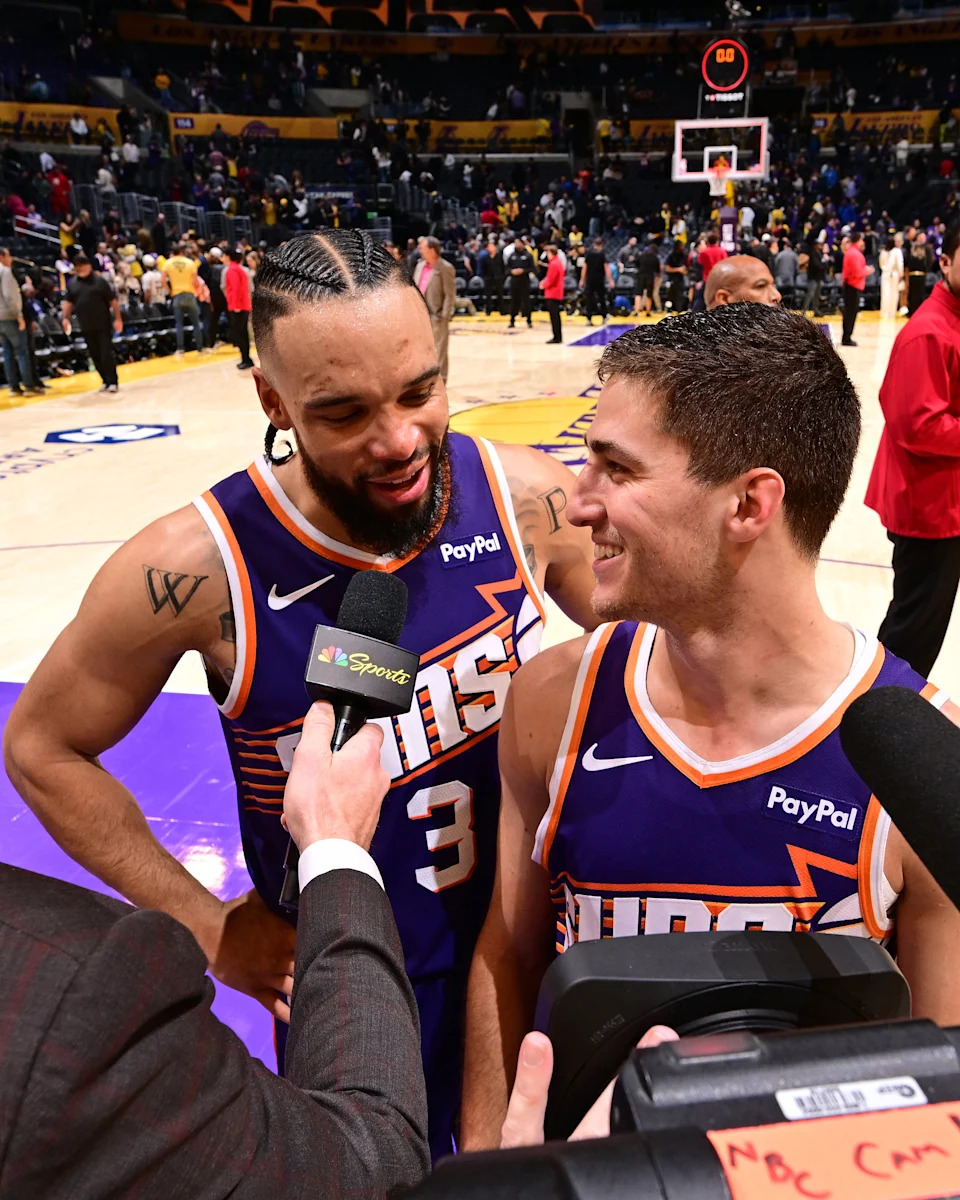
I love this not because it’s a good marketing beat, though it is, but because it’s an accurate scouting report wearing a joke’s clothing. Gillespie isn’t a shot-creator in the pick-and-roll sense. He’s closer to a connector and an elite catch-and-shoot threat, ranking sixth among high-volume three-point shooters in catch-and-shoot percentage last season.
But the edge Brooks recognized is real: a point-of-attack defender who competes above his measurables in a backcourt otherwise defined by Devin Booker’s shot-making and Jalen Green’s shot creation. Brooks brought the villain persona to Phoenix by way of the Kevin Durant trade. Gillespie made it a two-man bit, and in doing so became part of the team’s answer to a reputation for being soft that’s followed this roster for years.
The business side backs the story up cleanly, which is its own kind of satisfying. Gillespie re-signed this June on a four-year, $48 million deal, fully guaranteed, team-friendly enough to be viewed around the league as one of Phoenix’s best pieces of offseason business. At roughly $12 million annually, it runs concurrently with Booker’s extension rather than competing for cap space.
The Suns held his early Bird rights, meaning they could have gone as high as $66.6 million over the same four years. They didn’t need to. That’s the rare front office moment of getting exactly what you wanted without overpaying for it, and it means this isn’t a one-year infatuation. There’s a real runway here.
Where the Nash Line Actually Fits
It’s tempting — and I’ll admit, a little absurd — to draw a straight line from Gillespie to Nash. They aren’t the same category of player, and no serious read projects Gillespie toward an MVP trajectory. I want to be careful here, because the lazy version of this essay just says “small unheralded guard, must be the next Nash” and calls it a day. That’s not what I’m doing.
What actually happened is smaller and, I think, more honest: during a nationally televised game last season, an NBA on TNT broadcast caught Gillespie mid-heater and, half-joking, likened his handle and pull-up rhythm to Nash’s. It was a passing comment, not a scouting conclusion. But it’s the kind of moment that explains why a neutral viewer — someone who, like me, learned to love this league through a very specific undersized Canadian point guard — might find something familiar here. An overlooked guard whose value shows up in shot release and tempo rather than measurables. That’s the whole comparison. Not legacy. Not trajectory. Just a recognizable shape.
Gillespie is a five-year college player nobody drafted, who needed two extra seasons on minimum money just to get a real look — while dropping triple-doubles on the daily in the G-League, the kind of stat line that means nothing until someone finally watches — and turned that look into a franchise shooting record and a nickname built on competitive spirit.

NBA: Golden State Warriors at Phoenix Suns
Why I’m Actually Here
Phoenix’s season will hinge on what Booker, Green, and a retooled frontcourt become. That’s the analytical truth, and it has nothing to do with why I’m excited for October. In a league obsessed with created shots and star gravity, Gillespie’s game is a quiet rebuttal: near-elite shooting, real defensive competitiveness, and a refusal to back down still buys you a seat at the table, even when nobody sent you an invitation first.
I watched Nash rewrite what point guard play could look like and fell in love with the position because of it. I don’t expect Gillespie to rewrite anything. I just want to watch the next iteration of a player who had to earn every single minute of relevance he’s got, and see how much further that competitive streak takes him.
Collin Gillespie is why I’m watching the Suns this season.
Read the full article here


