



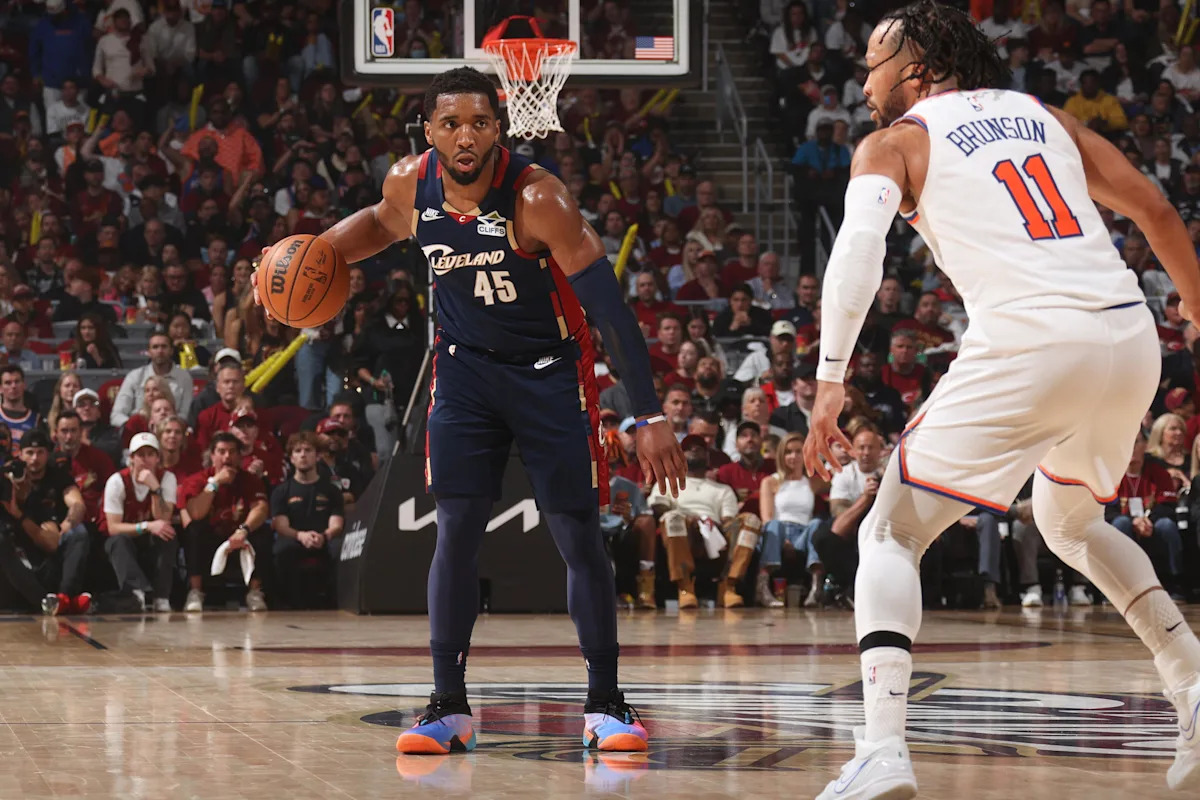
This was a complicated season for Donovan Mitchell. The Cleveland Cavaliers aren’t in a position to make a deep playoff run if Mitchell doesn’t carry them through a turbulent regular season. Simultaneously, the disappointing four-game sweep in the Eastern Conference Finals can be laid more at the feet of Mitchell than anyone else on the roster.
Regular Season Stats
Mitchell held the Cavs together when their roster was decimated by injuries during the regular season. His efficient scoring and energy were a godsend for a team that was in desperate need of both most nights.
This past season was Mitchell’s second-highest scoring output and his second-highest efficiency. Further implementation and perfection of the short mid-range floater — in addition to his usual scoring output — allowed him to increase production without sacrificing efficiency. Mitchell converted 55% of his looks in the short midrange (four to 14 feet from the basket), putting him in the 95th percentile for scoring guards from that zone.
The increased usage in the short midrange was part of a season-long plan to keep wear and tear off his body. In previous years, he was more of a downhill finisher who initiated contact at the rim to draw fouls and get to the line. This past season, he got the shot off before contact, allowing him to play 70 games (his second-highest since being traded to Cleveland) and the entire postseason.
This was important because the Cavs as a team went as Mitchell did throughout the regular season. Cleveland was 22-6 when Mitchell played and scored 31 or more points. That record got better the more he scored. When Mitchell put up 35 or more points, his team was an outstanding 14-1.
More importantly, it was Mitchell’s off-the-court leadership that kept the team afloat when they could’ve gone completely off the rails.
“He kept this thing together,” head coach Kenny Atkinson said after their Game 7 win over the Detroit Pistons. “When things weren’t going great, he was the beacon, the light, his leadership carried us on the court. … And when things weren’t going great, he was the person everyone looked to his positivity. I would have said this even if we lost.”
The postseason proved to be a different story.
Mitchell has long been an efficient and productive playoff scorer, even though his teams had never advanced out of the second round before this past season.
The 2025 series against the Indiana Pacers is a good example of this. Mitchell contributed 34.2 points per game, but that wasn’t enough to carry the team over the finish line, considering the injuries and struggles everyone else was going through. It’s difficult to point a finger at Mitchell when his teammates weren’t living up to expectations.
It was easier to blame Mitchell this past postseason run. Mitchell’s scoring was more inconsistent than normal during this playoff run against rangey wing-heavy defensive teams like the Toronto Raptors and Pistons. He failed to eclipse 25 points in nine of his 18 postseason appearances. For context, he achieved this in six out of nine appearances in 2025 and in seven out of 10 games in 2024.
This is important because the regular-season trend of the Cavs performing well if Mitchell did continued in the playoffs. Cleveland was 4-2 in postseason games when Mitchell scored 30 or more points, and were 4-8 when he scored less. This included going 1-3 when he registered 20 or fewer points.
The lack of consistent scoring highlighted the other shortcomings in Mitchell’s game, particularly with his playmaking for others. He wasn’t able to get teammates involved, and when he wasn’t scoring, the offense was mostly stuck in neutral. This is why Cleveland’s offense was 11 points worse with him on the floor in the postseason compared to when he was off.
Assists aren’t necessarily the most accurate way to determine whether someone is creating for others, but they can be instructive. Mitchell averaged 5.7 assists in the regular season. He only exceeded that average once in 18 playoff games.
This coincided with Mitchell’s passes made per game and potential assists dropping. He averaged 41.7 passes per game in the regular season, and just 34.6 in the playoffs. His potential assists went from 11.1 per game in the regular season to 7.6 in the postseason.
The frustrating part of this is that when Mitchell made a concerted effort to get others involved, it led to tremendous team and individual success.
Mitchell made it a point to get the bigs involved in Game 7 against the Pistons. He had a playoff-high eight assists in that game, with all but one of those helpers going to either Evan Mobley or Jarrett Allen. The willingness to make those passes opened up the offense for himself and his teammates, resulting in a lopsided 125-94 road elimination victory.
Mitchell’s team advanced to the conference finals for the first time in his career, but it felt like many of these wins were despite Mitchell’s efforts, not because of them. That was a first for his Cleveland tenure and was in stark contrast with Jalen Brunson’s postseason run with the New York Knicks.
The two undersized scoring guards often find themselves in similar places in the NBA player rankings and have similar archetypes. The difference between the two this past playoffs was Brunson’s willingness to move the ball and compete defensively.
Brunson consistently took what the defense gave him. This led to 14 assists in Game 2 against Cleveland because the Cavs consistently double-teamed him. This caused Cleveland to adjust away from that strategy in the final two games of the series, which allowed him to attack one-on-one mismatches.
At the risk of belaboring the point too much, this is also seen in Brunson’s passing numbers. Brunson made 63.6 passes per game in the regular season with 11.7 potential assists per game. Those numbers didn’t dip much in the playoffs as Brunson posted 63.1 passes per playoff game with an average of 10.3 potential assists.
It’s fair to point out that Brunson is the point guard of the Knicks, while Mitchell isn’t. However, if you’re in the 99th percentile for usage in the regular season and 100th percentile in the playoffs — as Mitchell is — the point guard designation doesn’t matter all that much. In the NBA, whoever has the ball in their hand needs to be able to act as a facilitator if they’re going to optimize the offense. And with Mitchell occupying that many possessions, he needs to do a better job of helping his teammates.
The shorcomings Mitchell’s games aren’t skill-related. He has the tools to be a great passer (and defender). The question is whether he wants to improve his game the way he needs to in order to help his team more in the playoffs next season, regardless of how different the roster might look.
The difference between the regular season and playoffs makes it difficult to grade Mitchell’s year. On one hand, the Cavs aren’t in a position to even make a playoff run if it weren’t for his consistent play on a nightly basis. On the other hand, his shortcomings directly led to Cleveland not being able to put away Toronto and Detroit as early as they should’ve, which contributed to the one-sided loss to New York.
I’m going to lean more negative than I’d like in this situation. The playoffs are all that matter for someone in Mitchell’s position. And that is where he fell short most.
Grade: C
Read the full article here


