







The change follows Canelo’s uncomfortable experience against William Scull in May 2025. That bout began around 6 a.m. in Riyadh so it could air during prime viewing hours in North America. He arrived three weeks early, but preparing to fight near sunrise still forced his body through an unnatural schedule.
Reports describing an eight-week stay in Spain followed by another week in Riyadh do not fit the calendar. September 5 to October 31 is exactly eight weeks. The more logical interpretation is that Canelo will spend close to seven weeks in Gandía before completing the final week in Saudi Arabia.
Spain changes its clocks on October 25, creating a two-hour difference from Riyadh during fight week. For most of camp, that difference will be only one hour.
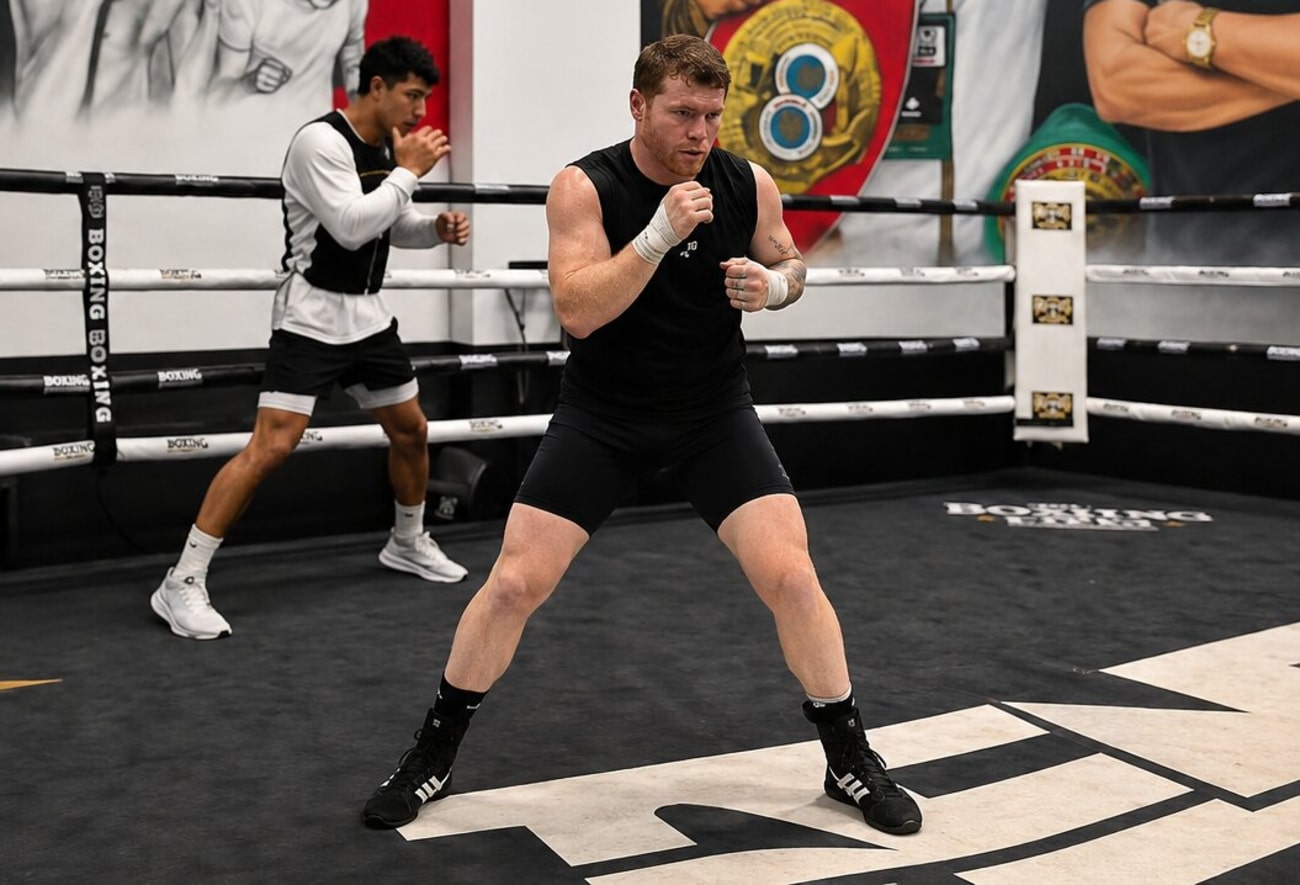
Oleksandr Usyk reportedly invited Canelo to use his training base in Gandía. That does not necessarily mean the two will spar or follow the same program, but Usyk’s camp offers the controlled setting Canelo wants for a fight carrying substantial physical risk.
“He’s a strong rival. He throws a lot of punches. He’s a very strong person. That’s what I like, being in there. He throws a lot of punches, and I really like that,” Canelo told Box Azteca.
Canelo Returns As The Challenger
His position has also changed. The unanimous decision loss to Terence Crawford in September 2025 cost Canelo the undisputed super middleweight championship and led to elbow surgery. He now returns as the challenger, trying to take the WBC belt from Mbilli.
That role may give him more urgency than he showed during the later years of his championship reign. Canelo controlled opponent selection, pace, and most of the commercial terms for more than a decade. This time, his reputation will not be enough if a younger champion is throwing twice as often and taking rounds through work rate.
Mbilli’s pressure should give Canelo more countering opportunities than Scull provided, but it will also test the 36-year-old’s conditioning. With age, Canelo has become increasingly economical, often conserving energy while waiting for isolated power shots. The champion keeps punching after the first exchange and is willing to absorb clean shots to maintain his attack.
Mbilli’s Pressure Creates Openings
That aggression carries defensive costs. While throwing hooks, Mbilli sometimes leans forward, lowers his head, and squares his shoulders. Canelo’s right uppercut is built to punish an opponent entering in that posture. The problem is finding enough room to generate force before the champion crowds him against the ropes.
A similar risk accompanies the body attack. Mbilli will remain close enough for Canelo to target the ribs instead of chasing a mobile opponent across the ring. Every committed shot downstairs, however, leaves him exposed to hooks and overhand punches coming back.
Trust in the repaired elbow will also be essential. Canelo’s right hand does not need to stop Mbilli immediately, but it must carry enough force to interrupt his entries. Any reluctance to release it at full speed would encourage the champion to attack without respecting the return fire.
“I really feel very good. I feel very good in the gym. I was thinking yesterday that in two or three weeks I’d be ready. We still have eight or nine weeks left, and I feel very good,” Canelo said during the same Box Azteca interview.
The scoring may depend on the contrast between Mbilli’s quantity and Canelo’s accuracy. Many of the champion’s punches strike gloves, arms, and shoulders, but sustained output can control how a round looks from ringside. Canelo favors clean, visible power punches separated by long periods of inactivity.
If Mbilli throws two or three punches for every one coming back, a handful of sharp counters may not automatically carry each round for Canelo. Judges may favor the fighter forcing the action, especially if the challenger spends extended stretches covering up against the ropes.
The Spanish camp removes the body clock problem that complicated Canelo’s first Saudi appearance. It cannot restore his younger reflexes or erase the effects of surgery and inactivity. He still owns the cleaner counters, but must land them often enough to prevent Mbilli from turning the fight into a twelve-round argument over quality against quantity.
Read the full article here


