





Why now? Why for Paul George, an aging but very expensive player? How is this bringing Boston closer to maximizing the prime years of Jayson Tatum and winning another ring?
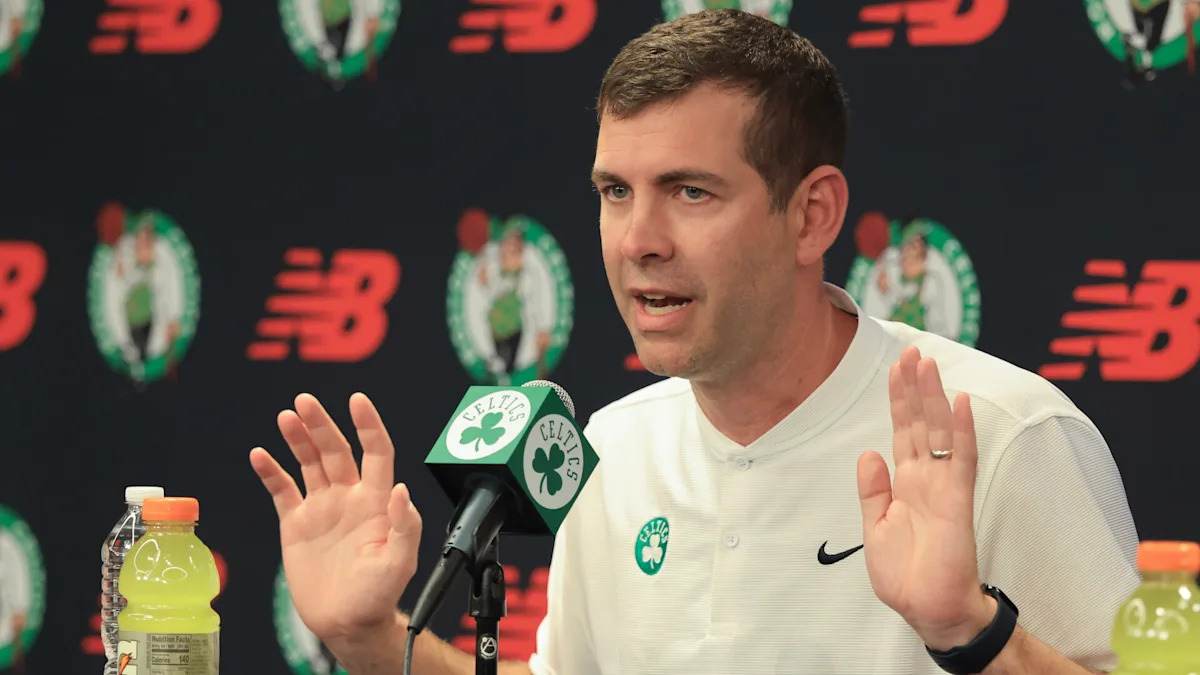
Monday, Brad Stevens explained his reasoning for trading away Jaylen Brown and all of the above questions. Stevens, the Boston Celtics’ president of basketball operations, pulled the trigger on a Brown-to-Philadelphia-for-Paul George trade that has been lambasted around the league and vilified in Boston. He took to the podium, sitting next to team owner Bill Chisholm, and explained his reasoning largely as “optionality.”
“When I looked at our team and where the league was heading, looked at the way that we’ve finished the last couple years and at the unbelievable way we’ve played in the regular season in the last couple years, the path looked a little bit more challenging to me. I might be wrong. I’m not going to stand up here and be defensive about that, but the path looked a little bit more challenging, with 70% of our cap and such a high percent of our usage tied into two players (Brown and Tatum).
“The reality in this day and age at the NBA, and you could see it obviously with the last couple of champions … you have to do a great job of building out depth that can hopefully replace the irreplaceable individual. And that’s not an easy thing to do. And that’s absolutely nothing against Jaylen. If you have Jaylen Brown on your team, you should feature him, you should use all those possessions and you should approach things that way. But I think the importance of depth and then obviously, we have to continue to work on ways to diversify our attack overall.”
Stevens is not wrong on key underlying facts. Tatum and Brown are both on supermax contracts, and next season they would have taken up 70.4% of the team’s salary cap, making it challenging to build out around them. Brown is up for a max contract extension on top of it, while it’s possible Boston can trade George next season in the final year of his deal (once he picks up his $56.6 million player option, which he will). Both Tatum and Brown are high-usage players who are best with the ball in their hands. Recent champions have been built more around one elite star and depth (although the Spurs and Thunder challenge that). The draft picks coming back to Boston in this trade have real value.
All that doesn’t explain the dismal return on this trade. More importantly, it doesn’t open a path to competing for a title while Tatum, 28, is at his peak.
For the next two years, George makes essentially the same amount of money as Brown but, at age 36 and at this point in his career, is not nearly as good a player. Brown is coming off a career-best season when he was sixth in MVP voting and lifted the Celtics to the No. 2 seed in the East. George played in 37 games last season due to injury, and at this point in his career, when he plays, he looks like a good role player.
After two offseasons of cost-cutting, Chisholm said this trade was “not about the money at all,” and he would spend to win. Stevens and Chisholm sold this as the right basketball move.
But it’s hard to get there when this trade just made Philadelphia a legit contender to win the East, Detroit is only going to get better, Indiana will bounce back with a healthy Tyrese Haliburton, and Boston got worse.
Stevens is going to try to build out a contender around Tatum, and maybe he can. But he already had a contender, a team that won a title, and he chose to move on from it for “optionality.”
Read the full article here


