






It’s not just the A’s. Following his historic 60 HR season in 2025, who in their right mind would have predicted that Cal Raleigh would spend the first half of the 2026 batting .169/.271/.310? That same Raleigh appears to have shaken off the demons and is back to homering at his 2025 pace lately, with a .490 slugging percentage since the All-Star break. What do you make of that in terms of projecting what to expect in 2027?
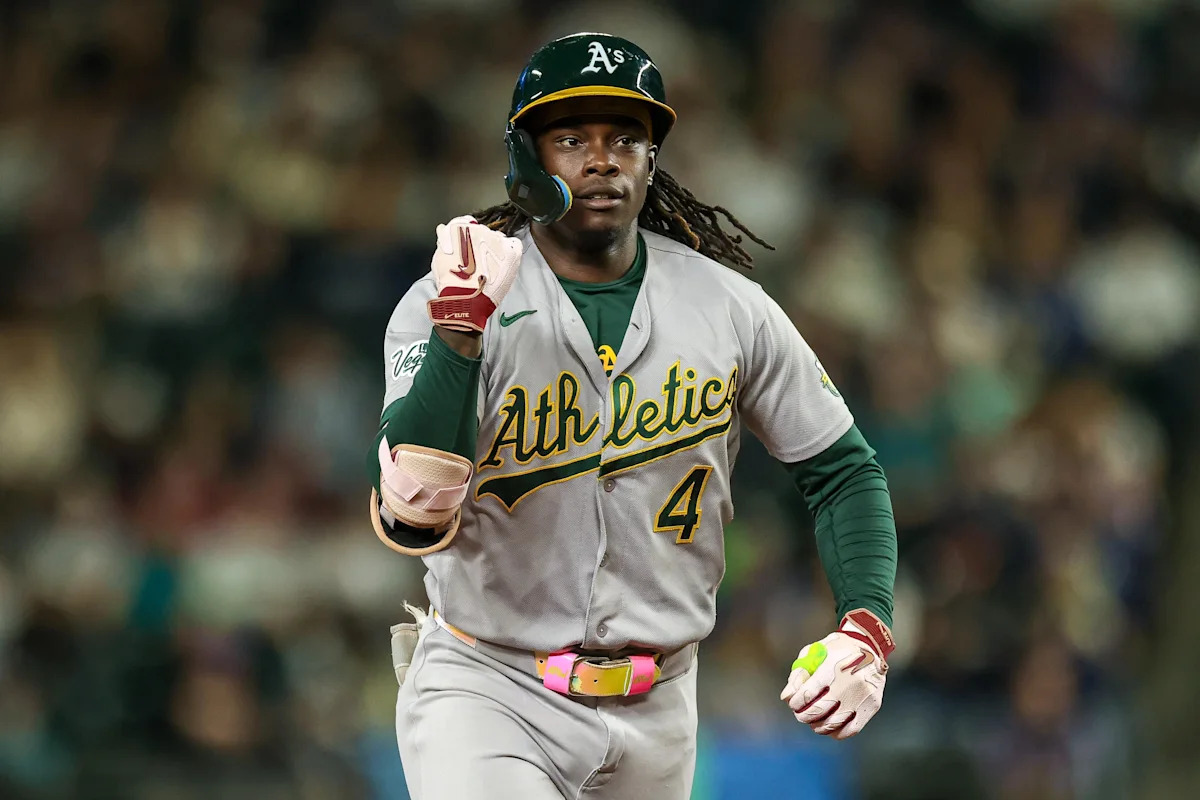
The A’s have been there twice very recently. Lawrence Butler was so good in the second half of 2024, batting .300/.345/.553, 155 wRC+, that the A’s rewarded this “breakout star” with a 7 year, $65.5M extension. Butler proceeded to stumble to a .234 BA and 91 wRC+ in 2025 in a season that, perhaps not coincidentally, ended early due to knee surgery.
But 2026 started out even worse than the year before. For the first half of the season Butler was literally the worst player in MLB by some measures as his average languished around .160 and his defensive stats cratered. There were some signs of life mid-season when Butler hit into some bad luck, lining into more than his fair share of outs, but nothing predicted he would revert back to his 2024 form.
Since the All-Star break, Butler is hitting .284/.366/.488 and consistently grinding out some of the best plate appearances on the team, spitting on close pitches off the plate even with 2 strikes and enjoying a career best 11.9% BB rate for the season.
What Butler is doing is known as “pulling a Gelof”. A rising star when he took the league by storm for a half season in 2023, Gelof then started a downward spiral that produced a disappointing 2024 followed by a disastrous 2025. Just when you wrote him off … like Lazarus he rose, only unlike Lazarus he can play above average defense at 2B, 3B, LF, CF, and RF. The super-utility man has 2.0 fWAR in just 93 games in 2026 and suddenly he looks like a core piece again.
Baseball is, as we know, that most unpredictable of games and nowhere is this seen more than in the bizarre highs and lows that often describe the same player in the same stretch of his career. How do you shrewdly plan your depth chart when the range of outcomes for a player so reasonably appears to be “somewhere between All-Star and DFA candidate”?
Case in point: Henry Bolte. Here are Bolte’s wRC+ stats month by month in his maiden voyage:
May: 99 wRC+
June: 111 wRC+
July: 27 wRC+
August: 124 wRC+
Sept: 200 wRC+
Now in Bolte’s case, those extremes are a bit more expected since it’s his first go-around and he’s only 23. But projecting “what you have” in Bolte, in terms of being an every day CFer on a contending team, is only as easy as figuring out what you will probably get from Butler and Gelof yesterday and tomorrow.
With Tyler Soderstrom, Bolte, and soon Devin Taylor in the mix, the A’s need to assess who “the real Lawrence Butler” is. With Joshua Kuroda-Grauer, Jacob Wilson, and soon Leo De Vries joining, the A’s need to assess who the “real Zack Gelof” is.
Just like the Mariners wonder who Cal Raleigh truly is, and many other teams have similar conundrums trying to make sense of their own bi-polar players. Good luck figuring it out in that most unpredictable game of baseball.
Read the full article here


