





When a writer tells a story from beginning to end, proceeding in order, it is called linear narrative or chronological narrative. More formally, it’s referred to as ab ovo narration (Latin for “from the egg”), a term from Horace’s Ars Poetica, meaning the story begins at the very origin of events and unfolds in sequence.
Conversely, starting from the end and working backward is called reverse chronological narrative or simply reverse chronology. A famous example is the film Memento.
But when a story opens specifically at the ending or a dramatic moment and then explains how events led there, it’s often described as beginning in extremis or using an analepsis (a flashback structure).
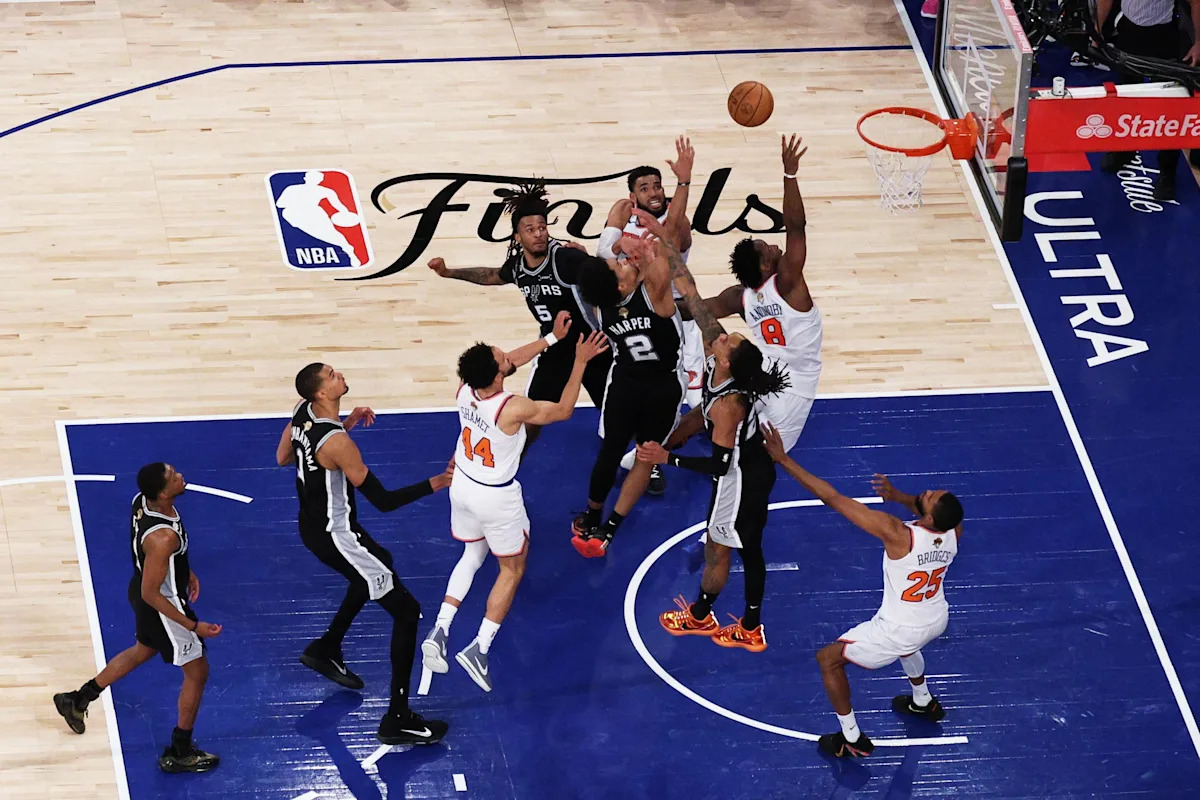
Credit: Brad Penner-Imagn Images
| Brad Penner-Imagn Images
Yesterday, I was at work and could not watch the game live. My plan was to head home, retreat into my bubble, and watch it from beginning to end. Unfortunately, a friend texted me the score at half-time. I was annoyed and asked for no further updates, but at the same time, it felt good. Our Spurs were leading by 27 at half-time at the MSG, in the pivotal Game 4. We were on our way back to San Antonio with a chance to restore home-court advantage.
When I got home, I decided to tune in from the start of the 3rd quarter. I didn’t feel I needed to revisit the first two quarters to understand how we’d built such a momentous lead, one that could have written NBA history, and so I bypassed this beginning in extremis…
I suppose you all know the ending anyway, no spoiler needed here. But the real question is no longer the result; it’s how we got there. How do you end up on the wrong side of history in just two quarters when, just 24 minutes earlier, you were firmly on the right side of it?

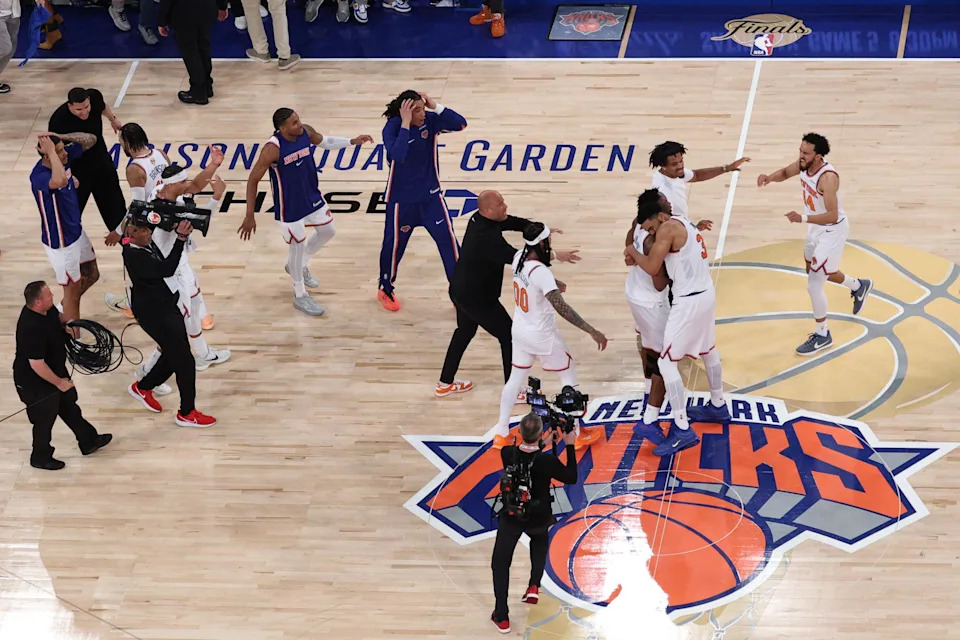
Credit: Vincent Carchietta-Imagn
| Vincent Carchietta-Imagn Images
My disappointment, let’s be honest, my fury, was overwhelming last night. I could barely sleep. So I decided to rewatch the game in full, this time with a linear narrative.
Before I get to the autopsy, though, I need to share a conversation I had with a friend in the hours before tip-off. I tried to explain how difficult it is to predict outcomes in basketball, but that it is sometimes possible to foresee the conditions that shape them. I pointed out that Karl-Anthony Towns was due for a bounce-back game, if Jalen Brunson could find ways to involve him more. KAT can direct the offense from the top of the key like almost no other player on the Knicks, and his elite three-point shooting makes him a genuine triple threat. However, I also noted that Brunson had been quite stubborn in this series, grinding to draw fouls through heavy dribbling in traffic which had led to turnovers and low shooting efficiency. The player I singled out as the most dangerous Knick was OG Anunoby. And finally, I voiced my concern about Victor: he had logged heavy minutes and would likely run out of gas in the second half. That, I feared, could determine the outcome, though I still expected the Spurs to win, by three.
As it turned out, KAT removed himself from the equation with two very quick fouls. The young Spurs exploited this early and took flight. Mike Brown threw everything at Victor Wembanyama, Mitchell Robinson (literally), Ariel Hukporti, and even Jeremy Sochan but none of it stopped the first-half onslaught.
From the end of the first quarter through to the end of the third, the Spurs’ lead sat between 19 and 15 points, with a peak of 29. During that entire stretch, Victor Wembanyama played 32 of a possible 36 minutes. I’ll come back to that shortly.
The first three quarters unfolded much like the rest of this playoff run. Anyone can push, shove, and grab Victor with relative impunity. The Spurs accepted this reality some time back and decided to apply the same treatment to Karl-Anthony Towns. The reasoning is simple: if refs were to whistle this type of plays in favor of KAT, they would have to do the same for Vic.
As a basketball fan, I am growing genuinely disillusioned with NBA officiating. On one side, you have players like Luka Dončić, Shai Gilgeous-Alexander, and, to some extent, Jalen Brunson, who rely heavily on theatrics to earn calls in their favour. On the other, you have blatant physical intimidation that diminishes KAT and Vic’s impact and, in turn, the quality, flow, and fairness of the game. Mobile bigs who can shoot the three, rebound, dribble, and pass bring something genuinely special to the modern NBA, something that studio personalities like Shaq and Charles Barkley seem incapable of appreciating, apparently out of jealousy.
Victor Wembanyama has been on the receiving end of this treatment throughout the entire playoffs. And we have also come to understand that Vic is troubled by what he perceives as persistent injustice. Under fatigue and pressure, he has repeatedly crossed lines: a Flagrant 2 on Naz Reid, a shove on Brunson, and taunting Mitchell Robinson early in this game. The pattern is clear, a tired and frustrated Victor struggles to keep his emotions in check. The coaching staff and front office have surely taken note.
The other major lesson of this playoff run concerns Victor’s stamina. It is genuinely remarkable that a 7’5 player who was struggling to play more than 28–30 minutes earlier in the season can now sustain 35 and beyond. Full credit to Vic and his training staff. That kind of physical progression ahead of a Finals run is extraordinary. However, it is equally clear that Vic, who deploys enormous energy on both ends of the floor, often arrives at the fourth quarter running on empty. We know he needs to impose himself early: the alley-oops, the drives, the post positioning if the Spurs want to start strong. And the Spurs have indeed managed by leads in the opening of each of their four Finals games in that way. But Vic also needs reserves to close games when it matters, as Game 2 demonstrated all too painfully.
Which brings me to my central grievance with last night’s loss: the management of Victor’s minutes. It is absolutely unimaginable that the coaching staff had Vic on the floor for 32 minutes across the first three quarters while the lead was never below double digits. To claim that Kornet is unplayable is an insult to the man. Is Kornet less playable than Ariel Hukporti? Than Sochan? And what about Harrison Barnes? The Spurs were up 29 at some point and he didn’t see a single minute?
The irony of Mitch Johnson’s minute management against the Knicks is almost too rich. Tom Thibodeau was held responsible for New York’s “disappointing” seasons between 2023 and 2025. The charge? He ran his players into the ground with relentless minutes and short rotations.
Having watched enough of Mitch Johnson in these playoffs, I am convinced he needs to learn how to better manage his rotation, before his star player ends up injured.
This loss falls squarely on the coaching staff, and on Mitch Johnson above all. We now know Vic cannot play 44 minutes and sustain the same intensity on both ends of the floor. We also know that an exhausted Vic is a less composed Vic and that composure is precisely what leads to flagrant fouls. One more, and he faces a one-game suspension.
With a 27-point lead at half-time, and a double-digit advantage held for more than 32 consecutive minutes, the decision to deny Victor Wembanyama meaningful rest before the fourth quarter was a massive mistake.
There’s a reason I titled this piece after Justine Triet’s Palme d’Or-winning film. Anatomy of a Fall opens with a man already dead at the foot of a chalet, and spends two and a half hours asking a single question: how did we get here? The courtroom never delivers a clean verdict. The film trusts you to sit with the ambiguity. Last night’s Game 4 offers no such comfort, the verdict was final, the scoreboard unambiguous. But the question is the same. A 29-point lead. Two quarters. A fall. How did we get here? Mitch Johnson owes us an answer. It is not a trial. I expect a reaction and some changes.
I still believe.
Spurs in 7.
Read the full article here


