Welcome back to our AL Central previews, where I’ll give my take on the other four teams challenging Detroit for the AL Central title. We touched on Kansas City’s top-heavy roster the other day. Later, we’ll be checking out the rebuilding Chicago White Sox and the aimless Minnesota Twins. For now, though, it’s time to look at the Cleveland Guardians’ roster of misfits that always seems to find a way.
As a reminder, we’ll begin with the projected records from both Baseball Prospectus PECOTA systems and FanGraphs Depth Charts systems and a summary of what changed over the winter. Then, we’ll focus on the best and worst parts of the Guardian’s roster and a few key players who could have an outsized impact on Cleveland’s status this year. Let’s get into it.
Projected Record and Team Summary
This one’s a lot simpler than the KC Royals’ was because PECOTA and the Depth Charts are much more aligned. PECOTA forecasts a 75-87 record, while DC has them at 76-86, which is a rounding error in projections-land. Basically, nothing the Guardians did last year to sneak away with the AL title seemed legitimate. That starts with the fact they were outscored by 6 runs over the course of the season, which suggests a general talent level closer to .500 than the .543 they actually posted. Additionally, their starters’ ERA outperformed their FIP by almost half a run per 9 innings despite a middle of the road defense. An excellent bullpen would help explain a bit, except the team had a sub-.500 winning percentage in games decided by 1 run, when a good bullpen matters the most. Make it make sense.
Addition-wise, this is basically the same team as 2025. Cleveland added 3 relievers – Connor Brogdon, Shawn Armstrong, and Colin Holderman – and brought back Austin Hedges. They also committed a roster spot to Peyton Pallette, an effectively wild relief prospect with the White Sox, in the Rule 5 draft. That’s it for external additions. Expect a few prospects like Chase DeLauter or Travis Bazzana to come up in the early parts of 2026 and shake up an otherwise uninspiring offense. Injuries have been all that could stop DeLauter from rushing through the minor leagues; he currently projects as a Colt Keith type of hitter who can fake it in center field for now. Bazzana hasn’t quite lived up to expectations as a 1-1 pick in 2024, but he does have an OPS above .800 for his minor league career and should be ready around midseason.
Greatest Strength: Bullpen
The bullpen is where Cleveland really shines. Their vaunted rotation pipeline of the 2010s tailed off with Shane Bieber’s injury, but the bullpen has continued to thrive. Last year, the Guardian’s bullpen rated as between the best and fourth best bullpen in all of baseball in most major metrics. Of course, losing Emmanuel Clase for suspected gambling charges hurts, but of all the bullpens set to lose a top-3 reliever, Cleveland’s is certainly the one best equipped to handle it.
This operation starts with Cade Smith, who took over the closing role once Clase was suspended and hasn’t looked back. That shouldn’t have been a surprise, of course. Armed with a near unhittable fastball, Smith has struck out about 35% of all batters he has faced since he made the majors in 2024, 7th highest among MLB relievers. He doesn’t allow hard contact or walks and has thrown over 70 innings each season. He’s as good as it gets.
The rest of the bullpen is more typical, but still excellent. Hunter Gaddis, Erik Sabrowski, and Shawn Armstrong might not be household names, but they all strike out a lot of batters. Behind them is a group of interesting depth arms, up-and-down matchup relievers, and a few backend starter types getting the long relief treatment. An extremely durable starting rotation helps set the stage for the bullpen’s success, too, as Cleveland’s relievers threw the second-fewest innings of any unit last year. It stands to reason that reduced workload helps prevent relievers from getting overexposed or tiring out, which feels like it can only be a good thing.
Greatest Weakness: The Entire Offense
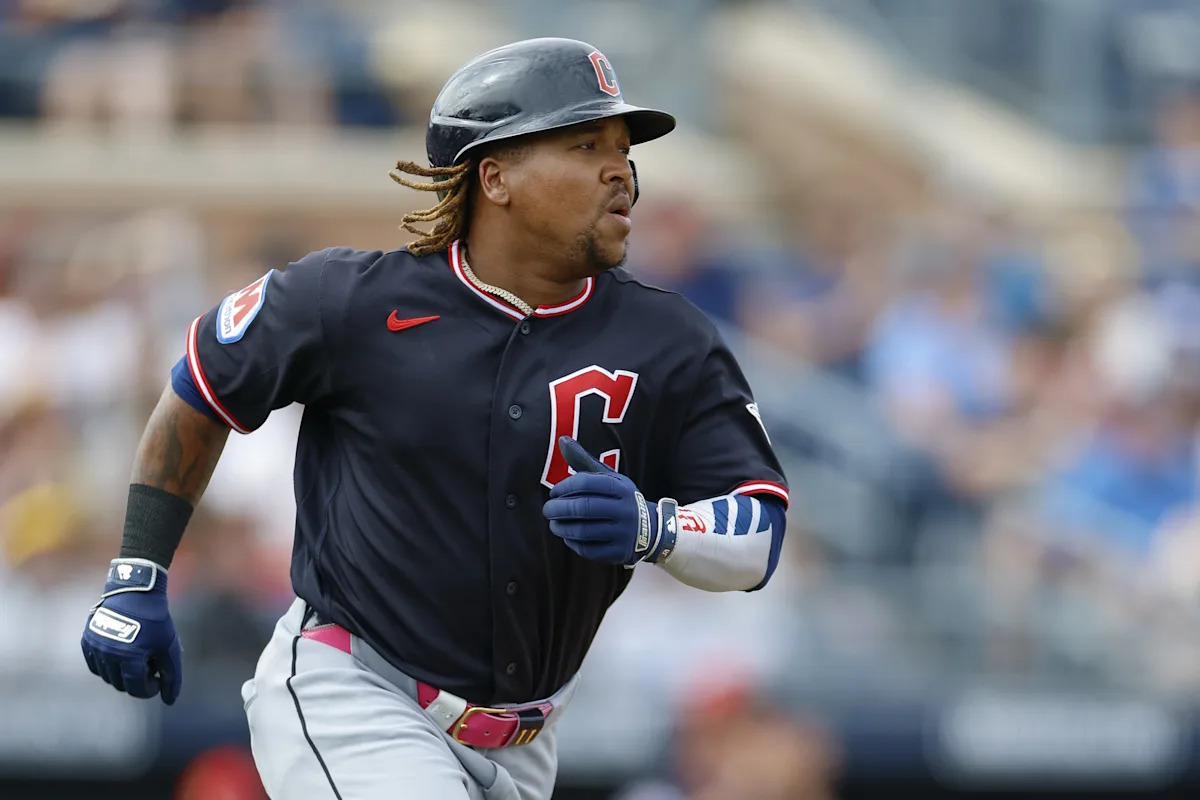
On the other side is the anemic offensive cast around Jose Ramirez. Last year, only one team – the Pittsburgh Pirates – had a lower team OPS. Even including Ramirez and Steven Kwan, their teamwide OPS was .670; Javy Baez had a .680. That says a lot. It’s also new for Cleveland. A traditional “scrappy” Cleveland team is more like the 2024 iteration, which posted an OPS of .702 in a year league average was .711. They’re usually respectable, or at least good enough to support an excellent pitching staff buoyed by a pretty good defensive squad behind them. Last year, though, everything fell apart, and the projection systems don’t really believe in a big bounce back for the team. Investing more than $4M to bring back Austin Hedges would certainly have helped; right now, it’s mostly the same team as 2025 but a year older, which doesn’t feel too smart.
As you probably expected, the lineup dries up quickly behind Ramirez. Kwan and Kyle Manzardo are about as good as it gets. After that, it’s a glove first catcher in Bo Naylor, an oft-injured rookie in Chase DeLauter, and non-roster 1B Rhys Hoskins, and that’s before we get to the really bad part. This is, essentially, a team that had multiple starting roles filled by guys who hit like Jake Rogers, made the playoffs anyways, and is running it back. Some of them will accidentally BABIP their way to better results, and a few will legitimately improve over the winter, but make no mistake, this is not a good offense. Whether it’s somehow good enough, we won’t know until much later.
X-Factor: David Fry and Gavin Williams
Tigers fans should be very, very familiar with David Fry. I won’t clip that 2024 home run, but we all remember it. In 2024, Fry was a slugging utility hitter who could hold his own behind the plate and frequently landed in the middle of Cleveland’s lineup. Last year, though, everything went wrong. He started the year on the IL after offseason UCL surgery, then his offensive game collapsed when he returned. His strikeout rate ballooned to an incomprehensible 36% and his OPS dropped by over .200 points over 66 games. That wasn’t even the worst part, though; his season ended after taking a Tarik Skubal fastball to the face while attempting a bunt. He’s healthy and resumed catching this spring, so hopefully the injury woes are behind him. Projection systems can’t ignore the atrocious performance last year, but it’s easy to expect a rebound now he’s fully healthy. Cleveland could certainly use a return to form to deepen their lineup.
Gavin Williams, on the other hand, is already a pretty known quantity. The hard-throwing righty is now three years into a pattern of being a little too erratic and not striking out as many batters as the raw stuff would suggest. He’s already a good starter, but he also represents Cleveland’s best bet at getting top of the rotation results from any of their starters. Williams learning to weaponize his high-octane stuff a bit better could turn Cleveland’s rotation from a deep one without any singular stand-out to one of the better units across the league. Pairing that with the already-excellent bullpen would create a solid run prevention unit that might help paper over the gaps of a weak lineup.
Overall, Cleveland rates as a budget version of the Kansas City Royals. Their superstar offensive player is on the wrong side of 30, they have offensive holes both larger and more widespread than KC’s, their rotation currently lacks a front end presence, and their upcoming prospects are less likely to really revamp their lineup, though they could add some much needed thump. The bullpen is a separating factor even after losing Emmanuel Clase to his gambling scandal, but also the least consistent element of a team year to year. If things break right with their prospects and a few key arms step forward, Cleveland could pose a real threat, but right now, I can’t really see it. Maybe they’ll magic their way to another 85+ wins, but that shouldn’t be how things work out. It’s baseball, though, so anything can happen; I just have Detroit as a solidly better team across the board.
Read the full article here