





If you’re new to these parts — “these parts” being the generic internet space surrounding the San Francisco Giants — then you’ll need to familiarize yourself with the lingo. Namely, one phrase: a “Webbing.”
A Webbing is the tragic sequel to a Caining, wherein a star Giants pitcher — first Matt Cain, now Logan Webb — pitches excellently, suppresses runs, and loses thanks to an inept offense. Last year, for instance, Webb allowed two or fewer runs a staggering 21 times, yet the Giants managed to lose seven of those games … and he was even tagged with the losing decision on three occasions.
That did not happen on opening day. San Francisco’s anemic offense was spared the embarrassment of a Webbing due to Webb’s uncharacteristic struggles against the New York Yankees. So Webb’s second start of the year, on Tuesday against the San Diego Padres, offered an opportunity for redemption and equilibrium. It seemed we were destined for our first Webbing of the year.
Instead, we were treated to something much rarer, and so much more delightful: the Reverse Webbing.
A Reverse Webbing, if you couldn’t deduce it, is when Webb doesn’t pitch to his brilliant standards, but it doesn’t matter because the offense displays so much vim and vitality* that the Giants cruise to victory nonetheless.
*I just wanted to see if my CMS would allow me to follow “vim and” with a noun other than “vigor.” WordPress wouldn’t let me pick a non-V word, but once I got the V in there it let me pick a new noun to pair with vim. Just workshopping. Like and subscribe for more experimental word pairings. And now, back to your regularly scheduled programming.
San Francisco’s offense, which was non-existent in their first two games, lifeless in their third game, and just barely functional enough to survive in their fourth game, finally broke out properly. And they wasted positively no time doing so.
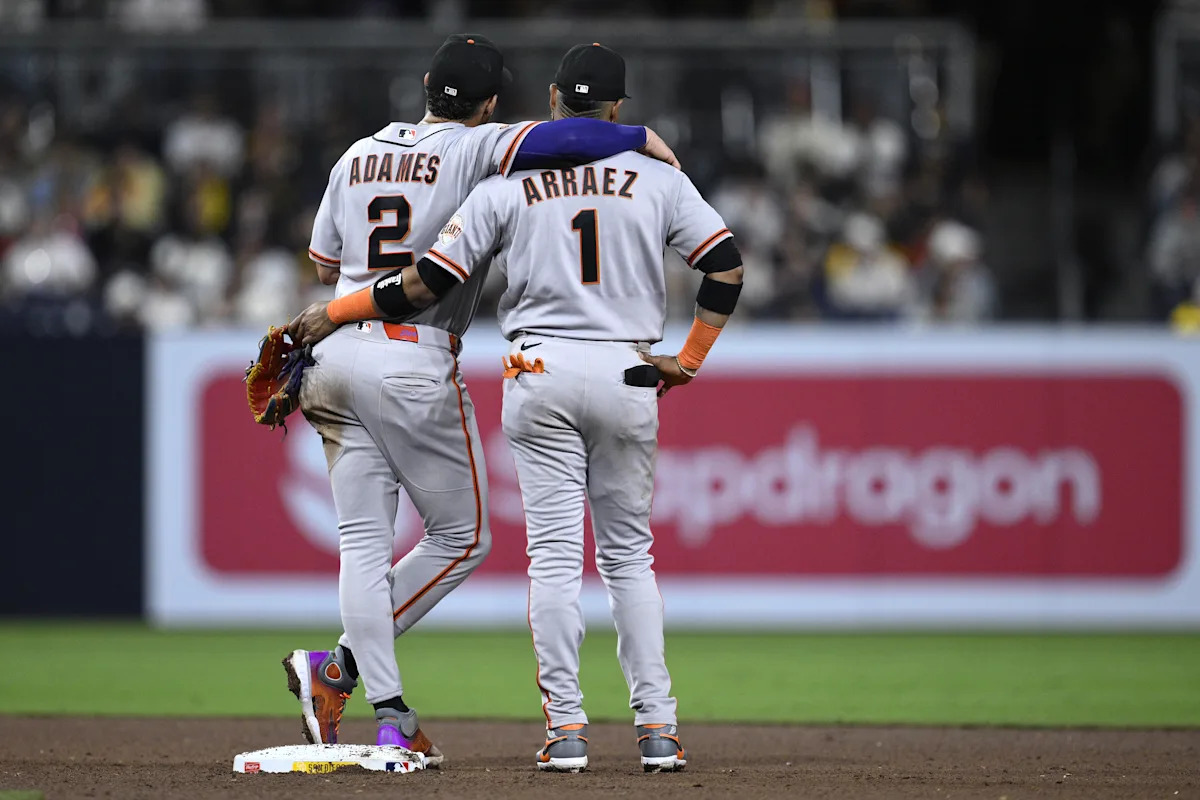
On just the second pitch of the game, Willy Adames — mired in another early-season slump — put the Giants on the board. Old friend — and I really do mean “friend,” given his bloated ERA when facing San Francisco — Germán Márquez dropped a meek curveball right into the zone where hitters salivate, and Adames made him pay, with the first home run of the year for the reigning 30-homer streak buster (working title).
View Link
But the Giants were not done. On Monday, they had their first multi-run inning of the year, and the taste was fresh in their mouth. Armed with the knowledge that such an activity was legal, the Giants set about rallying. With one out, Heliot Ramos drew a walk. With two outs, Matt Chapman hit a single.
And then came Jung Hoo Lee who, like Adames, has been stuck in a painful slump to start the year, and who, like Adames, broke out with a superstar game. It started with a dose of two-out magic, on a virtually identical pitch to the one Adames had punished. It wasn’t an identical result, as Lee’s fly ball to right field stopped a foot or seven shy of clearing the wall, but it did clear the bases, and left the lefty standing on second with a two-run double.
View Link
The Giants had scored three runs in a single inning, after entering the game with just four runs in as many games.
But it became clear in the bottom half of the inning that three runs — unlike on Monday — probably wouldn’t be enough. It was clear that Webb didn’t quite have full control of his pitches. He kept runs off the board in the first inning — no small thing, given that opening frames are his Achilles heel — but it wasn’t particularly pretty, as he worked around a Fernando Tatis Jr. double and a Jackson Merrill walk, while missing the strike zone on 10 of his 21 pitches.
To make matters worse, the Giants spent the next half-inning trying to convince you that their first-inning showing was merely a ruse. Casey Schmitt, Adames, and Rafael Devers strung together back-to-back-to-back one-out singles to load the bases, putting a runner 90 feet away from home with less than two outs. The Giants were staring at a glistening opportunity to prove to you that they were not back on their 2025 BS, and instead had metamorphosed into a team capable of basic situational hitting competency.
Instead, Ramos popped out and Luis Arráez flew out, and the Giants went home empty handed. Webb, meanwhile, returned to the mound for a fairly similar second inning: no runs, but 22 pitches thrown, 10 of which were balls (well, technically, all 22 thrown pitches were balls, but only 12 of those balls were strikes).
The third inning tore us in both directions. It started the way the first did: with a leadoff home run from a scuffling star. This time it was Chapman, who worked the count in his favor before Márquez crossed the plate with a fastball right in Chappy’s happy zone, and it was launched deep into the Southern California air.
View Link
With that, the Giants had matched their season’s run total in just the opening third of the game, and gifted their ace a 4-0 lead. But it was in that same inning that Webb’s lack of sharpness finally caught up to him.
After retiring Jake Cronenworth to open the inning, Webb issued back-to-back five-pitch walks to Tatis and Manny Machado, as life returned to Petco Park. Merrill, who possesses the type of ownage against Webb that makes you question everything you know about baseball, blistered a single into right field, scoring a run and getting San Diego on the board.
What followed was the rare baseball play where you can see, in real time, an exact moment where a manager helps his team in a quantifiable way. After Xander Bogaerts worked the count full, first-year manager Craig Stammen had Merrill take off for second. Bogaerts rolled the ball directly to his counterpart Adames, but with Merrill on the move, the only play was at first. Rather than an inning-ending double play, it was an RBI fielder’s choice, and one that kept the line moving so that Miguel Andujar could cap a three-run inning with an RBI single.
The Padres had pulled within a run, and it was another long, ball-filled inning for Webb, who missed the zone on 12 of his 25 pitches. He just didn’t quite have it, and it would be up to his offense to star.
His offense starred. They didn’t stop with those four runs, and instead added four more in the sixth inning. First they flirted with another frustrating inning, after Harrison Bader led off with a double and Patrick Bailey drew a walk, but Casey Schmitt failed to get down a bunt before ultimately striking out.
But Adames would not let it be. The shortstop was deep in his bag, as the basketball writers say (not that I know anything about them), and singled home a run as part of a 4-5 day that finished a triple short of the cycle.
View Link
The insurance run was in, but the Giants weren’t done. In a comical but mesmerizing scene, Devers absolutely tore down the first base line to leg out an infield single, which brought up a situation that can either be tragic or deeply satisfying: the revenge at-bat.
Yes, for the second time in the game, Ramos stepped to the plate with the bases loaded and just one out. There would be no soft pop-out this time. Instead, Ramos jumped on a Bradgley Rodriguez sinker that found the heart of the plate, skillfully taking it the other way and through the hole, plating a pair of runs with a single.
View Link
The route was on, but not over. Thanks to Devers making it to third on Ramos’ single, Arráez could — and would — knock in the fourth run of the inning with a sacrifice fly, and then start a final rally in the ninth inning, when he bopped a leadoff single, and was pinch-run for by Jared Oliva. Doing exactly what he’s on the roster to do, Oliva easily stole second base, prompting a throw into center field that allowed him to take third. With two outs, Lee missed his third double of the day by about two feet … then settled right back in and blooped an RBI single.
View Link
San Francisco’s offense had done what it set out to do, and it had taken all the pressure off of Webb, giving him nine runs — something they achieved in just three of his 34 starts a year ago. And yet, while the offense justifiably was the star of the show, Webb quietly went about reversing his own fortunes as well.
After those three stressful innings in which he gave up three runs, struggled to find the strike zone, and saw his bullpen get loose in the third inning, Webb settled back into the ace that we all know and love. He set down the side in order in the fourth inning, needing just 13 pitches. He showed off his newfound strikeout stuff (Est. 2025) with a thoroughly dominant fifth inning, in which he struck out Tatis on four pitches, struck out Machado on four pitches, and then struck out Merrill on three pitches, finishing just two balls shy of an immaculate inning.
View Link
And in the sixth — an inning it once seemed impossible that he’d make it to — he got back to his old tricks, forcing three ground balls and giddily watching as the left side of his infield casually and artfully ate them all up.
It was a remarkable display of turning things around, as Webb, despite giving up three hits and four walks, retired the final 10 batters he faced. Webb said after the game that he made mechanical tweaks late in the start, while Tony Vitello summed it up nicely, stating, “That’ll be one of my favorite outings of the year even though you could take a step back and say it was one of the uglier ones too.”
In the end, the 9-3 victory was the best-case scenario. The offense broke out, and showed Webb that they can carry him. He doesn’t need to do all the heavy lifting. And yet, along the way, he rediscovered his ability to do so.
Can’t ask for much more than that.
Read the full article here


