

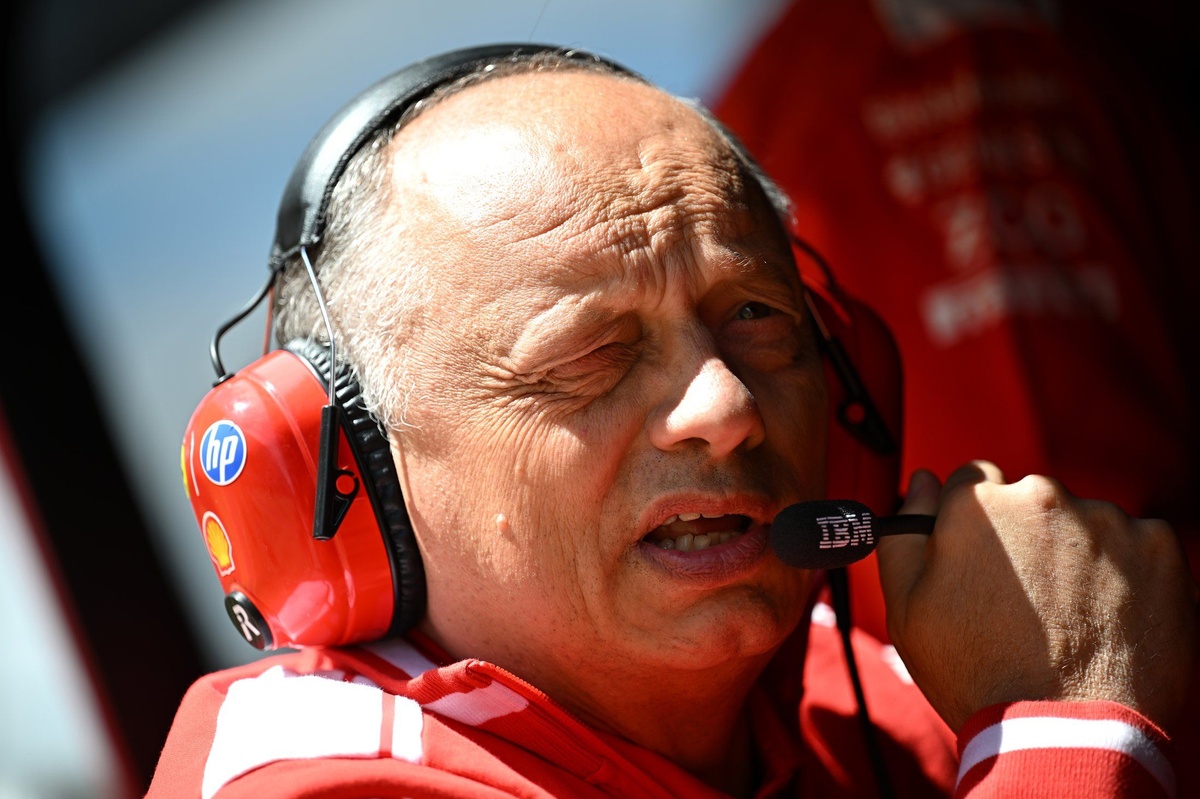
Fred Vasseur does not deny that there were things to clear up between Charles Leclerc and Lewis Hamilton at Monza and the Ferrari team principal has spoken to both drivers after the Italian Grand Prix, addressing what happened on track as well as some of the comments made.
What Vasseur does reject, however, is the scale the situation has taken on, with the episode becoming, within a matter of days, evidence of supposed tension within the team.
“We had some good meetings with Lewis and Charles,” Vasseur told Autosport. “They cleared things up together and I reminded them of some fundamental principles of the way I manage the team. And I will continue to stick to them.”
The point the Scuderia boss is making goes beyond what happened at Monza. Vasseur wants his drivers to accept their share of the responsibility for protecting the work of the team, in the same way that he says he does whenever something goes wrong.
“I reminded Lewis that when we won the race in Melbourne two years ago thanks to the strategy, I sent Ravin Jain onto the podium because it was right that he got the recognition. When we lost a race because of strategy, I went in front of the TV cameras and took responsibility,” he said.
“My job is to protect the hundreds of people in the team and to take responsibility. That is what I have asked the drivers to do as well: if we want to achieve results, we need to protect the team and each of us needs to take responsibility.”
Charles Leclerc, Ferrari, Lewis Hamilton, Ferrari
Photo by: Sam Bloxham / LAT Images via Getty Images
Vasseur won’t silence his drivers, but felt criticism was overblown
It is not a request for silence. Vasseur is not asking Leclerc and Hamilton to stop being critical, but he stresses that a comment made in front of the media can carry far more weight than the person making it may have intended.
“I’m not asking them not to be open or not to be tough. But very often they are much calmer with us than they are when they go and speak to the press,” Vasseur explained. “Lewis told me: ‘Fred, 80% of my message was positive and they took the 20% that was negative.’ But we all know how it works. If you say the team is doing a good job and then add a ‘but’, that is the part that will become the headline. It’s part of the game.”
This is where Vasseur connects the issue to the narrative that, in his view, developed after Monza. The two Ferrari drivers came close to making contact, Hamilton was aggressive and Leclerc subsequently admitted his own mistake. But what began as an on-track incident quickly turned into questions over the management of the drivers and even the stability of the Scuderia’s leadership.
“Charles, after the discussion, said: ‘I was too aggressive.’ And for me, that’s fine. When Kimi was fighting with Russell he ended up in the gravel, just as Lewis did at the start,” Vasseur countered. “But in our case, we moved very quickly from an incident on track to talking about a crisis in the way the drivers are being managed. I think the two things need to be kept in the proper perspective.”
Ferrari gives drivers principles to follow but no rules of engagement
On the subject of “rules of engagement”, Vasseur also rejects the idea that Ferrari has no framework governing how its drivers race each other, and while there is no code capable of accounting for every inch of an on-track battle, there are clear principles and responsibilities.
“To say that there are no ‘rules of engagement’ doesn’t reflect reality,” he said. “You can’t expect contracts to cover every possible scenario you might encounter on track, because inevitably everything would become a matter of interpretation. ‘I was there’, ‘no, you were five centimetres further back’ — you don’t solve anything that way. The principles are clear and the drivers know them.”
Ferrari’s philosophy remains unchanged: two number-one drivers and equal treatment. A hierarchy may eventually be established when the championship standings make it clear that one of the two no longer has a realistic chance, but not before then.
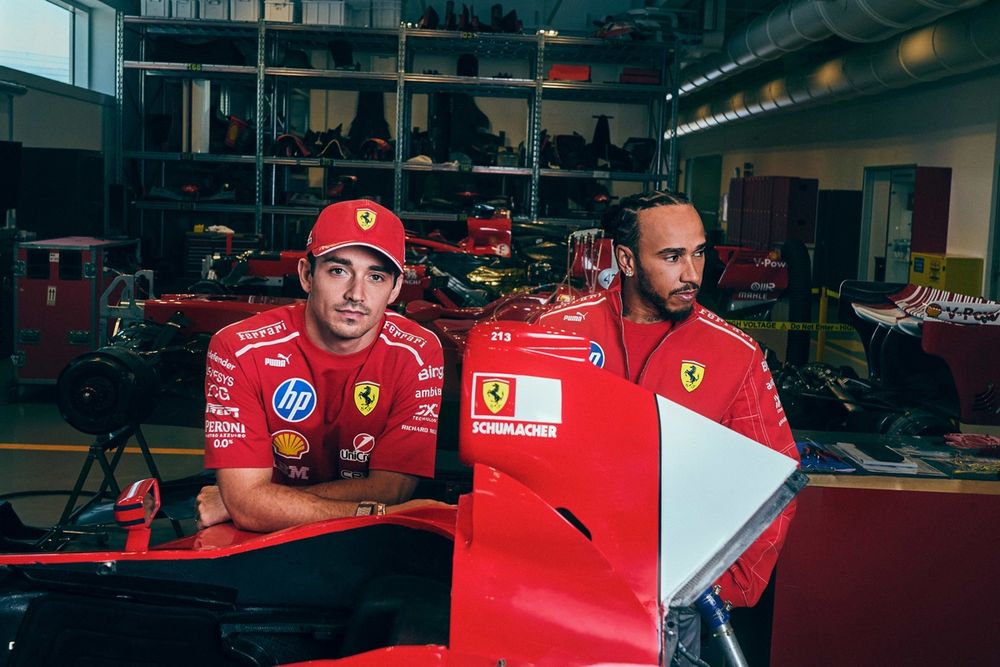
Lewis Hamilton, Charles Leclerc, Ferrari
Photo by: Ferrari
“Ferrari drivers can count on equal treatment, then there may come a point when we have to make a decision if one of them is out of the fight,” Vasseur said. “In that case, it will be my decision. But until that moment, the treatment will be equal.”
Vasseur points to the previous season as an example, when Piastri arrived at Monza with a lead of more than 30 points over Norris, and McLaren asked Piastri during the race to hand second place back to Norris.
“Imagine if McLaren had decided to put everything behind Piastri: perhaps Verstappen, who finished three points behind Norris, could have become champion,” he explained. “That’s what I told our drivers. We’ll make a decision when we’re closer to the end, why not? But today there isn’t even anything to discuss.”
Vasseur defends Ferrari engine upgrade
Another point Vasseur raises concerns the technical assessment of Ferrari. The ADUO 2 introduced by the Scuderia at Monza has, in some quarters, been portrayed as an upgrade that failed to deliver the expected results. The team principal believes that conclusion is wrong because it fails to take into account how differently engine power affects lap time from one circuit to another.
“I know it’s difficult to understand at first glance, but anyone with some technical knowledge knows exactly what I’m talking about,” Vasseur explained.
“Let me give you an example: at a circuit like Zandvoort, a power deficit of X horsepower might cost you three tenths. If we improve the performance of that engine to the point where we reduce the power deficit by a third, then go to a circuit like Monza, we may find that the lap time gap to our rivals, instead of getting smaller… gets bigger.
“That doesn’t mean the ADUO isn’t working. Even if you make a step forward of several horsepower, at Monza you can still be further away from the benchmark than you were at Zandvoort.”
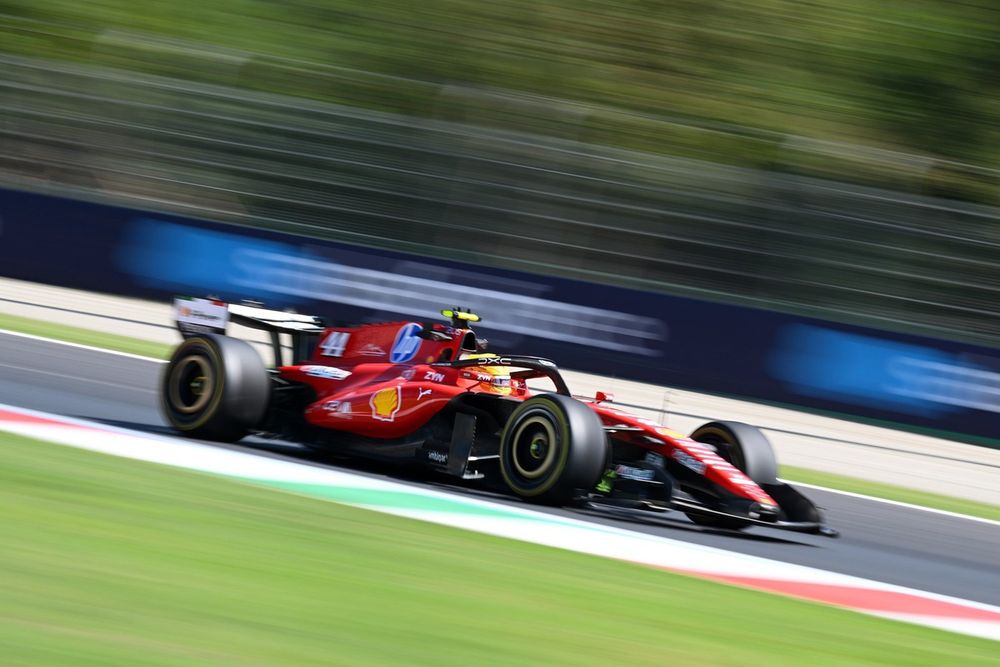
Lewis Hamilton, Ferrari
Photo by: Manuel Eletto / Getty Images
Behind the numbers, there is above all an issue that Vasseur considers important: respect for the work being done at Maranello.
“When I read that ‘the ADUO isn’t working’, I find that disrespectful towards the people working on the engine because it doesn’t reflect reality,” he said.
Embracing the pressure of being Ferrari boss
The Frenchman knows that being in charge of Ferrari means living permanently under a microscope. Speculation about his future has resurfaced periodically, just as it did last year, when rumours of a possible departure were circulating even though his contract extension had already been agreed.
“Somebody says I’m going to be fired this weekend, or that I was fired last night,” he said. “We’ve won two races, we can win more, and we have a clear idea of how to make further steps forward. That’s where I’m focusing my energy. Being under pressure is part of my job. It’s not something I want to waste energy on.”
Asked whether he sometimes feels “alone” in his position, Vasseur firmly rejected the suggestion.
“First of all, it’s not for me to underline whether or not I have the support of the chairman, but the communication channel is constantly open and constructive,” Vasseur affirmed. “On top of that, at almost every race weekend we’ve had representatives of the senior management from Maranello with us, from John Elkann to Benedetto Vigna and Piero Ferrari. I think that’s a really positive sign for everyone working in the team, both at the track and in Maranello.”
The pressure, nevertheless, remains. And Vasseur appears to have no intention of trying to escape it. It comes with the role of leading Ferrari. What he asks is that criticism remains criticism and a racing incident remains a racing incident, rather than every episode being turned into a symptom of a wider crisis.
We want to hear from you!
Let us know what you would like to see from us in the future.
Take our survey
– The Autosport.com Team
Read the full article here