

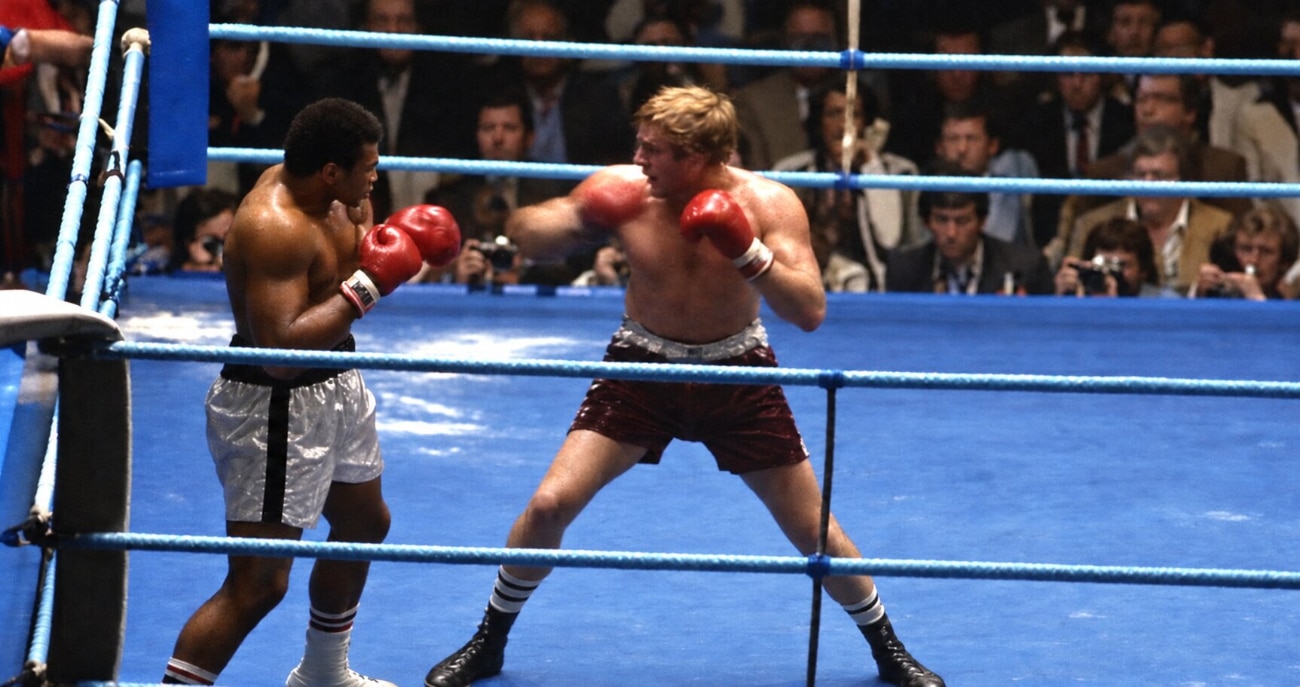

Both stood 6’3″, but nearly everything else separated them. Ali traveled with an international promotional circus and commanded million-dollar purses. Dunn was a former paratrooper and working scaffolder who balanced his trade with professional boxing. Their meeting was not part of the original plan.
German promoters anticipated that Bernd August would win the vacant European championship and provide Ali with a German challenger. Dunn ruined the arrangement by stopping August in the third round at London’s Royal Albert Hall seven weeks before the Munich date.
That victory sent Bradford’s working-class champion into a fight with the most famous athlete in the world.
Dunn was Ali’s third championship opponent in barely three months. Ali stopped Jean Pierre Coopman in February, struggled through 15 rounds with Jimmy Young in April, and returned against Dunn only 24 days later.
The champion traveled between Puerto Rico, Maryland, and West Germany while completing three training camps and fulfilling three promotional commitments. Money helped drive the pace. His large entourage, expensive lifestyle, and business obligations required a steady supply of purses.
Ali’s performance against Young showed what the schedule was costing him. He looked slow, poorly conditioned, and frustrated as Young made him miss before leaning through the ropes to escape exchanges.
The judges awarded Ali a unanimous decision, but the scores did not erase the criticism. Young had exposed how much of the champion’s timing and movement had disappeared since his physical peak.
Munich gave Ali an opportunity to look dominant again. Dunn held three respected championships, but his direct, aggressive style offered fewer complications than Young’s movement and defensive tricks.
The promotion struggled before either boxer reached the ring. A dispute involving $225,000 from Ali’s purse and German taxes placed the event in danger only days before the fight.
A late compromise kept the card alive. Ali’s purse was reported at approximately $1.6 million after adjustments, while Dunn received about $100,000, easily the largest payday of his career. Ali also helped cover a shortage in the challenger’s money.
The champion spent another $100,000 purchasing 2,000 tickets for American servicemen stationed near Munich. Even that gesture did not rescue the live gate.
The main event began around 3 a.m. local time to place it on NBC during American primetime. That decision served the television audience but punished German ticket buyers. High prices and the brutal starting hour helped leave thousands of seats unsold.
Roughly 11,000 people were inside the 12,700-seat Olympiahalle, but about 4,000 reportedly attended with complimentary tickets. Estimates placed the promoters’ losses between $300,000 and $500,000. Ali and Dunn received their money. The local backers were left with the bill.
Ali frequently described southpaws as awkward opponents. Karl Mildenberger had given him uncomfortable moments from the left-handed stance during their 1966 championship fight, creating the belief that the alignment itself caused Ali trouble. Dunn demonstrated the limits of that theory. A southpaw stance changes punching angles, but it does not automatically provide timing or defense. Dunn approached Ali upright, followed him instead of cutting off the ring, and often began his attacks with looping punches.
Those wide shots gave Ali time to recognize what was coming. Dunn also advanced without consistent head movement, leaving a direct lane for the champion’s right hand.
A quicker and more deceptive southpaw might have punished Ali’s low left hand and tendency to pull away from punches. Dunn lacked the speed and disguise required to take advantage. His stance altered the angles, but his technical flaws gave Ali the solution.
Ali waited for Dunn to square himself and drove short rights through the opening. The fight showed that his difficulties were not caused by southpaws alone. They came against opponents who knew how to use the stance.
Dunn pressed forward from the opening bell and tried to force a physical contest. His activity kept Ali from treating the bout as an exhibition, but much of his work struck gloves, arms, or empty space.
The challenger’s bravery soon worked against him. He continued marching forward after Ali established his advantages in speed, timing, and power. Instead of changing his approach, Dunn kept presenting the same openings.
Ali was more than 10 pounds lighter than he had been against Young. He remained heavier and less mobile than the dazzling fighter of the 1960s, but the lower weight helped him look sharper.
The champion stayed patient during the early rounds, studied Dunn’s attacks, and gradually began sitting down on his punches. Once he committed to the right hand, Dunn lacked the defensive reactions to protect himself.
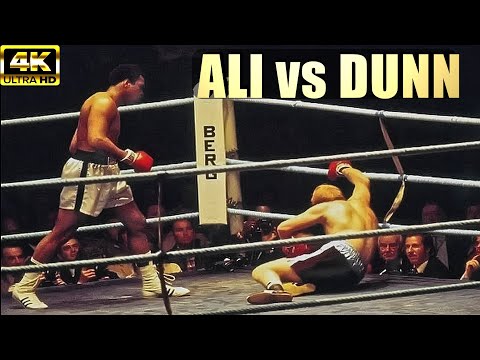
Ali dropped him three times in the fourth round. Each knockdown exposed the difference between determination and defensive ability at championship level.
Dunn rose from another knockdown in the fifth, but a short right sent him to the canvas again. Referee Herbert Tomser stopped the fight at 2:05 as Ali theatrically wound up his right arm from a neutral corner.
Ali later credited taekwondo instructor Jhoon Rhee for teaching him the short right used in the finish. Rhee called it the “AccuPunch” and said its quick delivery was based on a technique Bruce Lee had shown him.
The punch was designed to remove the physical warnings that normally precede a power shot. Instead of drawing back the hand or first rotating the shoulder, the boxer sent the fist directly toward the target and brought the rest of the body behind it.
That approach suited the opening against Dunn. The challenger was advancing with his head high and his guard separated. Ali released the right from close range before Dunn recognized the attack.
The exaggerated arm motion came afterward, when Ali knew the contest was finished and began performing for the crowd.
It gave him the 37th knockout of his professional career. Ali never stopped or officially knocked down another opponent.
The Dunn victory was the last time Ali increased the pressure, repeatedly floored an opponent, and ended a fight before the final bell.
His later victories depended more heavily on endurance, clinching, defense, and carefully rationed attacks. Ken Norton forced him through another punishing 15 rounds. Earnie Shavers hurt him badly before Ali rallied in the final round. Leon Spinks outworked him in their first fight and pushed him through 15 more rounds in the rematch.
Ali retained the ability to produce combinations and fight through exhaustion, but he was no longer an offensive finisher. His legs moved less, his punches carried less force, and too many rounds were spent on the ropes while opponents worked.
Dunn became the final opponent Ali was able to erase once he decided to attack.
Ali had little time to recover. Just 33 days after beating Dunn, he faced Japanese professional wrestler Antonio Inoki in a mixed rules exhibition at Tokyo’s Nippon Budokan.
Inoki spent much of the 15-round contest on the canvas, repeatedly kicking Ali’s legs while remaining outside punching range. Ali absorbed more than 100 kicks and left with severe swelling, bleeding, an infection, and two blood clots.
Three months later, he defended his championship against Norton at Yankee Stadium and escaped with a disputed decision after another exhausting 15 rounds.
The sequence captured the reckless pace of Ali’s career. He fought Young in April, Dunn in May, Inoki in June, and Norton in September. His body received little opportunity to recover between major events.
Thousands of people lined the streets of Bradford to welcome Dunn home. They honored a working scaffolder who had risen to challenge the most famous boxer in the world.
His championship run ended five months later when Joe Bugner stopped him in the first round. Dunn retired after a 1977 knockout loss to Kallie Knoetze.
The Munich promotion lost money, but the fight gained historical importance. Dunn became the final opponent Ali stopped, permanently linking the Bradford heavyweight to The Greatest.
Read the full article here