

A few weeks ago, I decided that there had to be a better way to figure out which baseball players were making meaningful changes to their approach. I used tools like Process+ and the Statcast rolling leaderboards, but I wanted to try to spot trends or changes before they led to clear performance boosts, and everybody in my leagues was adding the player I was researching. So I built a database.
I’m not a coder by nature, so I will admit to using AI for help with the coding, but the design was something I had been thinking about for a while. I took some of my preferred indicators that could be used to spot shifts in performance and added them to a database. That included results-stats like exit velocity and barrel rate, or velocity increases and usage changes for pitchers. It also included process-based stats like swing rate, chase rate, pull air rate, two-strike usage for pitchers, etc., and it also included biomechanical indicators like arm angle for pitchers or batting stance changes for hitters. I then had the database set up to flag any meaningful changes across segments of 50 plate appearances (or about three starts for a starting pitcher).
What that led to was me having an evolving database of hitters and pitchers who were doing new things that deserved my attention.
Now, some of it was not as useful. You can have pitchers who stop using a pitch for two starts because of hitter handedness, or you can have a hitter who has a surge in barrel rate without anything else changing in their process or swing mechanics. However, by having something flag these names for me, I’m able to dig into each name and see if there is something tangible happening under the hood.
As a result, I can now share some of those changes with you. Hopefully these types of articles are interesting to you, and I can continue to do them for pitchers and hitters through this season and into next season. Today we’re just going to look at hitters who stood out to me.
Fantasy Baseball Hitter Performance Changes
Alex Bregman – 3B, CHC (New Swing Plane, Approach Change)
Back on August 13th, I recorded a video on Bregman’s three-home-run game and mentioned that Bregman had started to make some clear approach changes starting around July 11th. Since then, Bregman is hitting .291/.365/.582 in 39 games with 12 home runs, 34 RBI, a 15.7% strikeout rate, 7% barrel rate, and 49% pull rate. That has come with a 13-degree attack angle that’s down from 15 degrees prior to July 11th, which means the sweet spot of his bat is coming through the zone a little flatter since he made a conscious swing change. There’s a good video on Instagram from Flips Baseball, but Bregman also mentioned that his hips and shoulders were not in sync. According to Stacast’s new Swing Timing leaderboard, 71% of Bregman’s swings since July 11th have been on time. That’s 45th in all of baseball. He was at 67% before the mechanical adjustment. It doesn’t seem like a major thing, but when a veteran hitter tells you they’re working to adjust their mechanics and then you see minor changes and major results shift, you have to pay attention.
Wilyer Abreu – OF, BOS (Increasing His Pull Air Rate, and Swinging Less)
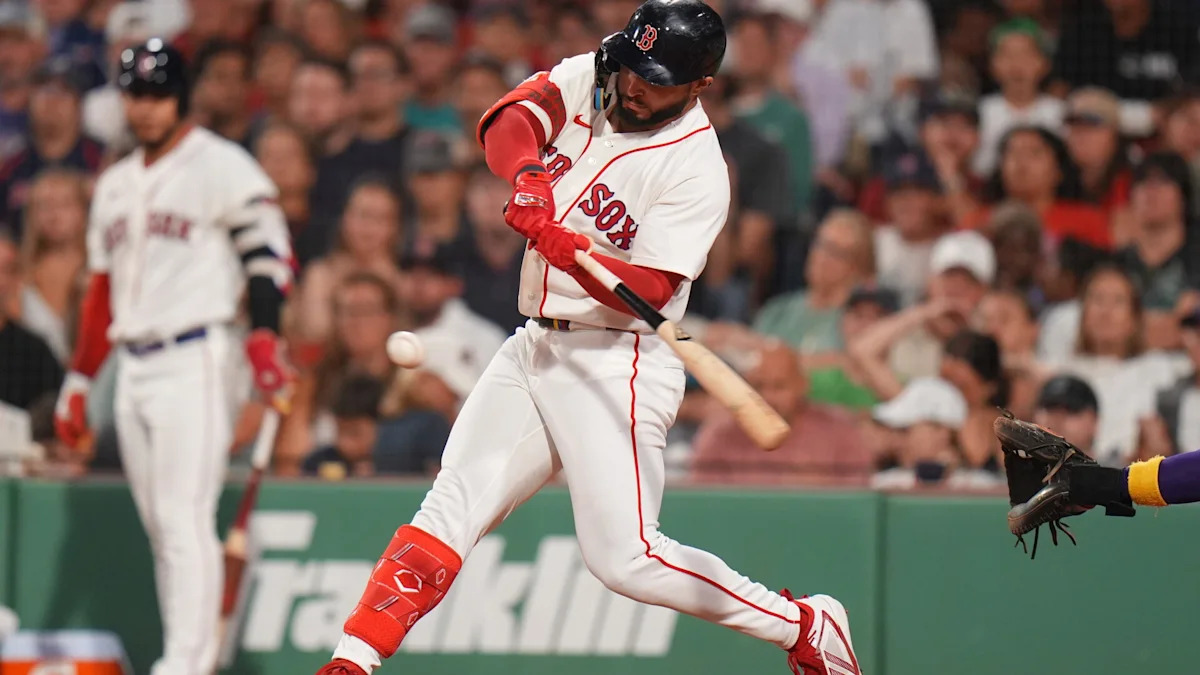
At the beginning of July, Wilyer Abreu was hitting .268 with 10 home runs and just a 19.5% strikeout rate in 82 games. Even though the overall production was solid, his power production was not what we’ve come to expect. He had just an 8.5% HR/FB rate at that point in the season after posting a 15.2% mark in 2025. Well, from the start of July on, Abreu has seen his hard-hit rate skyrocket (see graph) and his HR/FB rate has exploded to 18.2%. A big reason for that is that Abreu has raised his pull air rate from 17.2% heading into July to 22% from July 1st on. He’s also swinging less overall, lowering his overall swing rate from 49.7% heading into July to 45.7% from July 1st on. His batting average may be just .236 since July 1st, but he’s hitting for far more power and has the second-best wRC+ on the Red Sox since then.
Fernando Tatis – OF, SD (Changed His Batting Stance, Bat Speed up, Pull Air% Up)
Remember back when we were talking about how Fernando Tatis Jr. couldn’t hit home runs? Yeah, me neither. The outfielder has been on fire lately, and some of that boost in production could be tied to a stance change. As you can see from the graphic below, Tatis drastically opened his stance in June, opening up his feet 21 degrees and then opening his stance even more in August.
The reason we should care about this is that the stance change occurred at the same time that Tatis Jr. started to pull the ball more, pull the ball in the air more, and swing the bat faster. All of that tells me that opening up his stance allows him to clear his hips more quickly and turn on the ball more efficiently. At the end of May, Tatis had a 31.3% pull rate, a 25.5% fly ball rate, a 53.3% ground ball rate, a 7.8% Pull Air%, and a 9.6% barrel rate, with an attack direction three degrees to the opposite side. From June 1st on, Tatis has a 44.2% pull rate, a 36% fly ball rate, a 46.6% groundball rate, a 14.5% Pull Air%, and a 14.5% barrel rate with an attack direction that’s just one degree to the oppo side. He’s also continuing to make these changes since both July and August have actually seen his attack direction shift to one degree to the pull side, and Tatis Jr. has a 23.4% Pull Air% in August.
All of which is to say, Tatis Jr. opened up his stance, started turning on the ball more and hitting it harder, and the results have followed.
Luke Keaschall – 2B/OF, MIN (Change in Groundball Rate)
From July 1st on, Luke Keaschall is hitting .315/.414/.497 with six home runs, 20 runs scored, and 16 RBI in 44 games. That’s come with just a 31.7% hard-hit rate and 4.8% barrel rate, but Keaschall had just a 3% barrel rate and 31% hard-hit rate through the end of June, when he hit .245/.328/.317 in 81 games. One of the bigger changes has been that Keaschall’s groundball rate was 37% and his pull rate was 38% through the end of June. Through the end of May, the groundball rate was 43%, and the pull rate was 35%. From July 1st on, he has a 32.5% groundball rate and 46% pull rate, so he has continuously been getting the ball off the ground and getting it to the pull side more often. That’s likely why his ISO rose from .072 at the end of June to .181 from July 1st on.
Luis Robert Jr. – OF, NYM (Zone Swing Rate, Pull-Side Contact)
In August, Robert Jr. is hitting .302/.352/.603 with six home runs, 11 RBI, and an 18.8% barrel rate. Injuries had obviously impacted his season before then, but in 134 plate appearances before August, he was hitting .195/.291/.322 with four home runs. Over this stretch in August, Robert’s bat speed is up one mph, but it was already 76.7 mph prior to August. He is intercepting the ball six degrees to the pull side, which is up two degrees, but he has also gotten more aggressive in the zone. Robert Jr. has increased his overall swing rate by 1.8% in August, but his chase rate has fallen from 35.1% to 31.9%. That means his zone swing rate is up from 65.5% to 74.4%. That’s a pretty major increase. By being more aggressive in the zone and getting the ball out in front a little more, Robert Jr. is having easily the best month of his season.
Matt McLain – 2B, CIN (Moving Deeper in the Box, Opening Stance)
Matt McLain has been subtly moving deeper in the box and opening his stance as the season has gone on. I’m not sure that’s the right course of action, and not just because the results haven’t gotten any better. McLain has really struggled with pitches on the outside this season. On pitches away, McLain hits .139 with an 85.6 mph average exit velocity and a 34.1% hard-hit rate. On pitches everywhere else, McLain hits .228 with an 86.6 mph average exit velocity and a 41.6% hard-hit rate. What’s more glaring is that his contact rate on pitches away is 65.8%, but it’s 81.2% on pitches anywhere else in the zone. His whiff rate also rises from 18.8% to 34.2%. I’m not sure that opening up his stance more is going to help him do more damage on pitches on the outside part of the plate.

Garrett Mitchell – OF, MIL (Batting Stance Change, Zone Contact Increase)
In truth, Garrett Mitchell has been making these changes for much of the season. His batting stance stayed stable through May, with roughly a 14-degree open stance and 32 inches between his feet. That shifted sharply in June and has continued to change. In August, he has a batting stance is that is 40 degrees open with just 23 inches of separation between his feet, meaning that his stance is more open and narrower. We have seen the Brewers do this before with Brice Turang and Joey Ortiz. This type of tweak is often connected to a desire to have a cleaner, more direct path to the ball or quicker rotation of the hips, as we discussed with Tatis. For Mitchell, it may have also been connected to seeing the ball better and making more contact. Before changing his batting stance, Mitchell had a 77.1% zone contact rate, but that has jumped up to 83.1% since then. It was 87.1% in July and has since trended down a bit in August, but both months have been well ahead of what we saw in the past.
Mitchell saw a spike in chase rate in June, right after making the stance change, but he has since seen both his swing rate and chase rate decline, which is in keeping with the ideal that the stance change has helped his swing decisions and contact ability. Since changing his stance, his strikeout rate has fallen from 34.2% to 28.2%, his batting average has gone from .251 to .282, and his OPS has increased from .761 to .804. Those are noteworthy and intriguing changes.
Tommy White – INF, ATH (Swing Tilt Change, Barrel Rate)
In 54 plate appearances in July, Tommy White had a 4.5% barrel rate, .604 OPS, and .038 ISO. He had hit no home runs and was batting .269. In 85 plate appearances in August, he has an 11.6% barrel rate, .648 OPS, and a .098 ISO with two home runs and a .268 average. The barrel rate jump is massive, and the ISO jump is also pretty large, even though it doesn’t take him into a territory we really like for fantasy. Under the surface, there’s also not a huge amount of change that has led to the jump in barrel rate. He’s been a bit more aggressive in the zone with a 7.1% increase in zone swing rate, and his swing is about 1.5 degrees flatter. That could contribute to the fact that his Ideal Attack Angle rate has improved from 48% to 65.3%. So, at the end of the day, Tommy White is being more aggressive in the zone and is attacking the ball from a better plane. That has led to a huge increase in barrel rate but no other major improvements yet.
Connor Norby – 2B/3B, COL (Narrower and More Open Stance)
Since coming to the Rockies, Norby’s stance has changed drastically. The 26-year-old had nearly 200 plate appearances with the Marlins in the first two months of the season. During that time, he had about 33 inches of separation between his feet and his stance was just 10 degrees open. In August with the Rockies, he has just 23 inches of separation between his feet and his stance is 31 degrees open. That’s a significantly narrower and more open stance, and he’s also standing about two inches deeper in the box.

As I mentioned above, we saw the Brewers make a similar stance change with Mitchell, Turang, and Ortiz. The general idea is that a narrower stance like that can help make it easier to keep weight on the back foot to create more power. The more open stance not only makes it easier to keep balance in the loading process, but can also make it easier to clear the hips and turn on inside pitches. That’s working for Norby, whose swing produces line drives to the gaps but a lot of hard contact the other way, which will work in Coors Field.
Since coming to the Rockies, Norby is hitting .310/.408/.571 with a 43% hard-hit rate and a two-degree attack angle towards the opposite field side. In his early-season at-bats with the Marlins, he hit .205/.313/.325 with a 36.6% hard-hit rate and a four-degree attack angle towards the opposite field. He also had a 40-degree swing tilt and a 18-degree attack angle with the sweet spot of his bat when it traveled through the contact point. Those are down to a 38-degree swing tilt and a 16-degree attack angle with the Rockies. All of which is to say that the new stance MAY have helped Norby to hit the ball harder, use the middle of the field slightly more, and also come through the zone with a bit of a flatter bat path. Or, he’s doing all of that independent of one another, which is also pretty nice to see.
Norby also did an interview with a Rockies blog where he said, “There were a lot of things I was doing in Miami that just felt like weren’t me necessarily. There were some things I was doing a lot better, and I’m carrying over. But other than that, I just needed to be me.” Maybe being him will help these results carry over.
Read the full article here