

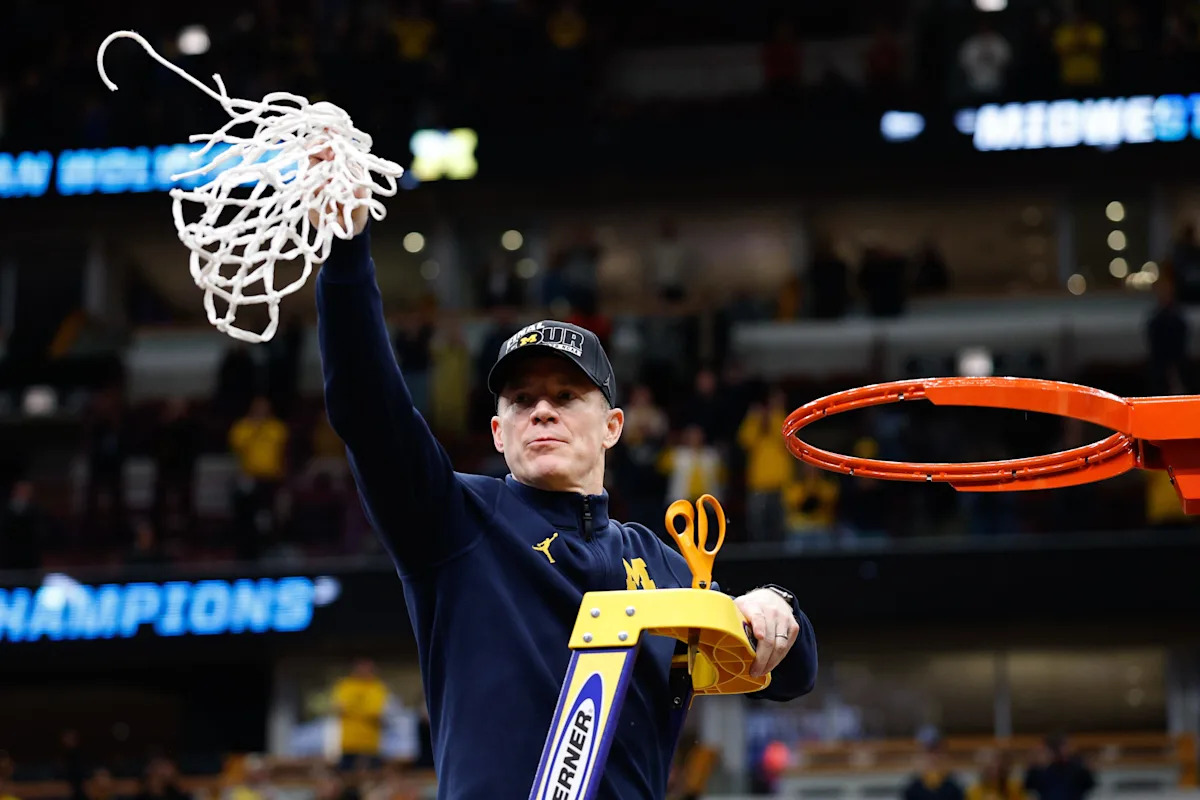
Dusty May’s One Shining Moment didn’t come with the sorts of feelings you’d expect after fulfilling a life-long dream.
After his Michigan men’s basketball team beat UConn back in early April to claim the program’s first national title in 37 years, May wasn’t overwhelmed by elation or joy when he stood at the apex of his profession. It was something much more hollow.
“I don’t know if it’s just me, but I’d heard where you climb the ladder and you say, ‘Is this really it?’ And it was worse,” May said in April to CBS Sports’ Matt Norlander. “It was less than ‘it.’”
REQUIRED READING: Days before leaving, Dusty May sounded all-in at Michigan. Then, poof!
May was speaking about the finality of a season and the bittersweet feelings that come when a championship signals the end of a journey for a team he described as “one of the most special groups of humans you’ll ever be around.”
More than two months later, though, it’s difficult not to view those comments under a different light.
On Monday, May left behind the program he had just guided to a title to take over as Dallas Mavericks coach.
While the move stunned much of the sport, if only because of the timing, it makes sense from a purely transactional standpoint.
May’s one of the brightest coaching stars at any level of the sport, someone who took Florida Atlantic to a Final Four and helped Michigan win a national championship two years after he inherited a program coming off an 8-24 season.
He’ll arrive in Dallas with a franchise pillar already in place in Cooper Flagg, the 19-year-old phenom who averaged 21 points per game as a rookie and has the potential to be one of the NBA’s best players in the not-so-distant future. Unlike many college coaches who have made the jump to the pros, May seems well-equipped for the move thanks to his tactical acumen, player development chops and, perhaps most importantly, even-keeled temperament.
The NBA’s gain, though, is college basketball’s loss. And in a sport prone to treating every move as a referendum on the health of the enterprise, it has raised some unsettling questions about what May’s departure says about college basketball in 2026.
Is his unexpectedly early exit at Michigan more than just a personal decision?
Long before “NIL” was an acronym that rolled easily off the tongue and the “transfer portal” sounded like something out of a science fiction movie, college coaches left enviable situations for the NBA, whether it was Rick Pitino, John Calipari, Brad Stevens, Billy Donovan, Lon Kruger, Mike Montgomery or Fred Hoiberg. It’s not even novel for a Michigan coach to make the leap, as John Beilein had done the same seven years ago. As much as some in the sport may long for it, the old system came with its own headaches that had successful coaches looking for greener, less tiresome pastures.
Once more relaxed transfer rules were enacted and athletes were able to financially capitalize off of their name, image and likeness, the career choices of coaches took on a different meaning. In a span of just three years, Mike Krzyzewski, Roy Williams, Jay Wright and Tony Bennett all retired, leaving behind a combined 11 national championships and a sport that was suddenly down some of its most recognizable and revered figures. In each instance, the newly instituted changes were cited as a reason for the farewells.
May, however, represents a different type of case. Unlike many of the aforementioned legends, he wasn’t in the final stages of his career after years and years at the highest level of the sport. At just 49 years old and two years into his Michigan tenure, he seemed destined to be at the center of the next generation of coaching stalwarts who could come to define college basketball in the same way that Krzyzewski, Williams and Wright did.
And, in what feels like the blink of an eye, he’s gone.
In the coming days, May will have the opportunity to delve into what motivated the move, but until then, there will be speculation about just how much college basketball’s calendar and demands played a role.
May benefited from the modern landscape as much as anyone. He coached at a massive school with an army of wealthy boosters that funded the Wolverines’ NIL endeavors. He mined the transfer portal as effectively as anyone. The top four scorers on his championship team transferred into the program the previous offseason and the year before that, Michigan enjoyed a 19-win improvement in May’s first season thanks to a roster headlined by another batch of transfers.
There’s also ample evidence that May was disillusioned with what being a college basketball coach in 2026 entailed. In an interview last week with The Field of 68, May mentioned the low quality of life for coaches because of “uncertainty and lack of overall structure” in the modern game. He expressed frustration with what he saw as selfishness from stakeholders that got in the way of progress.
“Every time there seems to be a solution to solve one of the biggest problems, some of the more well-known coaches come out and say that affects them in a negative way,” he said. “There’s a give and take with everything. It’s going to have a negative impact on someone. But I think rarely do we look at what’s best for the enterprise of college basketball and what’s best for the whole instead of looking at what’s best for my calendar.”
Though May was thriving in the sport’s modern era, that relentless grind appeared to be taking a toll on him. Building two excellent rosters centered around two largely different groups of transfers allowed him to rapidly rebuild Michigan, but it required a significant amount of scouting and recruiting that, if repeated year after year after year, could wear down even the most well-conditioned coach. At least some of the emotional emptiness that awaited him atop the ladder after the national title game was because he knew the transfer portal was opening in less than an hour. In fact, he and his staff had a 2 a.m. Zoom call planned with a potential addition (though it was later rescheduled).
Nobody’s going to cry over the job complaints of someone making $5 million a year, nor should they, but it’s understandable when they seek out other opportunities.
At least part of what’s distressing about May’s exit is how calculated and deliberate he had been with his career to this point. He didn’t ditch FAU after the 2023 Final Four run, despite more lucrative and prestigious offers elsewhere. When it did come time to leave Boca Raton, he chose Michigan over Louisville, a more historically accomplished program. He wasn’t prone to rash or conventional decision-making. If he’s willing to leave a potential dynasty behind in Ann Arbor to go to the NBA, that surely says something, right?
Not necessarily.
For one, college coaches aren’t fleeing to the NBA in droves. May became the first coach to leave for an NBA head-coaching job since 2019, when Beilein left Michigan for the Cleveland Cavaliers. It was only two years ago that Dan Hurley, another championship-winning coach in the prime of his career, turned down the chance to coach LeBron James and the Los Angeles Lakers. May only became a possibility for the Mavericks after Duke’s Jon Scheyer reportedly told them no.
Not every transaction in college basketball during this new, sometimes confusing era has to be treated as an existential crisis.
May was undeniably vexed by the state of play in his beloved sport, but there’s no guarantee the conditions that potentially drove him to the NBA are some permanent fixture.
Right now, college athletics is mired in an awkward transition period, caught between an antiquated age when athletes weren’t able to profit in the same way the coaches and administrators around them were and a more professionalized model featuring full-fledged front offices that take much of the roster-building burden off of coaches, market constraints like a salary cap, multi-year contracts for players and payments to smaller schools for poaching top talent, similar to transfer fees in international soccer.
When that day will come is anyone’s guess, but the “rapidly evolving landscape” that’s so breathlessly mentioned whenever discussing college sports is just that — rapidly evolving, meaning the current conditions are fleeting. The sport’s unsustainable right now in its current, largely free-for-all form, but that kind of chaos often leads to a widespread recognition change is needed, along with an urgency to get that done.
There are significant hurdles that will need to be cleared for any of the aforementioned fixes to be made — namely, recognition of athletes as employees and some form of collective bargaining — but as we’ve learned, it only takes a federal judge’s decision or, maybe, a piece of legislation that passes through Congress for that road to that once unthinkable future to be paved. After all, six years ago who would have thought we’d have athletes cycling through four schools in four years and a second-team all-conference selection reportedly set to make more next year than some top-10 picks in tonight’s NBA Draft?
It’s quite possible May follows the path of Stevens, another Indiana-bred basketball wunderkind, and becomes an NBA lifer. It’s just as likely, though, he flames out like so many of his college-to-pro predecessors did and comes back to the college ranks as the most sought-after coach on the market.
And in that scenario, there’s a reasonable chance the sport he returns to is much more palatable than the one he just left.
This article originally appeared on USA TODAY Sports: Dusty May leaving Michigan doesn’t mean college basketball is doomed
Read the full article here