

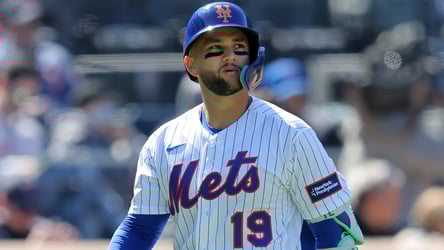
At times during the first three games of his Mets tenure, Bo Bichette was unrecognizable at home plate.
The former American League batting champion is 1-for-14. The man who had a better average with runners in scoring position than any player in baseball last year went hitless with one sacrifice fly in six tries this weekend. And the player so tough to strike out that the Mets gave him $42 million not to do it for them struck out eight times in three games, swinging through pitches up and the zone and down at his back foot, alike. He did not, in other words, look much like Bo Bichette.
“I’m not familiar with it either,” he admitted, eye black still pulled across his face after the Mets’ 10-inning loss to the Pirates Sunday. “… I think I’ve just gotta be more committed, more committed in the process. I definitely find myself trying to have a moment out there.”
Who knows where 158 more games will lead Bichette, who also spent this weekend working through growing pains at third base. But it could turn out that Bichette’s first “moment” as a Met came late Sunday afternoon, when the soft-spoken 28-year-old was not shy about an opening weekend so bad for him personally that it led to some Citi Field boos.
“If anything, I thought it took too long,” Bichette said. “I get it. I thought my at-bats were terrible, too.”
In some ways, the fix for Bichette is simple. Instead of chasing a moment, he will need to focus on “being in THE moment,” as he phrased it, and stop chasing pitches he might normally let go.
“I think he’s missing good pitches early in counts, and then they’re making him chase, especially at the top of the zone,” Mets manager Carlos Mendoza said. “He’s going to swing. He’s going to go up there and he’s going to hack. He’s a good hitter.”
In some ways, settling in will be more complicated. His six-week crash course on third base did not yield a finished product. He is handling reaction plays well, making stops and charging rollers with no signs of inexperience. But on plays that gave him time to set, his throws leaked up the first base line on multiple occasions, though only one resulted in an error.
“Front side, arm angle, footwork, there’s a lot there. It’s a completely different throw, and it’s new for him,” Mendoza said before the game. “He’s going to have to continue to get reps, which he has. I’m not worried about it because of the work ethic. It’s not going to be perfect, but he’s in a good place, but he’ll be out there right now working with our infield coaches.”
Mendoza was wrong: Bichette actually came out to work with the infield coaches a few minutes after his press conference ended. When he did, he worked mostly on routine plays at mid-to-deep third, and he debriefed with third base and infield coach Tim Leiper afterward.
“I rushed a little bit [Saturday] on a play, but overall pretty good,” Bichette said. “So I just have to keep working and getting better.”
Bichette has not been the only new Met to struggle at his new position. Jorge Polanco also wrestled with some hops in his first two games at first base. And in the meantime, having works-in-progress at the corners has made the sturdy double-play combination of Francisco Lindor and Marcus Semien look even more foundational to this team’s defensive fate. While Semien has started slowly offensively, the former Gold Glover has been as solid as advertised so far at second, and Lindor has looked like his usual self at shortstop.
“We do talk. Bo is a little more quiet when it comes on the defensive side,” Lindor said after Sunday’s game. “But it’s been great. He made great plays today … he’s excelling. He’s doing his thing. He looks good.”
Lindor said he understands Bichette’s desire to prove himself to his new team and city right away. He, too, was beloved with the only team he had ever known before becoming a Met.
“[I understand] 100 percent,” Lindor said. “He’s one of the best hitters in the game. He’s going to have a lot of big moments for us. This is only normal.”
Normal, Bichette said, might take some work, at the plate and in the field. He said he started imagining his first big moment as a Met the second he signed, but “didn’t anticipate it would affect the way I played.”
Asked if he thought heading to St. Louis and San Francisco would help ease the pressure, Bichette offered a wry smile.
“Maybe,” he said. “But I’ve gotta figure out how to hit here anyway, so…”
Bichette is right, of course. But what stands out is his willingness to say so. Struggling players often insist they took good swings or swung at good pitches, that they were happy with their approach or are so close to a hot streak. But nothing speaks to confidence like candor. Perhaps Bichette is right to stop chasing his Mets moment. Strange as it sounds, he might have just had one.
Read the full article here