

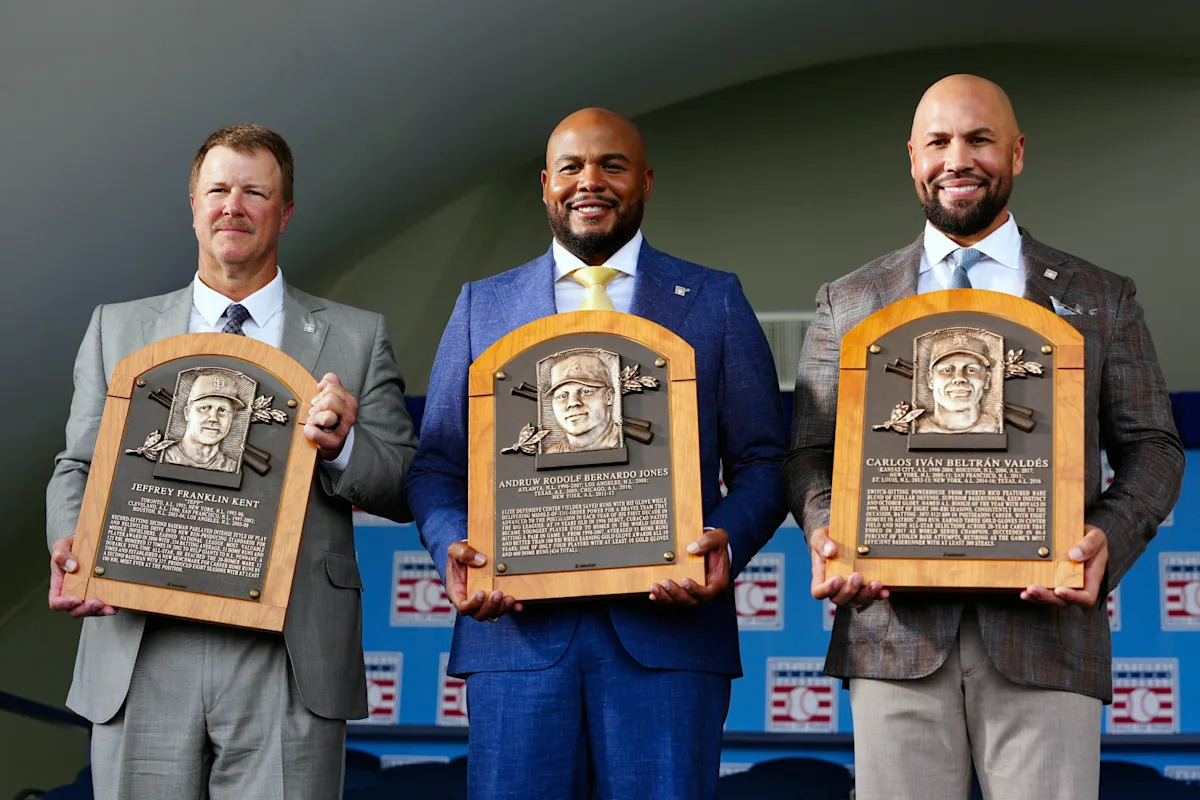
The National Baseball Hall of Fame welcomed Jeff Kent, Andruw Jones and Carlos Beltrán on Sunday in Cooperstown, New York.
The Clark Sports Center was home to more than 60 Hall of Famers. They came to watch the newest members of the Hall hold their plaques and deliver emotional speeches.
All three of this year’s inductees struck a chord. Here’s a rundown of how they got here and what they said to encapsulate their prolific baseball careers.
Jeff Kent, 5-time All-Star 2B
(Jamie Squire via Getty Images)
Teams he played for
Toronto Blue Jays (1992), New York Mets (1992-96), Cleveland (1996), San Francisco Giants (1997-2002), Houston Astros (2003-04), Los Angeles Dodgers (2005-08)
How he got to Cooperstown
Kent was granted enshrinement by the 16-member Contemporary Baseball Era Committee. He got a second look after spending 10 seasons on a BBWAA ballot loaded with stars at the time he first graced it.
His spot in the Hall is well-deserved. A 20th-round pick out of Cal, he went on to help reset the run-production standard for middle infielders. No second baseman has launched more home runs than Kent. He clocked out with 377 dingers, and his 1,518 RBI are mighty impressive, too. Kent piled up eight 100-RBI seasons. In 2000, he earned NL MVP honors with the Giants, who of course had Barry Bonds raking for them back then as well. That season, Kent notched a career-high .596 slugging percentage to go along with 33 homers and 125 RBI.
What he said during his induction speech
Kent opened his speech by noting that there was a time when he played baseball and didn’t dream of being on the stage he now found himself speaking on.
“There were more important things in my life than baseball,” he admitted. “One of them was a pickup truck. When I was 16 years old, I was racing motorcycles and driving my great-grandparents’ old Plymouth Volaré. And my dad knew motorcycles weren’t taking me anywhere, so he made me a bet.
“He knew that if I were to earn a college scholarship, that he’d buy me a pickup truck. My dad was a simple guy, a police officer in Southern California, and that’s about all we could afford extra at that time in my life. And that truck meant everything to me. So I quit racing and focused on school and baseball and won that baseball scholarship because I got that truck.
“That truck is still with me. It sits in my garage as a simple reminder that some of the simplest things. … the simplest things can change the entire direction of your life.”
Kent’s MLB career spanned 17 seasons. He earned All-Star recognition during three of his six seasons with the Giants, whom he assisted in reaching the World Series in 2002.
“San Francisco is home. San Francisco is where every lesson I’d learned finally came together,” Kent said before giving credit to then-Giants general manager Brian Sabean for bringing him aboard and building a title-contending roster.
“The group that Brian built started out as Game 7 losers in the 2002 World Series but eventually turned that organization into three-time World Series champions in five years,” Kent said, referring to San Francisco’s dynasty in the early 2010s.
Then Kent showered Dusty Baker with compliments. Baker managed the Giants from 1993-2002.
“The team wasn’t complete without a leader, and I had the best one there was, Dusty Baker,” Kent said. “He was the right man at the right time for me. And I’m naturally a half-empty guy. I see what’s broken, and I want to fix it. That’s probably what drew me to this game. But looking back, I think I complicated the game a lot more than it needed to be. And Dusty was the opposite.
“Dusty didn’t complicate the game. He respected it. I could feel his passion in winning and everything he did. Even those toothpicks used to chew out. What was great about Dusty is he’d reach you on your level, though. He’d reach you on your level and elevate your thinking and your drive. That was what was special. And I flourish in that environment and under his leadership. And I’m forever grateful for that, Dusty. Thank you.”
Kent was part of six major-league teams. The name on the front of his jersey changed over the course of his time in the bigs, except his position remained a constant.
“I took pride in playing second base: the position that keeps you in every play and demands toughness,” he said.
“But my bat was always my ticket. I learned a long time ago from Tommy Lasorda, one of the best motivators in the game, a simple truth that I lived by for my whole career: The money lies in the RBIs.”
Andruw Jones, 5-time All-Star CF
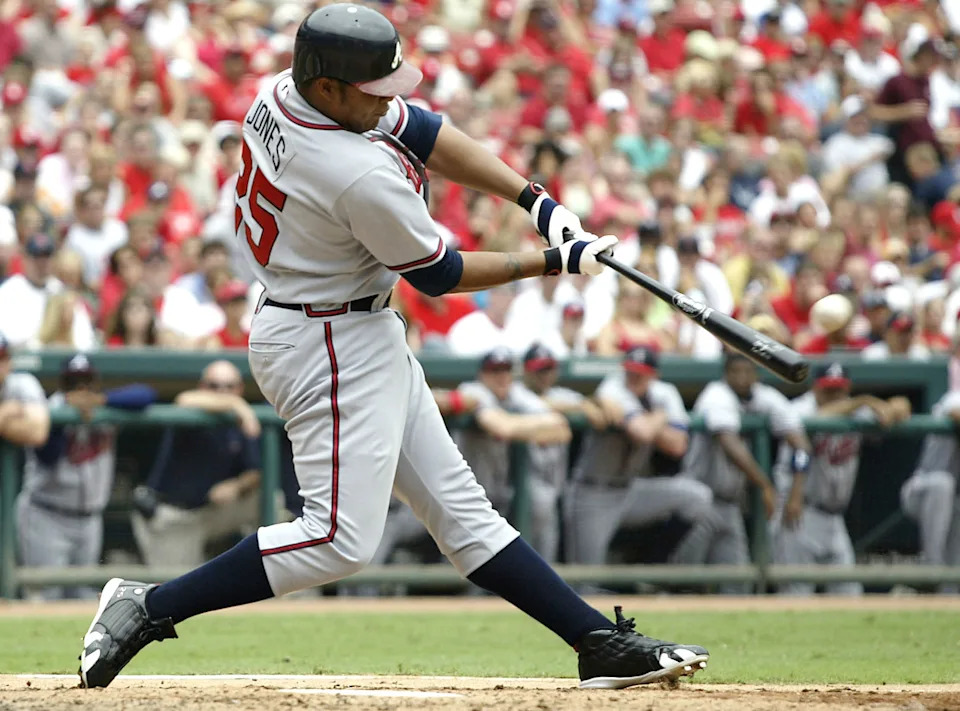
(Dilip Vishwanat via Getty Images)
Teams he played for
Atlanta Braves (1996-2007), Los Angeles Dodgers (2008), Texas Rangers (2009), Chicago White Sox (2010), New York Yankees (2011-12)
How he got to Cooperstown
Just 7.3% of voters gave Jones the nod in 2018, his first year on the ballot. No player eventually elected by the writers has ever received a lower percentage of the vote during their candidacy for the Hall, according to The Athletic. Nevertheless, Jones’ résumé stood the test of time. He possessed head-turning power and jaw-dropping defensive ability. He won 10 Gold Glove Awards and mounted 434 home runs across 17 seasons.
The Curaçao native is best known for his Braves tenure. In Atlanta, he ultimately himself as perennial All-Star. Perhaps notably, he rocketed an MLB-best 51 long balls in 2005. In the process, he amassed an NL-leading 128 RBI. He played in a pair of World Series with the Braves — famously homering in his first two World Series at-bats as a 19-year-old — although Atlanta came up short in both 1996 and 1999. Still, he wore several NL East crowns and is immortalized in the organization’s history, as his No. 25 jersey is retired.
What he said during his induction speech
Jones mentioned that since he never got to see transcendent Hall of Fame center fielder Willie Mays play, “Ken Griffey was my guy.” Jones said he wanted to be like Griffey.
But he expressed that he took after his father as well.
“This moment is bitter sweet because my father, Henry Jones, is not here today,” Jones said. “Dad passed away 10 years ago. He showed me how to work hard and what it takes to become a successful baseball player and a great person.
“Because he played center field, I wanted to be a center fielder. And he passed down every bit of knowledge [about] the game to me, like how to read balls off the bat. He hit me fly balls from foul pole to foul pole every time in Curaçao so I can track balls down because the ocean breeze make tracking balls very difficult on the island. He also showed me how to build strong wrists by rolling a sledgehammer.
Jones added: “Everything he taught me had a purpose. Henry Jones was a legend in Curaçao, a great player in his own right. And I’m not standing here in Cooperstown without his constant coaching. Dad, we did it. I know you looking down at me now and with a big smile, and I love it. I love you very much.”
Jones is proud of his Curaçao heritage. He thanked the array of people from his home country who aided his journey in baseball and in life as a whole. Plus, he paid homage to Hensley Meulens, the first Curaçaoan to play in MLB.
“There’s no easy way to get here from the small island of Curaçao, more than 2,000 miles away, but today Cooperstown and Curaçao are forever joined together.
“Being the first Hall of Famer from my island is an incredible moment. That’s why [this] makes such a memorable day. I’m overjoyed to share this day with people from my homeland. So many people helped me get here, helped me get the journey of loving this game and making it here to the major leagues.”
Jones is etched in Braves lore, and he explained Sunday that he wouldn’t have it any other way. He discussed his relationship with the late Bobby Cox, whose second run as Atlanta’s manager took place from 1990-2010.
“He put a 19-year-old in the World Series lineup and believed in me,” Jones said. “Bobby had confidence in me and helped me become the best player I could have been. He commanded respect, created a winning culture: You play hard, you play to win and you always give your honest effort — simple rules to play the game.
“For my 12 years with the Braves, he was my only manager. He was like a second father to me. I know he’s looking down, laughing and [would] be so happy for me and my family. Thank you, Bobby.”
Jones characterized fellow Hall of Famer Chipper Jones as “my brother from another mother” and pointed out that the legendary third baseman pushed for his induction for several years. Andruw Jones continued to tip his hat to the Braves, saluting their fans, who he considers the best in the world.
“I never played this game thinking about going into the Hall of Fame,” Jones said. “I was blessed to play for an amazing organization with a winning culture. The game is a lot easier when you focus on the team, not yourself. That’s the beauty of the game.
“But when baseball is your life, there’s no way to put in words what it means to finish a career with a Hall of Fame plaque.”
Carlos Beltrán, 9-time All-Star OF
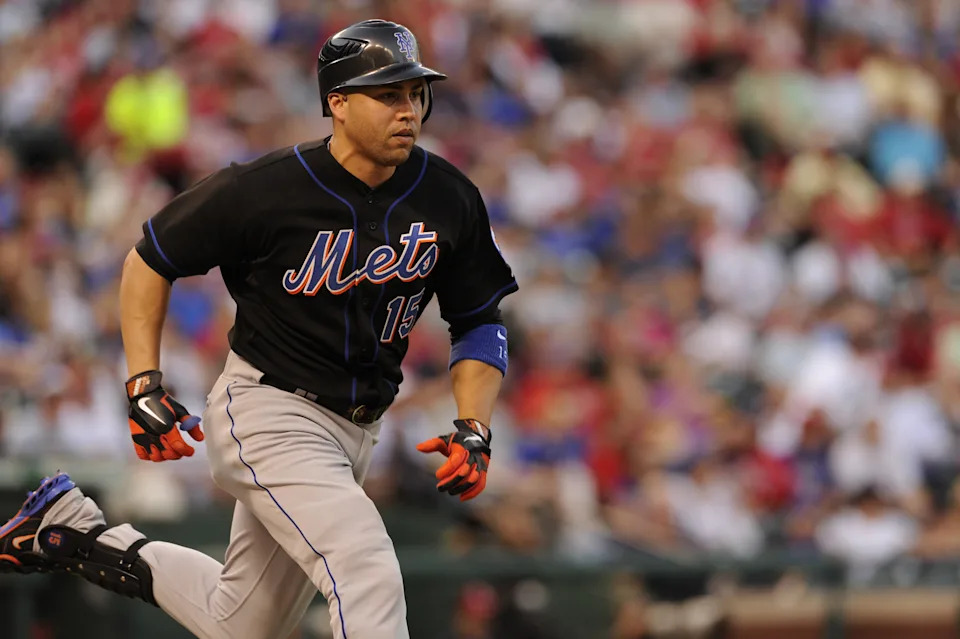
Carlos Beltrán starred for the New York Mets from 2005-11, winning all three of his Gold Glove Awards and both of his Silver Slugger Awards in that span. (Photo by John Williamson/MLB Photos via Getty Images)
(John Williamson via Getty Images)
Teams he played for
Kansas City Royals (1998-2004), Houston Astros (2004), New York Mets (2005-11), San Francisco Giants (2011), St. Louis Cardinals (2012-13), New York Yankees (2014-16), Texas Rangers (2016), Houston Astros (2017)
How he got to Cooperstown
Beltrán, a renowned center fielder like Jones, had his name checked on 84.2% of the Hall of Fame ballots submitted by the BBWAA this year, eclipsing the 75% threshold. His involvement in the Houston Astros’ infamous sign-stealing scheme — a ploy that partly consisted of banging on trash-can lids to telegraph which pitches were on their way to Houston hitters — resulted in a three-election penalty. With that in the rear-view mirror, the Puerto Rican star finally made it into the Hall.
Before his tainted World Series season with the Astros in 2017, Beltrán had 19 seasons worth of authentic success that he spread across seven organizations. The switch-hitting outfielder won AL Rookie of the Year with the Royals, except he achieved his highest marks with the Mets. He played for them from 2005-11, winning all three of his Gold Glove Awards and both of his Silver Slugger Awards in that span. While with the Cardinals in 2013, he took home the Roberto Clemente Award, given annually to the “player who best represents the game of Baseball through extraordinary character, community involvement, philanthropy and positive contributions, both on and off the field.” Beltrán is one of five players in AL/NL history with at least 400 home runs and 300 stolen bases, according to MLB.com. The others are Mays, Bonds, Andre Dawson and Alex Rodriguez.
What he said during his induction speech
Similar to how Jones represented Curaçao, Beltrán dedicated a portion of his speech honoring Puerto Rico.
“Everywhere I play baseball, I always try to represent my island,” said Beltrán, who finished his MLB career with 435 homers and 312 swiped bags. “I try to do the best I could for the organizations that I played [for], but also I wanted to represent Puerto Rico.”
Beltrán’s winding path in the majors began in Kansas City. On Sunday, he shouted out Royals icon George Brett.
“You told me something that I will never forget,” Beltrán said, “that greatness is built long before anyone is watching. I appreciate every conversation that I have. I still remember some of the conversations that we had together. ‘Carlos, hit the ball hard, not far. Hit the ball hard, not far.’
“And I love you, my man, for everything that you did for me.”
Beltrán was a sponge, particularly early in his big-league career. In 2004, during his first stint with the Astros, he absorbed tips and tricks from Hall of Famers Jeff Bagwell and Craig Biggio, who were both in the final acts of their careers.
“You told me something very special,” Beltrán said. “You told me that in order for me to aspire to have a long career in baseball, I needed to learn how to play with pain. I saw you guys grind day in and day out. That was very special to me. And that was something that I carried for the rest of my life.
“There’s no way that I could’ve lasted 20 years in the big leagues without learning how to play with pain.”
In that same vein, Beltrán talked about how Mets manager Terry Collins opened his eyes to a new outlook on the knee issues Beltrán battled.
“You reminded me, Terry, that setbacks don’t really define us,” Beltrán said. “What defines us is how we respond to them. So the fact that you took your time to connect with me, to push me, to encourage me, to challenge me, I appreciate, my friend, our relationship.”
Collins took over as the Mets’ skipper in 2011, the last season Beltrán played for the team before he was dealt to the Giants. That said, the Mets occupy a special place in his heart.
“Every organization shapes your career,” Beltrán said. “New York shaped my life.
“I was here where I experienced my greatest success and some of my greatest challenges. Playing for the Mets made me a better man and a better leader. Many of the most meaningful relationships that I was able to build in my career, I did it wearing a Mets uniform. So the Mets cap, what [it] represents to me is growth and it represents a place where I became the best version of myself.”
Read the full article here