



Games can be won and lost in short spurts.
The Cleveland Cavaliers found that out the hard way once again as they dropped Game 2 109-93 to the New York Knicks.
After blowing a 22-point lead in an eight-minute meltdown in Game 1, it was 18 unanswered points in the middle of the third quarter that cost them Game 2. Both were fueled by poor offensive execution.
Now, the Cavs are in a 0-2 hole for the second consecutive series.
The offense once again abandoned them in a critical part of the game. They went scoreless in a five-and-a-half-minute stretch in the third quarter when the game was decided.
That simply can’t happen in the postseason, against an opponent that is this good offensively.
The outside shot deserves a lot of blame here.
The Knicks have been willing to give up three-point looks all season if it means they can secure the paint. That’s why they ranked 29th in opponent three-point frequency all season. That showed through once again.
New York was willing to concede open attempts from three if, in doing so, they were preventing a look inside the arc. That’s how Sam Merrill was able to generate seven three-point looks in 23 minutes. And if you look at the shots below, all but the last attempt were quality looks.
The issue was that none of them went down.
View Link
Support us and Let ‘Em Know with Homage!
Anything bought from the links helps support Fear the Sword. You can buy the Let ‘Em Know shirt HERE. You can also shop all of Homage’s Cavs gear HERE.
The same is true for Cleveland’s other shooters. Max Strus went 1-4, Donovan Mitchell went 2-7, and Jaylon Tyson went 0-3. When four of your best shooters combine to go 3-21, there’s not a whole lot you can do to overcome that.
“We didn’t shoot the ball well,” Kenny Atkinson said afterward. “I thought our process was right. … At the end of the day, you have to put the ball in the hole.”
Playoff basketball is about making the most of what your opponent gives you. The Knicks are content with giving up the three-ball. And this was the second-straight game the Cavs shot far below their season-long average from deep.
Conversely, Josh Hart played better offensively than he had at any point in the postseason. The Cavs dared him to make shots in Game 1, and he didn’t. In Game 2, he went 5-11 from three en route to a game-high 26 points.
There’s no way to take away everything. Teams are simply too good at this point in the playoffs.
You have to be willing to give up something. What the Cavs gave up came back to bite them. What the Knicks gave up didn’t. And that’s ultimately what made the difference in this game.
There were other areas the Cavs couldn’t take advantage of offensively.
The Cavs took the same percentage of shots at the rim as the Knicks, but they just couldn’t convert there either. Only 61.5% of their looks in the restricted area went down.
Going hard to the rim allowed them to attempt more than twice as many free throws as the Knicks, but they didn’t make the most of that either, leaving 10 points at the line.
Overall, the Cavs got to the spots they wanted on the court. Forty percent of their looks came from three (62nd percentile), 34% came at the rim (61st percentile), and they had more free-throw attempts. That’s the balance you want
But basketball comes down to converting those shots, not just generating them.
“We just didn’t make shots,” Mitchell said. “I loved everything about the looks we got. Some days, you just miss the open ones. … Offensively, I’m not worried at all.
That said, the Cavs need to do a better job of getting the bigs involved.
Evan Mobley scored 10 points in the first quarter, but took just two shots the rest of the way. Jarrett Allen was physical in the paint offensively, but wasn’t rewarded enough for his work, as he had just 13 points on 5-10 shooting.
The story is always the same for the Cavs. The offense is at its best when the bigs are a focal point. When they aren’t, the offense can become too dependent on the outside shot.
New York knows this. That’s part of why they’re selling out to cut off passes inside and clogging the paint.
There’s something to be said about the Cavs not being able to flex their strengths as easily as you’d like. It often feels like they take the path of least resistance if it’s opened to them. Given the skill of their bigs, they do need to make it a priority to get them going, even if it’s difficult.
Missing shots influences the defense. Every misfire, particularly from deep, is an opportunity to run the other way off the rebound.
The Knicks benefited from this. They were able to get into their half-court sets quickly and establish an offensive rhythm more easily. This resulted in every member of their starting lineup scoring 14 or more points.
Jalen Brunson beat the Cavs with his passing, not his shooting. His 14 assists were one shy of what the Cavs had as a team.
Cleveland tried to vary the defensive looks against him after he torched them down the stretch of Game 1. They sent two to the ball and hedged more often than they did on Tuesday, and Brunson made them pay. He quickly got the ball out and found the open man, which is exactly what you need to do in that situation. His teammates rewarded him for that trust.
Some of that is due to picking on James Harden. He held up better down the stretch of Game 1 than the results would lead you to believe. Brunson hit a lot of tough shots. That’s what he does.
The doubles and different looks came from Cleveland wanting to avoid what happened in Game 1. New York went back to the well again and had success, but more so because the rotations and doubles created more problems than they actually solved.
What you can’t do is let Brunson have his cake and eat it too. That’s what it felt like at times in this game with the easy reads he was presented with.
Despite that, this game was lost on the offensive end. Even with things getting away from them, the Knicks scored just 109. That’s a point total the Cavs have surpassed in all eight of their postseason wins.
What makes this frustrating is the fact that the Cavs are getting clean looks, and could be getting better ones if they could get Mobley and Allen more involved. If they’re able to continue to create good looks, then this isn’t over yet. That is, if Mitchell is healthy.
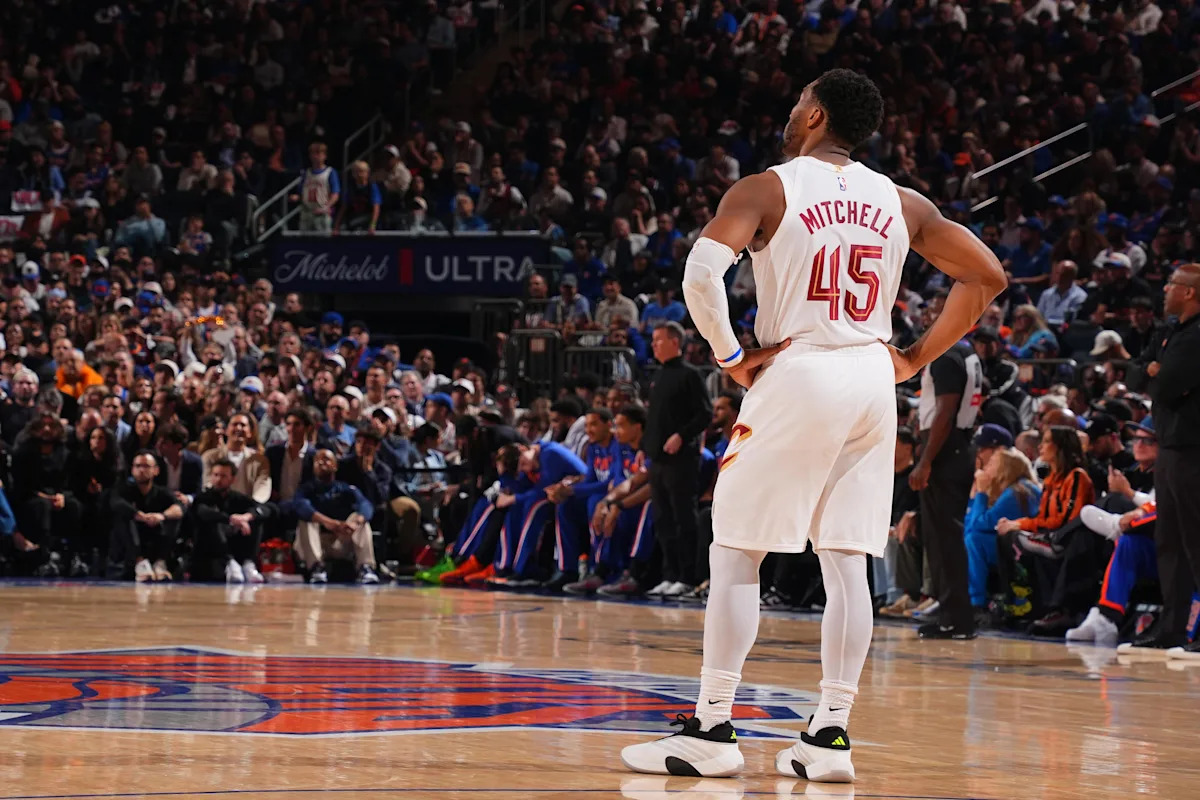
Afterward, Mitchell reiterated that he’s feeling great. That clarification was needed because he looked anything but that on the court.
The burst that we’ve become accustomed to seeing from Mitchell wasn’t there. He wasn’t moving quickly laterally on defense, and his drives to the basket were more line drives than quick side-to-side moves. That usually indicates some type of lower-body injury.
Mitchell still put up a game-high 26 points on 8-18 shooting, even with the three-ball not falling. That speaks to how skilled he is as a scorer. But if the explosiveness isn’t there, then it’s difficult for the Cavs to establish a consistent offense. They need him close to 100%, or at least as close as possible, after coming off two straight seven-game battles.
The Cavs can still get back in this matchup, but they’ll need their best player to be his best self if they want to do so.
Read the full article here


