

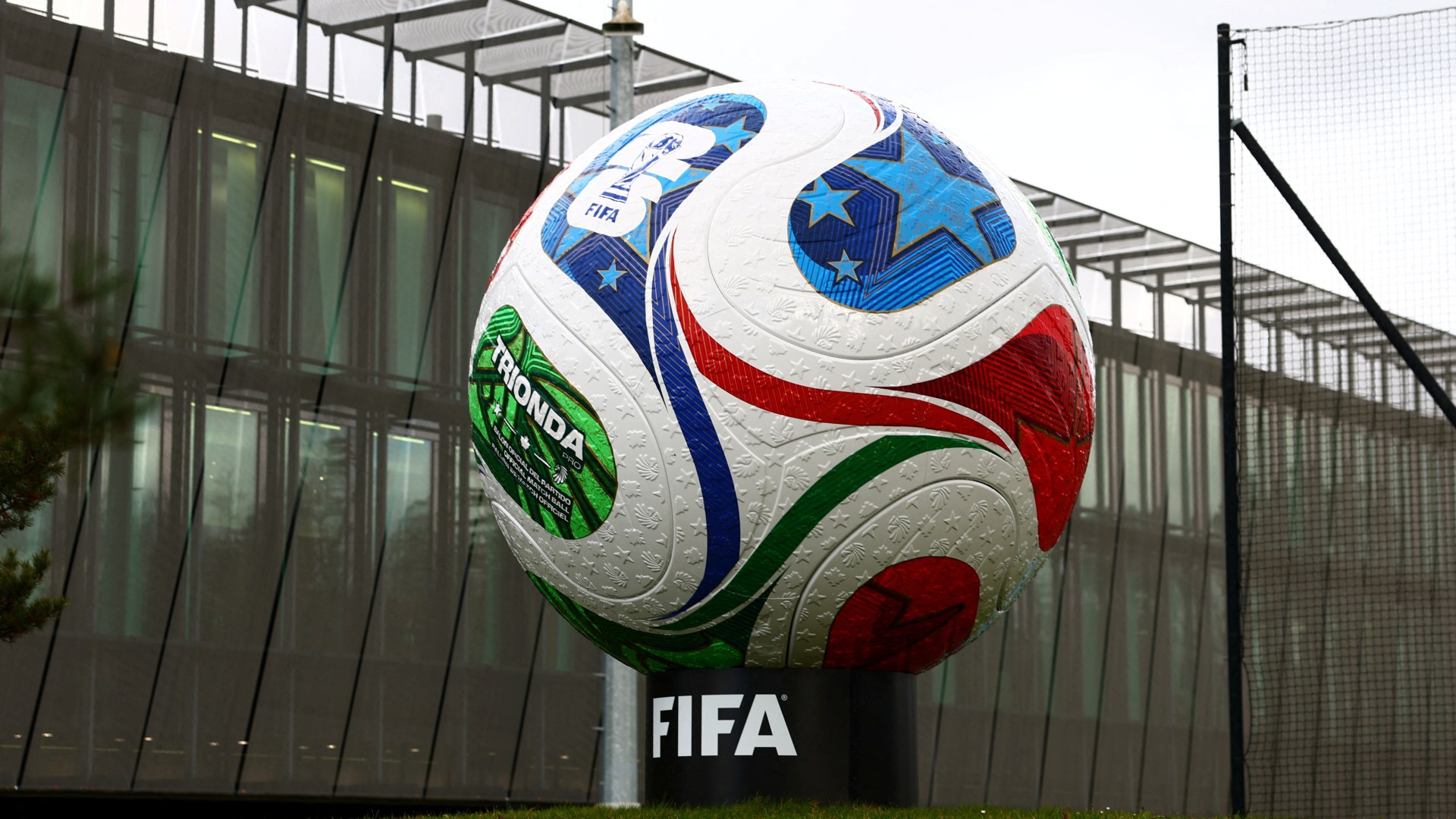
WORLD Cup 2026 is introducing a brand-new match ball featuring advanced technology and a revolutionary panel design.
Adidas has unveiled its 15th successive football for the biggest football tournament in the world, hosted in cities across the US, Canada and Mexico.
When does the World Cup 2026 start?
The 2026 World Cup is a summer tournament, with Fifa confirming it will kick off in June 2026, rather than the end of the year like Qatar 2022.
Matches will be staged across 16 host cities in the three co-host nations, with an expanded 48-team format – 16 more than the 32 nations competing in World Cups since France 1998.
The 2026 Fifa World Cup starts on Thursday, June 11, 2026, with the opening match to be played at the historic Estadio Azteca in Mexico City – where Diego Maradona scored his infamous Hand of God goal against England in 1986.
Estadio Azteca was officially renamed Estadio Banorte on March 14, 2025, after a naming rights deal was struck with Mexican bank Banorte.
more on the world cup 2026
Out in the cold
Cole Palmer left out of England’s 2026 calendar in major World Cup hint
OWN GOAL
ITV to hold major World Cup advantage over BBC after shock broadcasting decision
It finishes on July 19, with the final held at the MetLife Stadium, East Rutherford, New Jersey.
The schedule is as follows:
- Group stage: June 11-27
- Round of 32: June 28-July 3
- Round of 16: July 4-7
- Quarter-finals: July 9-11
- Semi-finals: July 14-15
- Third-place play-off: July 18
- Final: July 19
What is the World Cup 2026 ball?
The official 2026 World Cup ball is called Trionda, a name combining “tri” for the three host nations with “onda”, which means “vibe” in Spanish and Portuguese.
Adidas has constructed Trionda from only four thermally bonded panels – the lowest panel count in World Cup history – to create a smoother, more stable flight.
The design features graphics referencing the US, Mexico and Canada, with motifs and colours inspired by each country’s national symbols and the idea of three waves coming together.
Trionda also continues the “connected ball” concept introduced at Qatar 2022, using an internal high-frequency motion sensor, tracking touches and movement in real time.
Data from the chip is sent to match officials to allow faster and more accurate offside and handball decisions, working alongside semi-automated offside technology and VAR.
Adidas has tuned the surface texturing and panel shaping to balance grip, spin and drag, with the aim of offering predictable aerodynamics.
What have been the previous World Cup balls?
Every World Cup has had its own distinctive ball, with Adidas supplying the official designs since 1970.
The classic black-and-white Telstar used in Mexico 1970 marked the start of this era.
Named after the Telstar communications satellite, which looked a bit like a football, it featured 32 contrasting panels to make it clearer for those watching the tournament on black and white TV.
It was followed by the Tango Durlast for Argentina 1978, comprising 20 panels creating the illusion of 12 identical circles.
This ball was the foundation for all five of the next official World Cup footballs.
The Azteca was introduced for Mexico 1986, with a design based on ancient Aztec art.
It was the first synthetic football used at a World Cup, fabricated with a layer of polyurethane.
The 1990 World Cup in Italy saw the introduction of the Etrusco, featuring three lion heads on 20 of the 32 panels, inspired by the artistic ingenuity of the Etruscans.
It was also used in Euro 1992 and the 1992 Summer Olympics.
The Tricolore was the official ball of France 1998 and was the first multicoloured ball used in the tournament’s history.
It featured a synthetic foam layer, making it both softer and faster than the Questra.
The Fevernova came in for the Japan/South Korea World Cup 2002, heralding a new chapter in ball design – and it was gold.
Despite advancements in accuracy, it was still a bit on the light side, but this did lead to some spectacular goals
The Teamgeist, meaning “team spirit”, was the official ball of Germany 2006.
Billed as the smoothest ever World Cup ball, it was made up of 14 panels that were bonded rather than sewn together, and was claimed to be rounder than any ball previously used at the tournament.
The much-debated Jabulani was Adidas’ South Africa 2010 ball, which saw the number of panels reduced to just eight.
They were thermally-bonded and moulded 3D panels designed to aid better grip from boot to ball – but there was widespread criticism of the ball because its flight was so unpredictable.
Then there was the Brazuca – a term Brazilians use to describe the pride they have in their way of life – for Brazil 2014.
It featured just six polyurethane panels and colours of blue, green, red, white and black, representing the traditional colours of the Brazilian wish bracelet.
The official match ball of Russia 2018 was the Telstar 18 – a reimagining of its namesake with only six thermally bonded panels and a microchip embedded in it.
Qatar 2022’s Al Rihla, which translates from Arabic as “the journey”, introduced an internal sensor and a 20-panel, near-seamless shell.
Read the full article here