



MIAMI — As Pitbull’s “Fireball” thundered from the stadium speakers, Shohei Ohtani readied himself for one last chance.
Standing in loanDepot Park’s third-base dugout before the bottom of the ninth inning, Ohtani went through his pre-at-bat routine. He tightened his batting gloves, fidgeted with his elbow guard and retrieved his lumber from the bat rack. He looked as confident and as impenetrable as ever. But with his club down three runs and down to its final three outs, Ohtani would have to conjure a miracle to keep Japan’s World Baseball Classic hopes alive.
It was not to be.
Neither of the two Samurai Japan hitters ahead of Ohtani reached base. And nobody — not even the greatest player on Earth — can hit a three-run homer with the bases empty. So when the Dodgers’ superstar skied a pop-out to shortstop, it marked the end of the inning, the night and Japan’s dream of back-to-back WBC titles.
Ohtani jogged meekly back to his dugout as the ballyard rumbled around him once again. This time, the reverberating stadium had nothing to do with the earworm anthems of Mr. 305.
[Draft your Yahoo Fantasy Baseball team for the 2026 MLB Season]
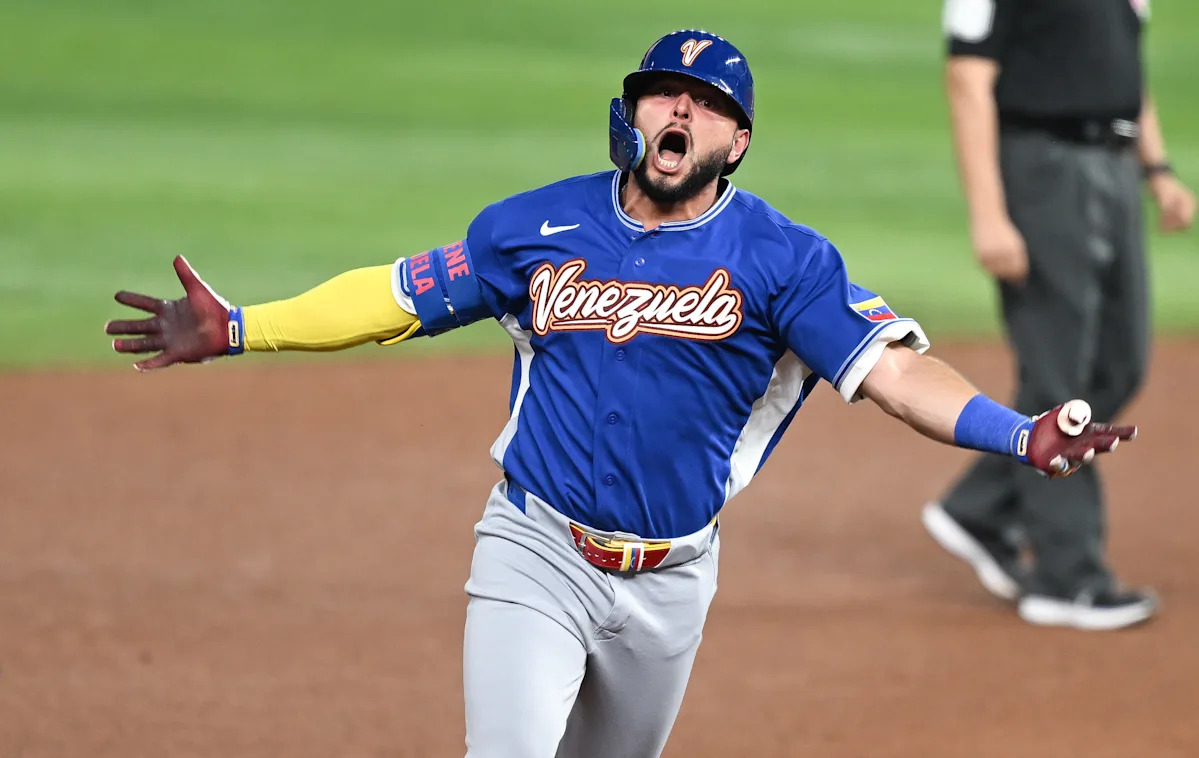
This rattling was caused by the majority-Venezuelan crowd erupting in jubilation, with tens of thousands decked out in blue, red and yellow quite literally jumping for joy. The victorious Venezuelan players streamed onto the field to embrace one another. Ohtani gathered his things and ducked out of sight down the dugout tunnel, with the sting of Japan’s worst WBC finish ever yet to sink in.
But Venezuela’s 8-5 victory on Saturday (or rather, Sunday morning — this was a 9 p.m. ET first pitch) was no upset. Nothing about it was flukey, despite Japan’s status as defending champion and Pool C winner. On this night, Venezuela outpitched, outhit and outmanaged Samurai Japan. On paper, Venezuela’s roster was better. And on the field, the team proved as much.
Their reward is a semifinal matchup against a Cinderella Italy team on Monday. Also, crucially, the win guaranteed Venezuela a spot in the 2028 Olympics in Los Angeles.
“My country right now is celebrating. It’s extremely happy. It’s on the streets,” Venezuela manager Omar López said afterward. “They’re drinking right now, and that makes me [happier] than anybody else in this world.”
The game started with a volcanic blast, courtesy of Venezuelan top dog Ronald Acuña Jr., the second-most accomplished and talented player on the field. Acuña dispatched the second pitch of Yoshinobu Yamamoto’s evening just over the wall in right. It was vintage Acuña, a low laser to the opposite field, the type of homer that few players could even attempt to muster.
After Acuña’s swing sent loanDepot into a frenzy, Ohtani changed the mood almost immediately with a clob job of his own that evened the score at one. It was a long ball equally predictable and awe-inspiring. If Acuña’s homer produced raw sound, Ohtani’s elicited a more wondrous wave of “ooohs” and “aaahs.”
From there, the game see-sawed. Yamamoto and Venezuela starter Ranger Súarez were both uninspiring, rusty, less than their best. Yamamoto surrendered four extra-base hits with exit velocities over 105 mph within the first 11 hitters of the game. He allowed three such hits across 37 2/3 stellar innings in the 2025 MLB postseason.
Suárez’s night unraveled in the third, when Japan pounced for a four-spot. The frame was punctuated by a Shota Morishita three-run homer that put Japan up 5-2. At that juncture, Morishita was tracking to become an unlikely hero of this contest. The Hanshin Tigers’ utility man wasn’t even in manager Hirokazu Ibata’s starting lineup and joined the proceedings only when Chicago Cubs outfielder Seiya Suzuki exited due to injury after being thrown out trying to steal a base in the first.
But Venezuela hung around, battling Yamamoto even as he settled into the ballgame. And when the 2025 World Series MVP did not return for the fifth inning, Venezuela took full advantage of an overmatched Japanese bullpen.
Ibata, managing in his first WBC, didn’t help. His decision to go to soft-tossing southpaw Chihiro Sumida directly after Yamamoto was extremely questionable, considering that Venezuela’s next three hitters — Jackson Chourio, Acuña and Maikel García — are all dangerous right-handed bats. And when Sumida tried to sneak a fastball by García in a two-strike count, disaster struck.
Garcia’s two-run smack trimmed the lead to one, and that lead evaporated altogether an inning later. With two runners on and nobody down, Red Sox outfielder Wilyer Abreu delivered the swing of the tournament thus far. Again, a Japanese reliever failed to elevate a heater and was punished for it.
Abreu clocked a no-doubter into the third row of the upper deck in right field to put Venezuela ahead 7-5. But instead of admiring his handiwork, he turned toward his dugout, placed one hand on either end of his bat and hurled it to the heavens. The lumber was in the air for so long that it actually hit third baseman Eugenio Suárez on the leg as he hurdled out of the dugout to celebrate.
While Venezuela’s offense deserves all the credit in the world for punching their ticket to the semifinals, the club’s bullpen made the comeback possible. After Suárez’s premature departure, a sextet of Venezuelan relievers combined to throw 6 ⅓ scoreless frames against a very talented Japanese lineup. Japan managed just three hits after the third inning and hardly threatened at all. The highlight was seven brilliant outs from Enmanuel De Jesus, a 29-year-old lefty who spent all of 2025 with the KBO’s KT Wiz.
“This is history for us and for our country. We have been working on a daily basis to give this joy to our country,” Acuña said postgame. “But the job is not completed. We have two games to win.”
In the end, Venezuela was simply the better team in this quarterfinal matchup. Japan arrived at this tournament with an inferior roster to the one that captured the country’s third WBC crown in 2023. The absences of MLB arms such as Yu Darvish, Kodai Senga, Shota Imanaga, Yuki Matsui and Roki Sasaki left Japan undermanned on the pitching front. That underbelly proved fatal against Venezuela.
The offense never got rolling, either. Masataka Yoshida went cold at the wrong time. Munetaka Murakami, the clutch star of the 2023 team, didn’t shine this time around. Even during Japan’s 4-0 run in pool play at the Tokyo Dome, things felt sticky and tense, with the games much closer than they should’ve been.
And when finally tasked with a formidable opponent, Japan and Ohtani faltered and failed.
Many of the Japanese players now face a long, long flight home. The three years until the next WBC and their shot at redemption will feel even longer.
Read the full article here


