

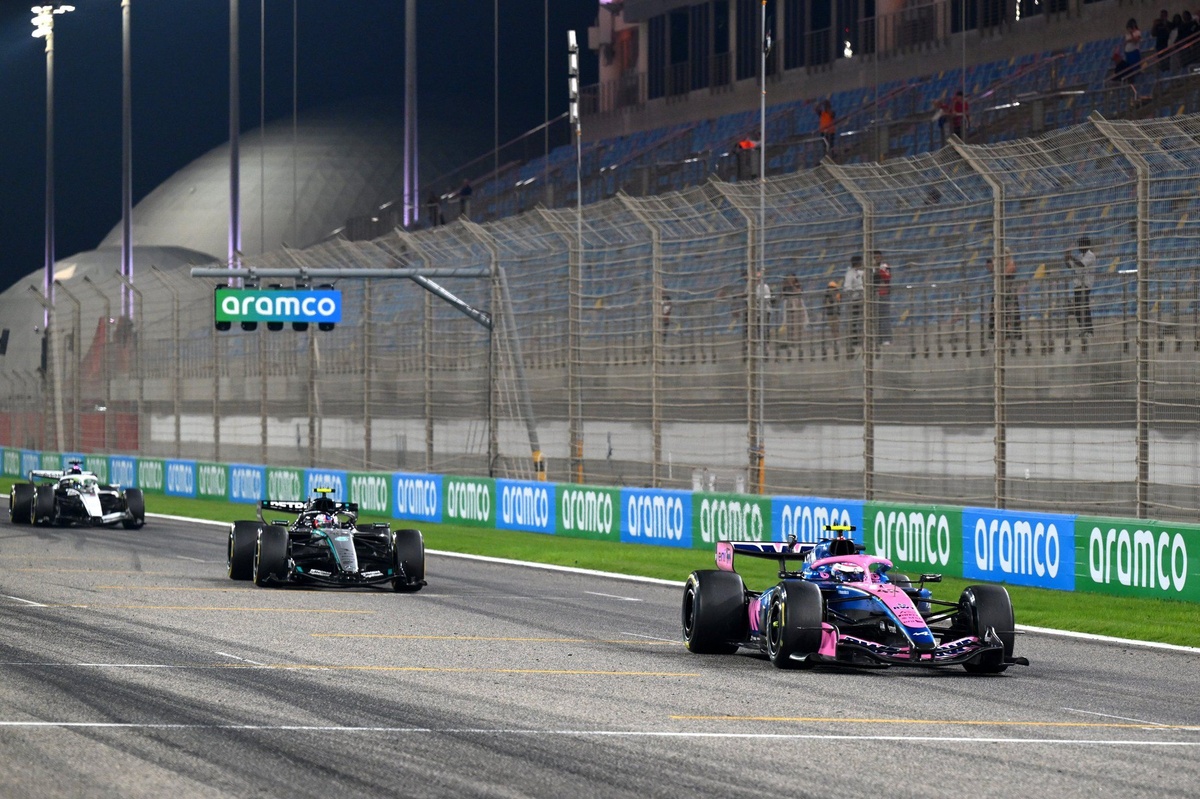
If the Formula 1 news agenda were a weather system, right now it would be trapped in an anticyclonic gloom. Until the new-generation machines start running on track competitively, as opposed to pottering around on different run plans as they were in testing, the unknowns remain stubbornly unknown.
Only the ongoing slow-motion car crash that is Aston Martin has provided a narrative which moves on rather than churning its wheels in the proverbial gravel.
So, amid this unsightly collection of metaphors, let’s return to the subject of overtaking, and the likelihood of there not being much of it – a prognosis apparently shared by most of the grid, apart from the Mercedes drivers. One of the persistent themes of the pre-season has been the relatively low-key effect of the ‘overtake mode’ which will in effect delay the ramping down of electrical power towards the end of straights, and the possibility that the active aerodynamics will lead to cars being unable to follow each other closely.
That mood music has continued in Melbourne, where Esteban Ocon said overtaking “looks quite difficult on paper” because “the overtake usage looks like it’s only a tenth gain, while DRS last year was like six or seven tenths through the lap”.
He couched that by adding, “Is it going to be like that in reality? Maybe not.” But, again, that cleaved to F1’s captive narrative of unknowns and uncertainties.
So it was interesting to witness Mercedes drivers George Russell and Kimi Antonelli being much less equivocal, even if Antonelli’s way in was to say, “Some races may be crazy at some point, because with this energy [deployment], you can overtake in places where before you wouldn’t even think of.” This is also something we’ve heard before, towards the end of last year, before the groupthink shifted towards a more downbeat assessment.
George Russell, Mercedes
Photo by: Alastair Staley / LAT Images via Getty Images
But Russell was unequivocal. “I don’t think overtaking will be a big issue at all,” he said.
“I think having these discussions even before the season has started is too premature, because the truth is we don’t know how the racing is going to be. And at least from what Kimi and I have seen on circuits like Melbourne, Saudi [Arabia], actually the racing can be very exciting. And just with how you distribute the energy around the lap.
“So we need to give it at least five races or so on different circuits. I think China will be different to Melbourne with regards to the energy. I think Suzuka will be very different once more.
“Saudi will be more similar to Melbourne. Bahrain may be more similar to China. So after the first five races, I think we’ll have a much better understanding.”
It’s highly likely that at least two of the races he spoke of will now not happen, or be rescheduled, but that’s not germane to the matter of overtaking. What makes Melbourne either a fascinating experiment or the worst-possible place to start the season – depending on who you speak to – is how its circuit configuration will affect the racing. Essentially the layout is “energy poor” or “energy hungry” in 2026 F1 parlance: plenty of straights with relatively few heavy braking areas, so the internal combustion engine will be doing much of the heavy lifting in terms of electrical energy harvesting via super clipping.
This is an alternative to lift-and-coast in which the driver remains at full throttle in a straight line and the electrical motor is turned in negative torque, generating electrical energy like a dynamo. The downside is a reduced top speed – which potentially makes overtake mode more powerful if deployed to pass a car which is super clipping.
Obviously, though, energy ‘spent’ in this way has to be recouped elsewhere, hence much of the uncertainty surrounding overtaking. But for Antonelli and Russell to be taking a more positive position speaks to Mercedes being relatively confident in its simulation results. Equally, cynics might say that if the W17 is as competitive as expected, many of these overtaking moves will be facilitated by blue flags.
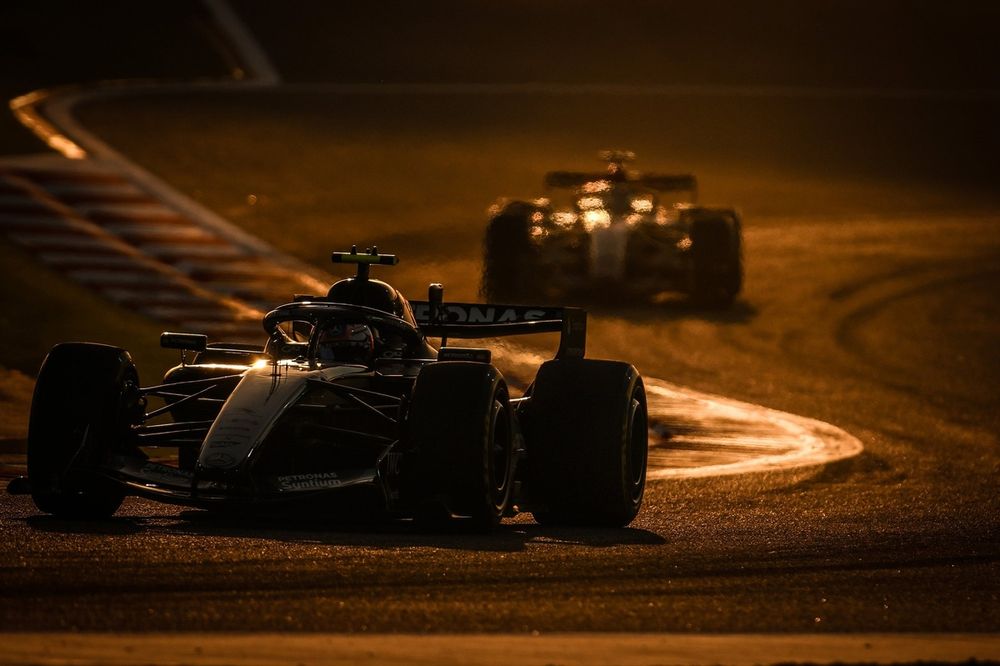
Andrea Kimi Antonelli, Mercedes
Photo by: Simon Galloway / LAT Images via Getty Images
So Autosport asked Antonelli to clarify his position: when he talked about “spectacular” moves, was there data to support the assertion, or was it the case that these unusual overtaking moves would be the result of desperation because overtaking will be difficult?
“I’m not going to lie,” he said. “To follow is not easy.
“But I say this because this track is so demanding on energy that the overtake mode can give you six tenths in one straight over the car in front, it can even give you up to eight tenths. And also there are places where if you deploy full battery – obviously it’s maybe not efficient if you look at the optimal lap time – but it can be a place where the other car is not deploying and saving battery. If you press the overtake boost you gain basically 400 horsepower compared with an optimal lap, you can gain massive amount of lap time and you can make a move in a corner where the other one doesn’t expect.
“Of course when I talk about this it’s more start of the race, safety car restart and even last lap. If you’re in a scenario where the cars are close to each other than during the race when it’s stabilised, of course it’s going to be a bit more difficult.
“I say this because obviously Bahrain was more difficult – but Bahrain is also a much more straightforward, and much better on the energy side. You have barely any super clips, here you have incredible amount of supercuts so you do slow down on the straight and the overtake is extremely powerful – the speed either stabilises or keeps increasing [i.e. in overtake mode or with full deployment] so that’s why the difference is going to be really big in this track.”
The reality of racing at these energy-poor tracks is that there will be protracted periods of neutralised racing where the drivers are, in effect, stalemated. In previous seasons this was a function of being stuck in DRS trains and/or having to manage tyre sensitivities. Now it’s more a question of being locked in to these so-called ‘optimal lap’ energy-management strategies until something happens to disrupt the flow.
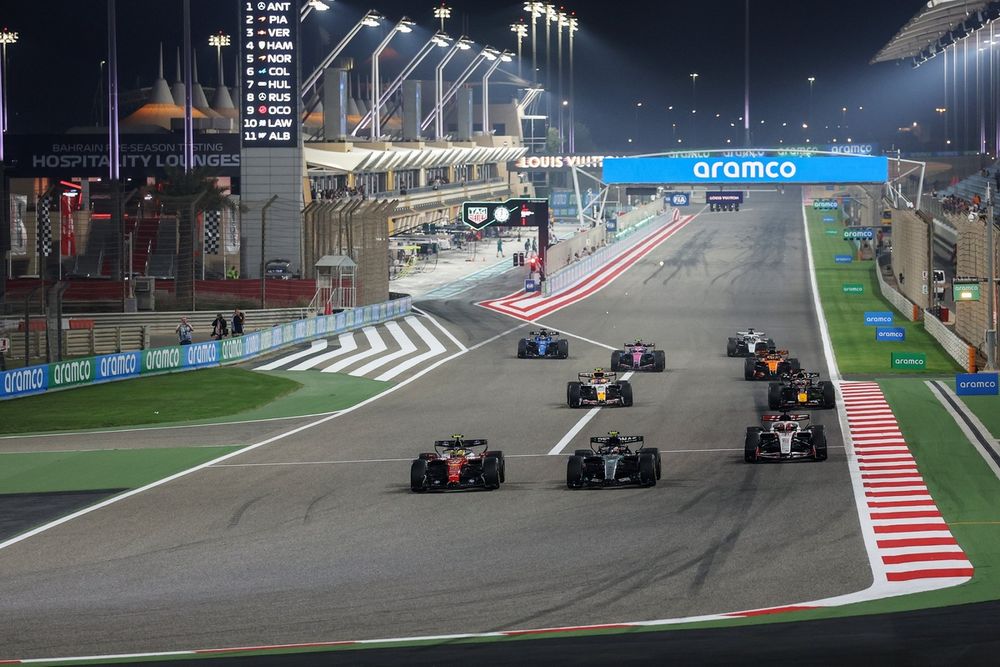
Lewis Hamilton, Ferrari, Andrea Kimi Antonelli, Mercedes, Esteban Ocon, Haas F1 Team
Photo by: Steven Tee / LAT Images via Getty Images
So the opening laps are now more likely to be harum-scarum before races settle down. Then another of the great unknowns: although several simulated race starts were staged during testing, at no point have the teams undergone real-world rehearsals of a safety car restart. The first one of these in race conditions, therefore, will be fascinating.
So too is the tantalising possibility of the gloves coming off, as it were, when cars are close to one another with the chequered flag in sight. Until strategies converge as this latest ruleset becomes familiar, then, the chances are that Mercedes’ glass-half-full position is the correct one.
We want to hear from you!
Let us know what you would like to see from us in the future.
Take our survey
– The Autosport.com Team
Read the full article here