



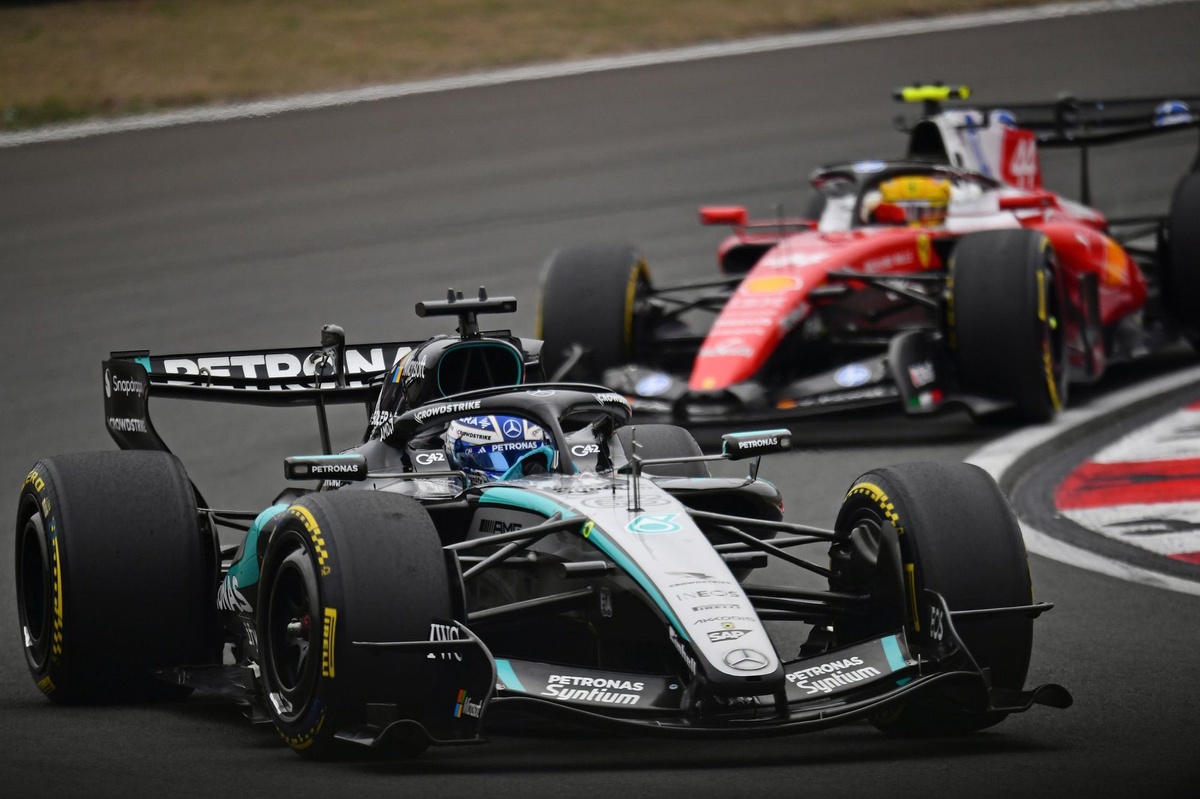
From 1 June, new FIA tests for Formula 1 engines mean Mercedes’compression ratio loophole will be closed – but it may not be sufficient for Ferrari to catch up.
As the world championship switched to new power units for 2026, the internal combustion engine’s compression ratio was reduced from 18:1 to 16:1. However, the ratio is checked at ambient temperature, and Mercedes found a way to expand it when the engine is running.
The Anglo-German team played the trick down, with team principal Toto Wolff arguing it was worth 2-3hp, while Red Bull’s Max Verstappen retorted “you definitely have to add a zero to that, and maybe even more”.
As Mercedes’ main – and arguably only – challenger in the first two grands prix of the season, Ferrari might be closer to Wolff’s stance.
“I’m not convinced that the new compression ratio rule will be a huge game changer,” team boss Fred Vasseur said. “It’s more that you will have the ADUO at one stage – the introduction of the ADUO will be an opportunity for us to close the gap.”
The ‘Additional Development and Upgrade Opportunities’ mechanism means that power units will be evaluated after the sixth, 12th and 18th grands prix of the season. Each time, manufacturers that are between 2% and 4% down on the best engine’s power will be allowed an additional upgrade, while those who are more than 4% down will get two.
In the 2026 season, this was going to happen after the Miami round in May, Spa-Francorchamps in July, and Singapore in October. However, the cancellation of April’s Middle Eastern rounds means the evaluation will now take place after June’s Monaco race, August’s Zandvoort round and the Mexico City GP on 1 November.
Frederic Vasseur, Ferrari
Photo by: James Sutton / Formula 1 / Formula Motorsport Ltd via Getty Images
“But once again, it’s not just about pure ICE performance,” Vasseur insisted. “I think you have a lot in the energy management, a lot in the chassis, and it would be a mistake from our side to be just focused on one parameter.”
Regardless, there clearly is a significant gap between Mercedes and Ferrari. So far in qualifying, the lead Silver Arrow was six tenths faster on average; Ferrari was closer in terms of race pace, though that’s partly down to Overtake Mode, according to Vasseur.
“At the beginning [of the Shanghai race] we were fighting with the Merc,” he said. “As long as we are in the one-second [window], we can have the extra boost, and we are able to keep the pace, but as soon as they are making the one-second gap, it’s much more difficult. We are pushing perhaps a bit more than them on the opening laps, and then after the first 10 laps of each stint, we are coming back to the four, five-tenths a lap that they have.
“We know that we have a deficit of performance, mainly in the straight line, that we have to work on it. We are improving because we were eight-tenths off in Melbourne, six-tenths on Friday, four-tenths on Saturday. Step by step we are understanding a bit more the situation and closing the gap, but they are still far away.
“It’s not just about the engine. It means that we have to work everywhere, we have to improve on the chassis, on the tyres, like always. Racing didn’t change, all the components of the performance are still on the table and we don’t have to be focused only on one parameter, but it’s a challenge.
“We know that we have to improve on the ICE – but this will be after the ADUO [evaluation] – on energy, on chassis, on aero. We are pushing like hell, on every single area to close the gap.”
Ferrari already has a 31-point deficit to Mercedes in the constructors’ championship, while being 49 points clear of third-placed McLaren – with Ferrari customer Haas one point further in arrears.
We want to hear from you!
Let us know what you would like to see from us in the future.
Take our survey
– The Autosport.com Team
Read the full article here


