

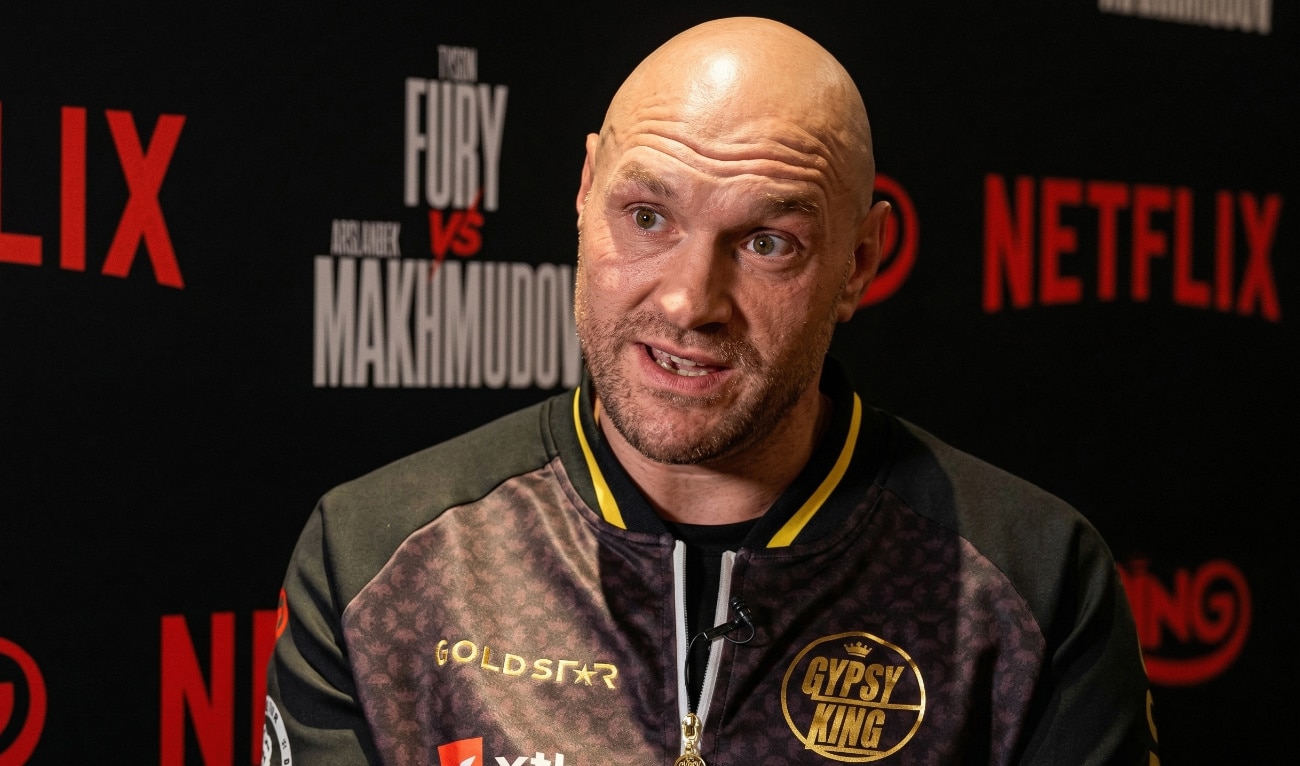

There is no bad blood, no build-up tension, and no attempt to sell it as something bigger. Fury made that clear when describing how he views Saturday night.
“There’s no rivalry between me and Arslanbek. There’s no animosity. There’s nothing. It’s never been a rivalry,” said Tyson Fury to Queensberry about why he’s fighting Makhmudov. “Strictly business.”
The “it’s just business” line is the ultimate shield in boxing. When a fighter uses that phrase, they are basically trying to remove the burden of entertainment value from the conversation.
By viewing it this way, Fury is attempting to bypass a few specific criticisms and pressures. By calling it a “transaction,” he’s signaling that he’s doing this for the paycheck and the activity.
It serves as a subtle defense against the “soft touch” narrative. It’s his way of saying, “I know you wanted a blockbuster, but this is the deal that was on the table, and I’m here to finish it.”
“This is just a business transaction,” Fury said.
Whether it feels like a cheap excuse depends on how you view the heavyweight landscape right now. Fans who feel Fury has been “ducking” certain opponents or stagnating the division will likely see this as a way to coast.
“There’s no need to trash-talk somebody who’s not very good at English, who can’t speak back,” Fury said. “You need a dance partner to do all that with, and Arslanbek is not that person.”
If the former heavyweight king Fury were to scream at and belittle a man who barely speaks the language and is clearly the “B-side” of the promotion, it would look less like promotion and more like punching down. Fury knows that trash talk requires a specific type of opponent to work. Without it, he just looks mean-spirited.
“It doesn’t change. It’s just going to be usual business,” said Fury. “Any man who gets in there to fight me on the night is a challenge,” Fury said. “I’ve got to treat everybody exactly the same.”
For Fury, this is a career-support mission. By labeling it “usual business,” he is trying to project an air of control, but the numbers tell a much more desperate story.
At 37, turning 38 this year and coming off a 16-month hiatus, Fury is returning to the ring with a record that has cratered. If Makhmudov pulls off the upset on Saturday night at Tottenham Hotspur Stadium, the “Gypsy King” era officially ends in a whimper.
A loss would technically be his third in a row after the back-to-back defeats to Usyk in 2024. If you factor in the Ngannou performance, which many fans viewed as a moral defeat, he hasn’t looked like a world-class operator since early 2023.
Fury has always carried extra weight, but in the second Usyk fight, he looked jaded and lacked the elite footwork that once allowed him to dance around giants.
The only reason this fight is happening on Netflix is to build toward a payday with Anthony Joshua. A loss to a 15th-ranked opponent destroys that leverage entirely.
By calling this “usual business” and saying he treats everyone the same, Fury is attempting to sound professional, but it can easily be read as a denial.
There is something inherently sad about a former undisputed-level champion fighting a “B-side” on a streaming platform just to prove he still belongs. If he struggles with Makhmudov, a fighter Fury himself described as “cumbersome” and “slow,” it won’t matter if he wins or loses. The “business” will be seen as bankrupt.
Fury is trying to avoid the desperation narrative by acting like he’s just clocking in for a shift. But when a fighter with a dad’s body and a string of losses starts talking about “business,” it usually means the fire for the sport has been replaced by the need for a check.
Read the full article here