

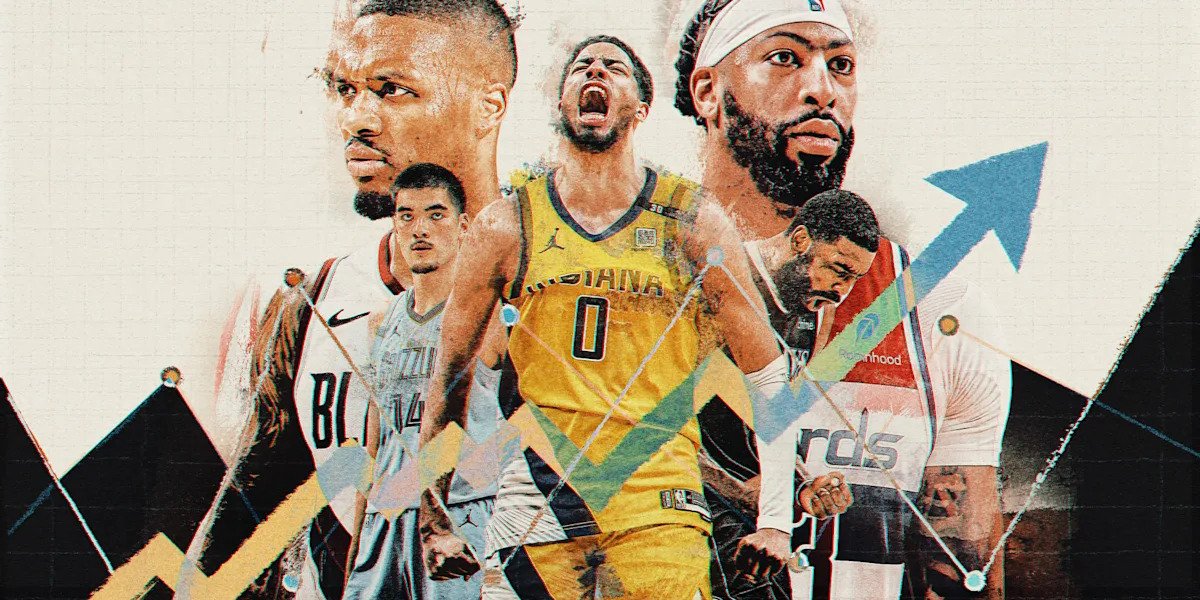
With the bulk of the 2026 NBA offseason’s player movement now concluded, and with the calendar now flipped to August, it’s time to start looking ahead to what’s coming next in the NBA, both this season and afterward.
In that spirit, and in the interest of killing some time in the depths of the summer, let’s take a look at the five* most interesting players — to me! — who’ll be making a comeback this season after missing all or more of last season.
(We previously considered my five most interesting potential free agents in the class of 2027.)
We begin with a man coming back after one false step cost him nearly everything:
When last we saw Haliburton, he had nine points in the first seven minutes of a tied Game 7 of the NBA Finals. He opened the biggest game of his life on fire, looking for all the world like a man intent on completing his monthslong mission: delivering Indiana’s first championship since the ABA and doing so by etching his name into the pantheon of all-time big-game crunch-time killers.
We know what happened after that, and why Haliburton missed the entirety of the 2025-26 NBA season. It’s not exactly as simple as saying that his absence explains the Pacers cratering from a 50-win offensive incineration machine into a 19-win squad with one of the league’s most feckless attacks; Myles Turner was also gone, and every other member of their 2025 playoff rotation besides Pascal Siakam missed a ton of time with injuries. But when one player is so singularly responsible for every element of orchestrating your offense — of injecting pace and danger into the game; of making everyone else’s offensive life easier, and sometimes even tenable; of finding the most direct pathway to points on any given possession, even (maybe especially) if it’s a pathway nobody else can see — it’s also not not that simple.
Since he arrived in Indianapolis at the 2022 trade deadline, the Pacers have gone as Haliburton goes. When he was there, they made consecutive Eastern Conference finals, found something like total basketball harmony, and came one win shy of the ultimate prize. When he was gone, so were they.
And now, Haliburton’s back. Back throwing down Eastbays in workouts. Back trolling Knicks fans in WWE storylines and wedding reception performances. Back using the NBA schedule to manufacture shoulder-chips. And, most importantly, back to full-speed, full-contact, full-tilt work in preparation for the 2026-27 season.
“I am telling you, I’m going to be healthy right now,” he recently told reporters. “I feel great. I’m doing everything. I’m playing pick-up pretty regularly at this point. I feel great. I will be ready for the season. If the season was today, I’d be ready.”
It’s reasonable to harbor some skepticism about just how ready. Might a player whose game is predicated so much on speed, quickness, touch and feel need some time to shake off the rust? How long will it take for him to develop chemistry with a new pick-and-roll partner in the just-arrived Ivica Zubac, a very different style of 5-man than Turner? Can the other key pieces of the 2024-25 squad — all of whom, with the exceptions of Turner and Bennedict Mathurin, are still around — just smoothly and immediately slot back into their respective roles and recapture the collective rhythm they found during that magical Finals run?
There’s no guaranteeing that the Pacers will just respawn at their last save point. Even with their best player, the one who defines their identity and the font of their offensive fluidity, they might not just instantly get right back to being able to trade haymakers with the likes of the 60-win Pistons, revamped 76ers, potentially Kawhi-ified Raptors and an increasingly tough Eastern Conference — led by, of course, the NBA champion Knicks. It might take some time.
Then again, as head coach Rick Carlisle said after his Pacers defeated the Knicks in the 2025 Eastern Conference finals — the second straight spring in which Indiana ended New York’s season: “Well, if you have the right player to build around, it can happen much faster than you think.” The Pacers have him again. Gentlemen, start your engines.
From the beginning of February to the beginning of March in 2025, Irving averaged 28.1 points, 5.8 rebounds, 4.1 assists, 1.8 steals and 1 block per game. He topped 30 points six times in that 10-game span, shouldering nearly the entire offensive load for a Dallas Mavericks team that had just traded Luka Dončić for two quarters of Anthony Davis and doing so at a level that only MVP winner Shai Gilgeous-Alexander had matched over the course of the full season.
And then, Irving tore the anterior cruciate ligament in his left knee on a drive to the basket against the Sacramento Kings. We haven’t seen him on the floor since — an absence of more than 17 months.
An awful lot has happened in Dallas since the last time we saw Kyrie play basketball. Davis, expected to serve as Irving’s tag-team partner following the Luka deal, played fewer than 900 minutes in a Mavericks uniform before being redirected to D.C. (More on him in a second.) The executive who dealt Dončić and brought AD to town, Nico Harrison, got run out of town on a rail.
Of the 11 other Mavericks who were active alongside Irving in that game against Sacramento, only three remain on the roster: the just-extended Naji Marshall, Max Christie and — for now, at least — Klay Thompson. Stretch back to the group that surrounded Irving in the 2024 NBA Finals, and there are three more: centers Daniel Gafford and Dereck Lively II (who has only played seven games in the last 19 months himself, undergoing three separate surgical procedures on his right foot in that span, and is still working his way back onto the floor), and — for now, at least — P.J. Washington.
Since the last time Kyrie played, the Mavericks have hired a new president of basketball operations, Masai Ujiri; a new general manager, Mike Schmitz; and a new head coach, Dusty May. They have a new face of the franchise in reigning Rookie of the Year Cooper Flagg, and a number of other new young faces, including lottery pick Morez Johnson Jr. and former No. 1 overall pick Zaccharie Risacher. This, very clearly, is a franchise that has turned the page — a franchise intent on breaking from the tumult of its recent past in hopes of moving into a bright new future.
And yet, despite not controlling their own first-round picks through 2030 as a result of past deals, and despite having clearly reoriented the entire organization around the timeline of the 19-year-old Flagg, the Mavericks resisted reported inquiries from playoff teams like the Detroit Pistons and Minnesota Timberwolves (who later swung a blockbuster for LaMelo Ball) for their 34-year-old point guard. Why?
Well, after finishing 27th in points scored per non-garbage-time possession last season, with Flagg spending the bulk of his freshman campaign flanked by Ryan Nembhard, Brandon Williams and D’Angelo Russell at the lead guard spot, you can understand the Mavs’ new brass wanting to at least get a look at how a Kyrie-Flagg partnership might fare — especially after they’ve had a chance to work out together a bit this summer.
“Kevin Durant once told me that there’s only one Kyrie walking around in the world,” Ujiri told reporters. “I think we have to figure out a way how Kyrie fits with our program. And I’ve had those conversations with Kyrie up until [Tuesday]. And I think Kyrie will fit. I’ve said it before. There’s a huge curiosity of our minds to see how Kyrie fits and plays with Cooper Flagg. … I think we owe this organization that.”
May, who wants to succeed where many others have failed in making the treacherous jump from college to the pros, likes the idea of having a nine-time All-Star who’s one of just 23 players ever to average at least 20 points and five assists per game for his career (minimum 500 games played) on hand to help kickstart his tenure.
“Kyrie knows what it takes to win a championship, so, as a first-time NBA coach, I’m going to lean on him in a lot of areas,” May said after his hire. “And someone as intelligent as he is, it’s going to bring a lot to the table for all of us.”
They’ll need him to. With only former Pistons reserve Marcus Sasser and Spanish rookie Sergio de Larrea behind him in the backcourt, getting a full-fledged return from Irving stands as the Mavs’ best chance at reducing Flagg’s shot-creation burden and improving on last season’s bottom-five finishes in 3-point makes, attempts and percentage. That, in turn, could represent Dallas’ best shot at leaping from 12th in the West back into the play-in picture.
Irving, for his part, sounds like he’s ready to go for the final fully guaranteed season on his deal ahead of a $42.4 million player option for 2027-28. If he is — and if he’s able to stave off wear-and-tear and stay on the floor — he could put himself in position for another big contract, and put the Mavs in line for a quicker-than-expected return to relevance in Flagg’s sophomore season.
It’s not easy to overlook a guy who’s measured at 7-foot-3 and 305 pounds … unless, of course, he has played a grand total of 284 minutes in the last 27 months.
After earning a 2024-25 All-Rookie selection as the starting center on a Grizzlies team that won 48 games and made the playoffs, Edey — the No. 9 pick in the 2024 draft — barely got on the floor last season. Offseason surgery on his troublesome left ankle cost him the first 13 games of the campaign; a December stress reaction in that same ankle, followed by another procedure on it in March, cost him the final 58.
In the 11 games he was there for, though? Edey was kind of … I don’t know, Godzilla?
The former Purdue standout averaged 13.6 points on 63.3% shooting, 11.1 rebounds and 1.9 blocks in 25.8 minutes per game while he was healthy. A Grizzlies team that went 25-57 overall went 7-4 with him in the lineup.
Opponents shot 67.8% at the rim against the Grizzlies, according to Second Spectrum, one of the worst marks in the league; they shot 57.9%, nearly 10 percentage points lower, when Edey was the closest defender. He hauled in 16.1% of Memphis’ missed shots during his time on the floor, and 30.6% of opponents’ misses — offensive and defensive rebounding rates that both would’ve ranked in the top three in the NBA among qualifying players.
A Grizzlies team that was outscored by 5.8 points per 100 non-garbage-time possessions for the season blitzed the opposition by 20 points-per-100 in Edey’s minutes. No player to log at least 250 minutes last season had a larger on-court/off-court split.
Is all that a pretty dramatic double feature at the ol’ Small Sample Size Theatre? Yes. Is the history of huge guys with foot, ankle and lower leg injuries troubling? Undoubtedly. Did six of those seven wins come over the also-very-bad Mavericks, Pelicans, Kings and pre-Chris Paul-jettisoning Clippers? Most definitely. Did the seventh come over a Trail Blazers team that had yet to find its way, was missing Donovan Clingan and Jrue Holiday, and started Yang Hansen at the 5? You know it.
All the same: Amid the teardown of a perennial playoff roster that has seen Desmond Bane shipped to Orlando, Jaren Jackson Jr. sent to Salt Lake City and Ja Morant dealt to Portland, Grizzlies general manager Zach Kleiman has continued to refer to Edey as a member of Memphis’ young core, alongside fellow 2024 draftee Jaylen Wells, 2025 lottery pick Cedric Coward and 2026 No. 3 overall pick Cameron Boozer. Memphis head coach Tuomas Iisalo referred to Edey’s 11 appearances last season as “the only stretch this season when we had stability, and when you have stability with the players that are available, you can build on each game and you can start to build something longer term.”
The Grizzlies have hedged their bets somewhat on Edey’s health this summer, first by swinging a trade for former Pistons reserve — and, really, pitch-perfect spiritual Grit ‘n’ Grind successor — Isaiah Stewart and then by signing restricted free-agent stretch big Quinten Post from Golden State. Between the newcomers, the arrival of the eminently pro-ready Boozer and holdover small-ball 5s like Olivier-Maxence Prosper and Taylor Hendricks, Iisalo will have some options to deploy if (and, most likely, when) Edey misses time.
But the reporting has suggested that Edey’s likely to be ready for opening night. If he’s ready to go — penciled into the starting lineup to provide a back-line anchor and glass-controlling possession-ender behind what should be a long, athletic perimeter core, and to act as a brick-wall screener and soft-handed finisher for potentially revelatory point guard Ty Jerome — then a Memphis side that was interesting mostly for the persistent off-court drama surrounding Morant could suddenly become way more compelling as an actual on-court product.
Provided, of course, we can buy what the big fella was selling in those 11 games.
“I think the season showed me the player that I could be, that I want to be, and I should be in this league,” Edey told reporters during his exit interview. “It’s just a matter of health. I’ve got to stay healthy.”
I don’t blame Young for saying on a recent episode of the podcast “The Pivot” that he feels like this is the “most slept-on [he’s] been in [his] whole life.” He was a top-20 national prospect and five-star recruit coming out of high school. He was a consensus All-American at Oklahoma, the first player ever to lead the nation in both scoring and assists. He was a top-five pick in the 2018 NBA Draft, an All-Rookie selection in Year 1, an All-Star in Year 2, the leader of a conference finalist in Year 3, an All-NBA selection in Year 4 and a max player by Year 5.
From preps to pros, Young was routinely recognized as one of the game’s best young offensive players. Even as his Atlanta Hawks teams largely sputtered after that 2021 conference finals run, he continued to rack up numbers and All-Star nods. But after consecutive sub-.500 seasons that ended without a playoff berth, Young found himself without the lucrative contract extension he’d expected — an indication that the way he was viewed had shifted.
Less than three months into the 2025-26 season, the team that drafted Young traded him from the city he’d ruled. The deal didn’t even net the Hawks any draft picks.
Young played all of 104 minutes before being shut down with quad and back injuries by the desperately tanking Wiz, bringing his grand total for the season to just 15 utterly nondescript games. (You’ll note that those injuries didn’t deter Washington’s brass from giving Young an eye-poppingly sizable four-year, $212 million contract.) The reshuffled Hawks, meanwhile, promptly took flight, playing better in Young’s absence than they had in ages and returning to the playoffs, where they became the only team to take more than one game off the eventual champion Knicks — thanks in large part to C.J. McCollum, whom the Wizards sent to Atlanta in the Trae trade.
So, yeah: When you barely played last year, when you haven’t played past the first round of the playoffs in five years, and when the team that traded you immediately starts playing better after the deal, folks might start to wonder whether you’ve still got the juice to propel a team toward postseason relevance. The same holds for Davis, who was limited by injuries and indifference to just 20 games last season between Dallas and D.C., and who has played more than 60 regular-season games and played beyond the opening round of the postseason just once since the 2020 bubble.
The theory of the case for the post-“deconstruction” Wizards goes something like this:
-
Davis — who, lest we forget, was averaging damn near 26 points, 12 rebounds, 3.5 assists and 3.5 stocks per game in L.A. before the Luka trade led to him getting banished to the Shadow Realm for like a year and a half — will join Sarr, Dybantsa, Bilal Coulibaly and Co. to use their collective length and physicality to insulate Young, who has routinely graded out as one of the worst individual defenders in the NBA, from repeated hunting by opposing offenses;
-
Adding two experienced All-NBA-level players (plus returning vet Khris Middleton) gives the young guys an example to follow as they build the habits that will define their careers;
-
The overall infusion of proven talent raises the floor of a franchise that hasn’t finished over .500 since before Trae was drafted (and that has never won 50 games) — and having an elevated floor matters more in a post-lottery reform world in which being the Absolute Worst isn’t as helpful as it used to be;
-
Having a couple of recognizable names, plus Dybantsa, gives the Wizards more juice (and sells more tickets) than they’ve had since the decline of the John Wall-Bradley Beal partnership.
In fairness, in those five games and 104 minutes of basketball that Young played for the Wizards after the trade, he shot the cover off the ball (59.5% from the field, 42.9% from 3-point range), delivered an assist on 47.5% of Washington’s offensive possessions (which would’ve been the highest assist rate of his career) and finished just 26.3% of the Wizards’ trips with a shot attempt, foul drawn or turnover (which would’ve been the lowest usage rate of his career).
It feels like a lot has to break right for that theory to prove out, and for the Wizards to go from three straight win totals in the teens to suddenly vaulting back into postseason contention. Davis sure seems to think so; he reportedly wants to slow-play talks on a new extension of his own, perhaps due in part to lingering skepticism that the plan will come to fruition.
“I’ve been in this league a long time, and I’ve been with losing teams, been on losing teams,” Davis said during an April appearance on “The Draymond Green Show.” “It’s very hard to be a losing team and then a championship contender, right? […] That’s what I would like to see. What is our plan for winning going into next season? And how? Not like this is a plan, but how do we execute that? And based on that, we’ll kind of see what happens.”
(I’m guessing the Wizards’ marketing team isn’t rushing to put that slogan on the opening night T-shirt.)
While Davis, who holds a $62.8 million player option for 2027-28, proceeds with caution as he considers his next move, the freshly paid Young sounds eager to go full steam ahead.
“Imagine the Wizards as the No. 1 team in the East next year,” Young said on “The Pivot.” “What are people gonna be saying?”
I can’t speak for anyone else, but I am pretty sure I will be saying, “Holy s***! This is IMPOSSIBLE! I absolutely cannot believe this! This is incredible! Is this real? How the hell did this happen?”
Whatever actually winds up coming out of my mouth, though, this much I know for sure: If Trae and AD get the Wizards to the top of the East, none of us will be able to sleep on them anymore.
You know what I missed? Watching Damian Lillard shoot. Luckily, the Portland Trail Blazers have a schedule-release video for that:
Forays into All-Star Weekend festivities aside, it’s been 15 months since Dame last laced a triple like that in a game of consequence — since before the Achilles rupture that ended his 2024-25 season, that effectively ended his ill-fated tenure in Milwaukee, and that precipitated his surprise return to the Pacific Northwest. It’s a virtual certainty he won’t waste much time getting one up when he next takes the court; the situation surrounding him, though, features plenty of uncertainty.
See, Dame’s not the only All-Star point guard we haven’t seen play in a while who’ll be suiting up in Portland this fall. After they traded for Ja Morant, NBA insider Chris Haynes reported that Blazers intended to start Lillard and Morant together in the backcourt, with All-Star Deni Avdija slotting in alongside them on the wing. On one hand, the introductions of Lillard, who averaged more than 24 points and seven assists per game on .604 true shooting during two “down” seasons in Milwaukee, and Morant, still one of the most electric pick-and-roll penetrators in the league when healthy, should provide a boost to an offense that has finished in the bottom 10 in offensive efficiency three straight years, with persistently errant 3-point shooting and a punchless half-court attack.
On the other, though: The Blazers returned to the playoffs last season in large part on the strength of a defense that finished just outside the top 10 in points allowed per non-garbage-time possession, and that smothered opponents like a top-five unit when Jrue Holiday and Toumani Camara shared the floor with center Donovan Clingan. I’m not an analytics genius, but if you’re starting both Lillard and Morant alongside Avdija and Clingan, and you only get five spots in a lineup, then I don’t think that leaves room to keep both Camara and Holiday in the starting group to harass ball-handlers the full 94 feet and pressure them at the point of attack. How exactly will head coach Micah Nori — oh, hey, that’s right, the Blazers have a new head coach, too — maintain a top-10-caliber defense with a pair of 6-foot-2 guards who’ve never exactly been stoppers?
Introducing two established star-level guards into the ecosystem also seems like it’ll curtail the minutes and opportunities of Scoot Henderson, the former No. 3 overall pick who started to come into his own in the final couple of months of last season after battling inconsistency and injuries. What kind of role will Nori find for the 22-year-old, who’s eligible for an extension of his rookie deal right now and will hit restricted free agency next summer if he doesn’t sign one? And what does the sudden logjam in the backcourt mean for Shaedon Sharpe, whom the Blazers gave a four-year, $90 million extension last fall?
Maybe Nori, very highly regarded after his stint as Chris Finch’s right-hand man in Minnesota, and his staff land on satisfactory answers to all those questions in the early going. Maybe they figure out how to balance the ball-handling and shot-creation opportunities enough to keep Deni, Dame and Ja happy and productive, while also managing to prevent the defensive identity that Tiago Splitter (and, before him, Chauncey Billups) established from slipping away. Maybe the injection of offensive talent is enough to put Portland in position to climb the Western ladder; maybe, if they get enough breaks, they’ll even have a shot to get out of the first round of the playoffs for the first time since before the pandemic.
I think I’m going to need to see some of those questions get answered in the affirmative before I’m ready to believe they will. One thing that’d probably help: Lillard coming back off his extended absence ready, willing and able to scorch the nets from distance once again.
Read the full article here