



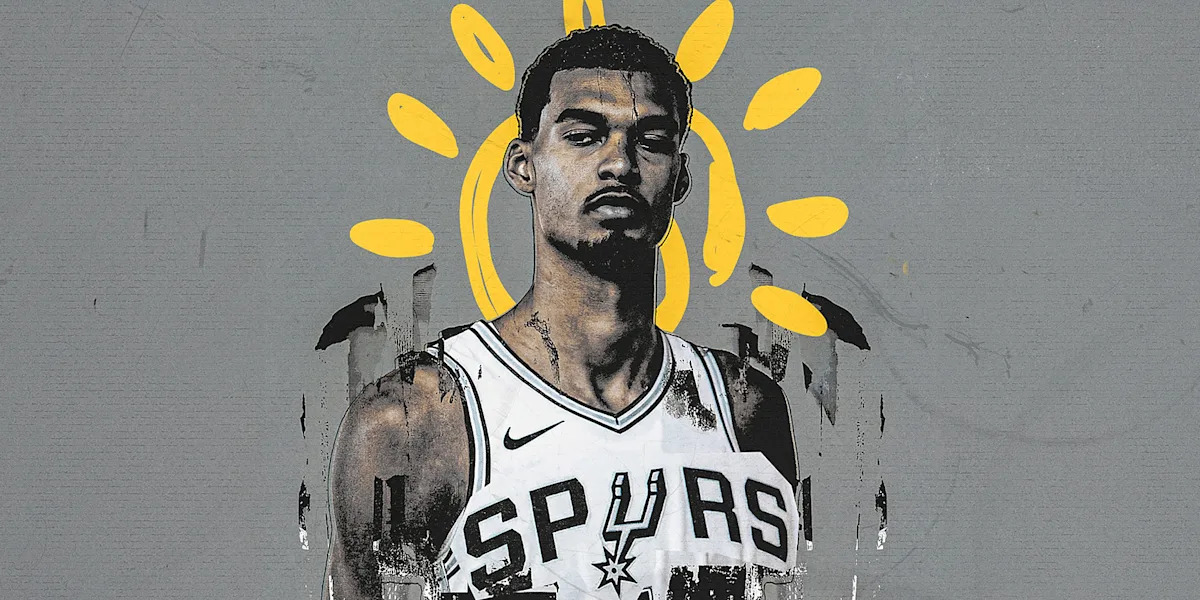
An electric regular season is nearing its end, which means two things:
1) We’re about to flow into an even crazier postseason, and 2) it’s time to put the finishing touches on award races.
Chief among them is the MVP award, the NBA’s most prestigious regular season honor. There have been plenty of great individual campaigns this season, but the MVP race has largely dropped to a four-player group: the reigning winner Shai Gilgeous-Alexander, a multi-time winner in Nikola Jokić, and a pair of megastars in Victor Wembanyama and Luka Dončić hunting for their first.
This week, I’m breaking down the cases for all of them — or at least I planned to before Dončić suffered a hamstring injury that may make him ineligible for any awards. This series is less about who I think should win — I revealed that on Friday’s episode of The Dunker Spot — and more about helping others either bolster their arguments for their favorite candidate, or understand the legitimacy of the other cases.
After examining the Jokić case on Tuesday and SGA on Thursday, we’re going to talk about Wemby today.
Let’s dig in, shall we?
All stats are updated through games played on April 10.
Tale of the tape
Record: 50-14 (78.1% win rate, 64-win pace); 12-5 without him (58-win pace)
Notable per-game rankings (min. 50 games): 13th in scoring, 4th in rebounds, 1st in blocks
Notable advanced stats: 1st in LEBRON, 1st in defensive estimated plus-minus (D-EPM), 2nd in estimated plus-minus (EPM), 4th in Win Shares per 48
The basic case: Who’s providing more per-possession impact?
The framing here is important.
Wemby, due to a combination of early injuries, preventative maintenance (nine games as a reserve), and the Spurs’ own dominance in 2026, simply will not play more than Jokić or SGA. He’s trailing both by nearly 400 total minutes, and that’s just not a gap that’s going to close in any significant way on Sunday.
Despite the minutes gap, Wemby has driven winning to an insane degree. The Spurs have won at a 64-win pace in the games he’s appeared in, and have outscored opponents by a whopping 682 points in his minutes — that ranks second behind SGA (+788).
(Hayden Hodge/Yahoo Sports Illustration)
The largest portion of that equation is what Wemby does on the defensive end. To be frank, we’ve never seen a defender like this: 7-foot-4 with an 8-foot wingspan that isn’t stuck in quicksand as a mover.
It’s hard to comprehend, much less actually quantify, what his presence alone does to opposing offenses. He covers an insane amount of real estate, amplified by the Spurs essentially using him as a one-man zone to make the paint inaccessible.
We can start with the easy stuff: Wemby leads the NBA in blocks (3.1, 197 total) by a landslide, and opponents convert only 53.6% of their shots at the rim when he challenges them — third behind Chet Holmgren (47.7%) and Brook Lopez (53% in the Big 2026!) among high-volume rim-protectors.
You’d guess that someone with his dimensions would have a wide “block radius,” but some of the swats from this season are video game-like. His block against Heat guard Norm Powell, in which Powell did the “right thing” by using the rim as a shield on a reverse layup attempt only to get it swatted anyway, is one I’m still struggling to wrap my mind around.
There’s a quieter highlight from the Spurs’ showdown against the Nuggets last weekend where he’s battling with Jonas Valančiūnas on the block. Wemby reaches for a steal, Valančiūnas tries to take advantage of that failed aggression with a swipe-through, and Wemby is able to both retract his arm to avoid a foul and get the block in one fluid motion.
Those are just two (of his 197) from memory that stuck with me; you can choose from a bevy of post-up blocks, floater rejections, top-of-the-backcourt swats and feel the absurdity. Because he has great timing, instincts, and historic length, teams don’t generally like attacking when the big fella’s in the paint.
To that end, opponents take only a paltry 26.2% of their shots at the rim with Wemby on the floor, a mark that would rank second only to Boston’s absurd 24.1% figure. With Wemby off the floor, that jumps to 31.6% (equivalent to 18th).
The effect on overall rim efficiency isn’t as loud — 60.8% (would rank second) with Wemby on the floor, 64.6% (would rank sixth) with him off — but that represents an 87th percentile differential.
But notice, I started this by referencing Wemby in the paint, not just near the rim.
With him on the floor, opponents don’t take as many floater-range shots (-8.3%, 98th percentile) or long middies (-10.1%, 92nd percentile). Teams do take way more corner 3s (+3.6%, 23rd percentile), but that’s literally baked into the keep-Wemby-low plan.
(It’s been interesting to see teams get more intentional about who they’re spacing in the corner in light of that plan. It’s worth tracking its effectiveness in the postseason.)
Trying to directly engage Wemby — putting him in action, if you will — has its merits logically. Pulling him out of the paint should, in theory, open up avenues to attack behind him. And while he’s grown with his footwork and space-navigation in drop coverage, there’s still room for him to get better. Drivers (or strong rollers) are still able to dislodge him a bit with shoulder bumps to the chest.
In practice, though? Teams still haven’t had fun.
Among 31 players to defend at least 1,000 ball screens, Wemby’s 0.85 PPP mark ranks first; Jalen Duren (0.88) and Holmgren (0.89) are the only other players under 0.9. Even with growth areas present, he’s been absurd in drop coverage (0.84 PPP) and more than serviceable on switches (0.94; league average is 0.96).
The only thing to really poke at with Wemby’s defensive case, fun blocks notwithstanding, is how he’s fared on post-ups. A 1.57 PPP mark looks like a typo; it’s telling, though, that this has only come on 23 reps all season.
Of those, 13 have come from either Jokić or Alperen Şengün — two strength-based post options that coincidentally rank first and second in total post-ups this year.
Zoom out, and you have a Spurs defense that defends at an absurd, league-leading level with Wemby on the floor (105.1 defensive rating; OKC is first at 106.9), and falls off a cliff (117.1, would rank 20th) when he sits. That 12-point differential also ranks first, edging out Rudy Gobert (-11.8) and Derrick White (-10.3) among players to log at least 1,500 minutes.
Let’s talk about the offense
You know how good your defense has to be for 25.0 points on 59/35/83 shooting splits (62.6 true shooting, 4.1 points above league average) to be your secondary case?
That’s where we are with Wemby, a guy that’s objectively in the midst of figuring things out while managing to drop [checks notes] three 40-point games in his last five outings.
I understand the risk of sounding repetitive by saying variations of “it’s not supposed to look like this” but, I mean, it just isn’t supposed to look like this.
His handle, while poke-able, is still good enough to win 1v1s in a way that defies logic. His grab-and-go sequences in transition are electric; you don’t know if he’s truly going coast-to-coast with dunk gathers starting at the 3-point line, or if he’s legitimately going to take a pull-up 3. (I, for one, have enjoyed the trend of him blocking shots and almost immediately taking a pull-up 3 as a treat to himself.)
If you’ll allow me a cross-league comparison, there have been shades of A’ja Wilson in Las Vegas and Satou Sabally in Phoenix when it comes to the Wemby experimentation.
To the A’ja portion, there’s a clear desire to give their big star more freedom. That’s where you see the uptick in Wemby bringing the ball up (5.9 per game, up from 5.3 last year), initiating ball screens (185, career-best 0.98 PPP), and receiving more off-ball screens (334, a ridiculous 1.16 PPP mark on those possessions) in the flow of their offense.
I’ve had a great deal of fun watching the Spurs hit opponents with early flare screens to give their guys a running start. Wemby has received 54 flares this year after receiving 22 across his first two seasons. The Spurs have generated over 1.3 points per possession on those trips; please keep mixing those in!
But then there’s the Sabally portion of the equation; Wemby can do a little bit of everything, but the Spurs are still trying to figure out the right dosage (and location) of everything.
One of the early storylines of the season was Wemby essentially cutting his 3-point volume in half, though that volume has grown (6.2 attempts post All-Star break, 5.0 attempts before it) as the season has unfolded.
He grades out below average in self-creation situations: 0.94 PPP (league average is 1.03) on post touches, 0.96 PPP (league average is 0.98) in isolation. But when either of those touches have come in the middle of the floor, complicating an opponent’s ability to send help, you’ve gotten dominant flashes of what this could turn into.
The most impactful piece of Wemby’s game right now is his work as a roller in ball screens. The Spurs have generated a whopping 1.12 points per possession on trips featuring Wemby as an on-ball screener. That easily leads the league among high volume rollers (min. 750, 60 players), outpacing Lakers center Jaxson Hayes (1.08).
He’s grown as a screener (though there’s still room), but, as my illustrious Dunker Spot co-host Steve Jones Jr. would note, he’s really gotten better at angling his body in a way to force defenders to navigate higher on the floor regardless of the amount of contact Wemby actually levies.
Giving any of those ball-handlers — De’Aaron Fox, Stephon Castle, Dylan Harper, Devin Vassell to a lesser extent — some variation of two-on-the-ball while Wemby rolls has largely spelled trouble for defenses. The same way Wemby high-points shot attempts for highlight blocks, he does so for lob attempts.
Even when he doesn’t get the ball, his roll gravity opens up opportunities for everyone else on the floor. Despite ranking outside the top-40 in screen-setting volume, he’s in the top-20 in terms of how often he’s been tagged on his rolls. Those tags open up weakside skips to shooters in the corners. And even with a tag, Wemby is so large that he can muscle through and get lob opportunities anyway.
Related: the Spurs generate 1.2 points per possession on ball screens where Wemby is tagged, best in the league among 58 players with at least 100 reps.
Also related: the Spurs shoot 40.5% on corner 3s when Wemby’s on the floor, and only five players have a more positive impact on corner 3 frequency than Wemby does.
This is all before digging into Wemby’s growth as a passer. The assist number (3.1) may not wow you, but I’ve been impressed with the way he’s mapped out the floor. The inverted ball screens with him pop in part because he’s gotten really good at slipping in passes to whoever his screener is. There have been quite a few corner skips in his film that have legit wowed me in terms of the timing and placement.
His turnover rate has dropped considerably from last year. The aggressive double teams that the Suns and Nets were able to disrupt him with earlier in the year don’t seem to phase him as much.
That’s not to say he’s completely solved them, but he has done a much better job of diagnosing when and where the doubles are coming from and delivering counter-passes as a result.
Here is how he’s fared on touches where he’s seen a second defender (or hard double) throughout the season:
-
Oct/Nov (12 games): 167 touches, 0.99 PPP, 9.0 turnover rate
-
Dec (9 games): 81 touches, 1.17 PPP, 8.6 turnover rate
-
Jan (13 games): 97 touches, 0.93 PPP, 13.4 turnover rate
-
Feb (11 games): 110 touches, 1.17 PPP, 6.4 turnover rate
-
Mar (15 games: 140 touches, 0.96 PPP, 9.3 turnover rate
-
Apr (4 games): 45 touches, 1.40 PPP, 2.2 turnover rate
This is how an imperfect offensive player can still average 25 points per game on high efficiency while managing to throw defenses for schematic loops. When you add that with legitimate game-breaking defense — he’s winning DPOY, folks — it’s easy to map out an MVP case despite the minutes gap.
Read the full article here


