

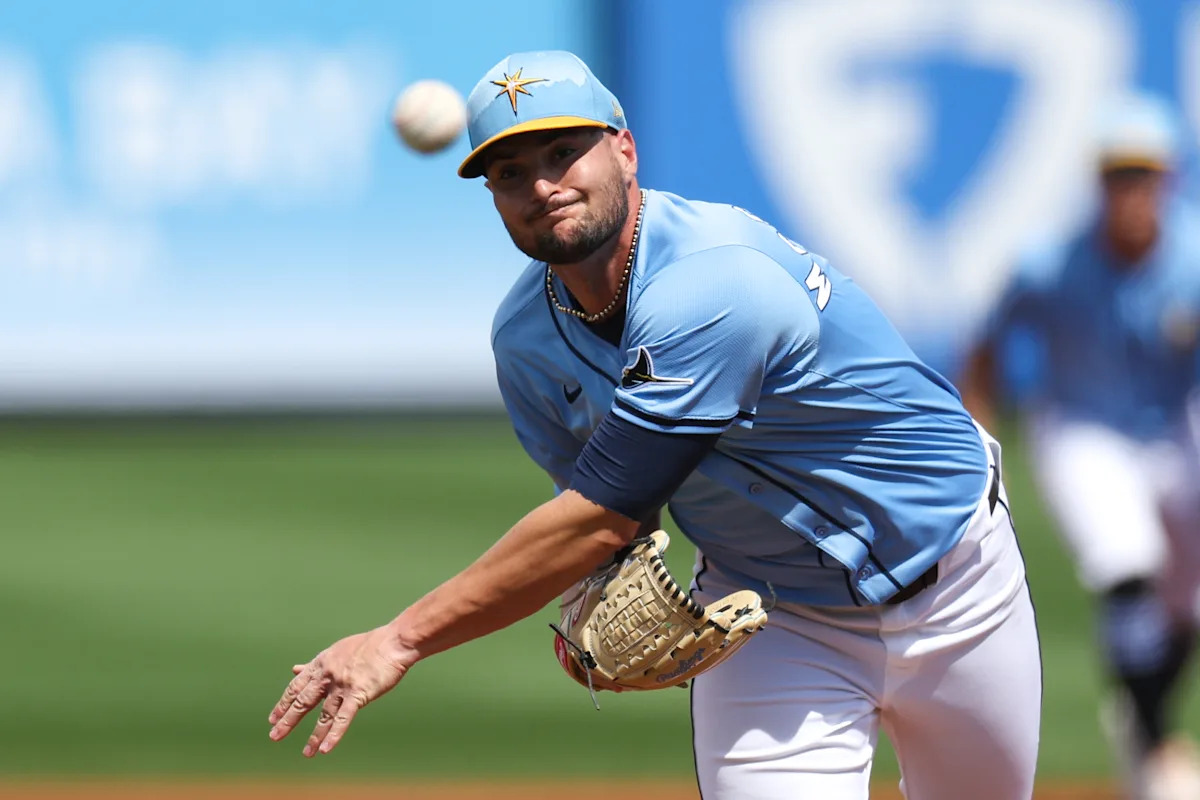
With Shane McClanahan hopefully returning to the rotation for the first time in two seasons, the Rays will need to manage his workload carefully to ensure he’s healthy for October – both this year and beyond. The goal isn’t necessarily to restrict or limit him, but to preserve his health while also allowing him to provide value in a structured way.
The most effective way to do that while maximizing overall rotation performance may be to abandon the traditional five-man model altogether.
Optimizing Performance
Below I’ve listed wOBA-against for starting pitchers by the number of days between starts for the league across the last decade including the postseason. For instance, two days since a pitchers most recent start would mean they had one day of rest (Player A pitched on a Monday, rested on Tuesday, and then pitched again on Wednesday):
|
Number of Days Rest Between Starts |
wOBA-against |
|
1 Day |
.338 |
|
2 Days |
.325 |
|
3 Days |
.326 |
|
4 Days (Traditional 5-man rotation) |
.319 |
|
5 Days (Proposed 5.5-man rotation) |
.316 |
|
6 Days |
.321 |
|
7 Days |
.318 |
|
8 Days |
.321 |
Two points of wOBA is worth roughly one run per 600 plate appearances. Over 3,600 batters (about what a rotation faces in a season), a three-point improvement translates to roughly nine runs, or about one to two wins. Of course, with off-days, rainouts, injuries, etc. not every start in a season will be made with five days between starts, but there’s still a clear benefit to aiming for that amount of rest. A one-win edge may seem marginal, but teams routinely spend millions of dollars in free agency to gain that same advantage. While these are marginal performance gains, the primary benefit would be sustainable usage/workloads and – as a byproduct of that – possibly reduced injury risk.
A six-man rotation would also maximize the number of starts made on five days of rest. However, it can limit bullpen flexibility unless there are multiple, optionable multi-inning relievers available on the 40-man. Unlike a six-man rotation, this approach intentionally caps McClanahan’s workload per outing while maintaining five traditional starters.
What a Rays 5.5-Man Rotation Could Look like
The deepest area of the roster may be the starting pitching group. They’ve got 10 guys on the 40-man roster who could realistically start games in the majors this season:
Established Starters
Workload Management
Bulk/Piggyback/Flexible Pitchers
Among this group, Rasmussen, Pepiot, and Martinez are all guys who will likely start without many limitations. The rest will have limitations in some capacity due to a variety of factors (recovery from injury, previous season’s workload, strike throwing consistency) but are still valuable in bulk and starting roles. Any shift away from the traditional five-day cycle would require buy-in from pitchers accustomed to routine.
There are also a handful of guys not on the 40-man roster who are capable of pitching in bulk and starter roles if needed: Chase Solesky, Jake Woodford (who we recently profiled), and Logan Workman.
The health of the group coming out of spring training will largely determine who is on the Opening Day roster. If the Rays were to go with a 5.5-man rotation, they would carry six pitchers from this group. The obvious counterargument is that it would shorten bullpen depth. However, if they carried a seventh pitcher capable of 3-4 inning outings in tandem with the “half” starter, they could avoid overusing their short-relief options. Those innings would be planned and assigned to designated multi-inning arms, rather than spread across high-leverage relievers. Boyle, Seymour, Englert, and Scholtens all have options, so they could easily rotate in and out of that role throughout the season to help keep the bullpen fresh.
Below is an example of what it could look like in practice.
The exact names at the back of the rotation and in the bullpen are less important than the conceptual part of how this could all fit together. The greatest area of depth (and possibly the roster’s greatest strength) on the roster is their starting pitching/bulk options, so why not leverage that in a creative way to get the most out of the pitching staff as a whole? The swingman in the bullpen would primarily be used in combination with the half-starter but could be deployed in tandem with another starter depending on the context of a game.
-
Half-starter: Shane McClanahan
-
Bulk/swingman: Steven Matz
A 5.5-man rotation wouldn’t be a gimmick. It would be a structural hedge against injury and fatigue through workload management – and a way to ensure McClanahan is at full strength when the games matter most.
The Rays have long embraced incremental edges, even when they challenge convention. This would simply extend a philosophy that has already produced openers, bulk relievers, and fluid roles.
Read the full article here