



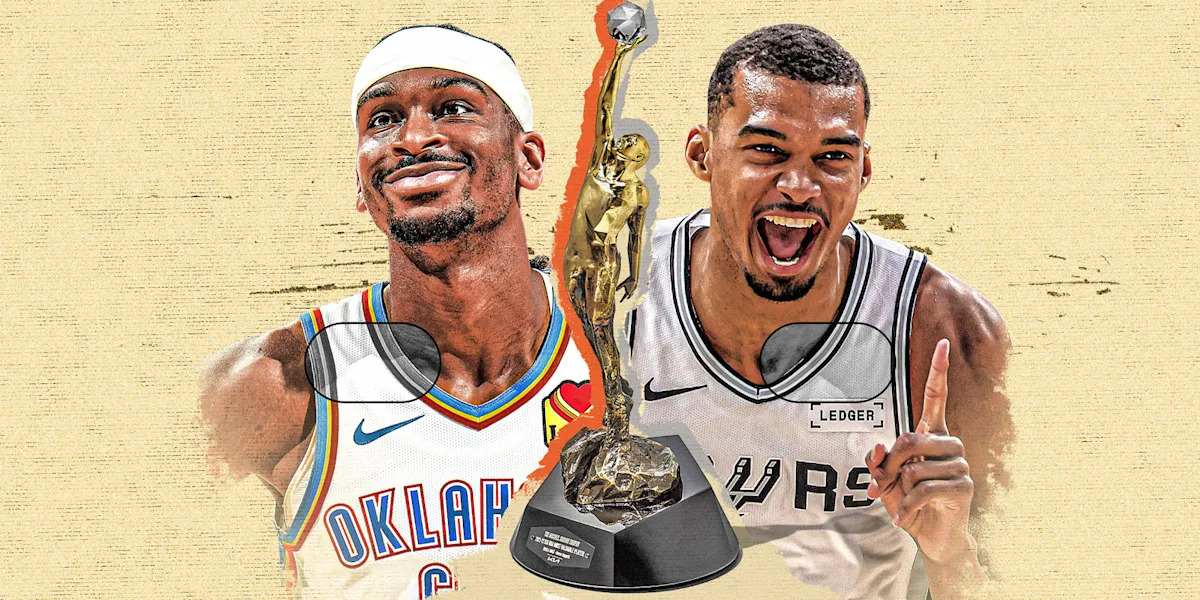
It should have been the easiest MVP decision in years.
Shai Gilgeous-Alexander is the reigning MVP and Finals MVP, and he’s even better this season. He is the best player on the best team, and he has been that for the entire season from the Thunder’s absurd 24-1 start all the way to a 64-18 finish to hold on to the top seed.
The case for Shai to win a second-straight MVP should be the cleanest, most boring, most airtight argument in basketball. Best player, best team, historic consistency, game winners, defending champion. Pencils down. Go home.
Except, there’s a guy by the name of Victor Wembanyama.
On the night of March 30, SGA had one of his most memorable games of his entire dominant season. He scored 47 points, including 31 in the second half and in overtime to beat the Pistons. But hours earlier, Wemby had 41 points with 16 rebounds in 31 minutes, shooting 17-of-27, while swatting three shots. It was his first of consecutive 40-point double-doubles — the first player in Spurs history to pull that off, a franchise whose annals include David Robinson and some guy named Tim Duncan.
This is what the MVP race had become in its final month — a nightly game of Can You Top This between a Canadian assassin and a French alien who is doing things that have no historical comparison because no one with his dimensions has ever possessed his skill set.
(Davis Long/Yahoo Sports Illustration)
And there’s a guy by the name of Nikola Jokić, too. A three-time MVP averaging 28/13/11, still at his peak powers offensively, and still playing a version of basketball that nobody else can replicate. Down the stretch, Jokić won the battle against Wemby, scoring 40 points and hitting clutch shots in overtime, including his signature Sombor Shuffle over the outreached arm of Wembanyama. A seemingly impossible task that only Jokić is capable of.
But Jokić will finish third on my ballot. The Nuggets were in the bottom 10 in defensive rating, and Jokić was nowhere near as impactful at getting stops as he was in any of his three previous MVP seasons. Denver had a 115.2 defensive rating with Jokić to 115.7 without him. An MVP is supposed to move that number. He didn’t. This regression was largely due to a hyperextended knee in December that eroded his defense. In most years, Jokić would have still done more than enough, but that’s the margin on a tight ballot.
Jaylen Brown carried Boston to the 2-seed after key roster losses last summer and without Jayson Tatum for most of the year. He is in consideration for a top-five spot, but he didn’t perform at the level of the aforementioned three. Meanwhile, the NBA will deliver word about the award eligibility status of Luka Dončić and Cade Cunningham. Neither of them will crack the top three, but both had sensational seasons. All of them deserved a cleaner runway to my MVP vote. None got it because of the unprecedented performances of SGA and Wemby.
This has been, without a doubt, the most thrilling and most difficult choice I have ever had to make for NBA MVP in my 10 seasons as a voter. It’s come down to a question I’ve never really had to answer on a ballot before: How much do you trust what the box score won’t tell you? One of these guys carries his team in the most visible way the sport allows. The other carries it in ways the box score doesn’t have language for.
The case for SGA: He was even better than last year
SGA averaged 31.6 points on a 66.5% true shooting mark, the second-most efficient season any 30-point scorer has ever had, trailing only the 2015-16 Steph Curry year that broke people’s brains. He did it while defending a title. While absorbing every opponent’s best shot. While leading a roster where nine rotation players missed at least 10 games, including his co-pilot, Jalen Williams, who missed more than half the year. Young core, deep playoff run, roster churn, bad injury luck. The Thunder had every ingredient of a hangover team. SGA did not let the year get away from them.
He was also better than he was last season. This is because he is reading the game at a level he wasn’t a year ago. Part of that is forced on him. SGA gets doubled more than any guard in basketball — on 21% of all his touches. Last season, the Thunder scored 1.16 points per play when Shai got doubled. An elite number that trailed only Giannis Antetokounmpo and Kevin Durant, of all players to get doubled at least 500 times. This season, that number jumped to 1.23 for Shai, putting him in first place of 39 qualifying players.
Gilgeous-Alexander looks like he’s mastered how to carve up a defense. SGA averages 31.1 points and creates 17.5 points per game for teammates on 6.6 assists, all three numbers well clear of Wembanyama’s 25 points and 3.1 assists creating 7.9 points. He posted a career-best assist-to-turnover ratio, showing a better feel for surveying the floor, manipulating defenders, and creating quality shots.
On March 9, Gilgeous-Alexander posted a season-high 15 assists and had zero turnovers against the Nuggets, who doubled him on 22 of his 94 touches. This clip from the first quarter shows what type of defense he was facing all game:
Christian Braun is there to meet SGA at the free throw line. Aaron Gordon is hovering over SGA’s left side. Jamal Murray is lurking at the right elbow. Cam Johnson has helped all the way off the corner to stand in the paint. Jokić is on the other side to contain both Jaylin Williams and SGA, leaving Lu Dort open in the corner. So what does SGA do? He takes a couple more dribbles into a sliver of space on the right side of the paint before whipping an overhead pass across the court to Dort for a wide-open 3-pointer.
Shai moves methodically by probing for space, using his tight handle to get anywhere he wants on the floor. He can also slam the accelerator, like he did later in the game by anticipating to beat the double before it could even happen behind the arc:
Four Nuggets collapse into the paint to slow down SGA. He knows that’s coming. He isn’t even looking to score. He slams the breaks, takes a glance at the left corner and sees no angle to pass it to Williams, so like a quarterback in the pocket, he goes to his second option and finds Jared McCain on the wing for another wide-open 3-pointer.
Gilgeous-Alexander’s presence on the court makes his teammates better. Chet Holmgren shoots 9.2% better. Dort shoots 6% better. Ajay Mitchell, 5.1%. Aaron Wiggins, 4.2%, per Databallr. He attracts so much attention that teammates get better quality, open shots. But sometimes, he needs to get it done on his own.
You might remember this game against Denver for a different reason. After Jokić tied the game with a 4-point play with 8.5 seconds left, the ball found SGA, who took one step inside the arc only to see two Nuggets defenders waiting in the paint, so he stepped back into more open space behind the arc to drain an epic game-winning 3.
“I have answers to the test, but I have to see the questions first,” SGA said after the game. “If I drove to shoot a middy, it was probably going to be contested with two guys. So I tried to separate from the 3 and get a good comfortable shot. And it went down.”
SGA is the player you want the ball in his hands with the game on the line. He is the betting favorite to win Clutch Player of the Year. The irony is that SGA sat out 26 full fourth quarters in the 68 games he played since the Thunder were blasting so many teams. And still, he played 393 more minutes than Wembanyama.
Balancing his playmaking with his bucket-getting has also led to career-highs in scoring efficiency. SGA makes 68% of his shots at the rim, 55% of his midrange pull-ups, and 39% of his 3s off the dribble. All of those marks are up from last season when he already seemed unstoppable.
Defenses have to pick their poison against him. They definitely don’t want him to get to the rim. And now his 3-pointer has reached a level that it’s as deadly as his midrange game. The pull-up 3 has become less of a hero shot and more of a punishment for a defense that has spent the entire possession trying to deny him everything else.
SGA has become a complete scorer. That’s how he has scored at least 20 points in 140 consecutive regular-season games — an NBA record that broke Wilt Chamberlain’s 63-year-old mark and kept going. SGA has not scored under 20 since before Cooper Flagg played at Duke. That’s how long it’s been.
Even his critics on the foul-drawing have to commend the way he sets the tone for the best defense in the league. The Thunder didn’t have the top defense in spite of SGA, as is the case for teams with high usage lead ball-handlers. They had it partly because the guy with the ball in his hands refused to take defensive possessions off.
Shai doesn’t match up with the opponent’s best player. There are plenty of other players on the Thunder who do. So usually, Shai hides on a weaker opponent. Playing that off-ball role allows him to roam and cause havoc. He ranked in the top 50 in both assists and deflections. And when he gets challenged, he’s effective. As my Yahoo Sports colleague Nekias Duncan wrote, SGA ranked second both defending pick-and-rolls and off-ball screens.
SGA carried a massive load on offense and always managed to play hard on defense. That set the tone for OKC’s entire roster to once again enter the playoffs as the Finals favorite.
The case for Wemby: Look beyond the box score
Wembanyama is the NBA’s most dominant defender since Bill Russell. It should come as no surprise that when he made his MVP case in front of the media, he led with defense. So let’s start there too.
The Spurs have posted a defensive rating of 103.2 with Wemby in the game. It’s 113.4 without him. That is the largest differential in basketball. He leads the league in blocks at 3.1 per game. Opponents have shot 8.7% worse with him as the closest defender. The numbers only illustrate what the eyes can see: the way he guards two players at once, the way he can contest a shot at the rim while his body is still technically in help position on the weak side, the way he baits players into thinking he’s not looking only to pivot directions and alter or swat the shot.
Wembanyama’s mere presence causes ball-handlers to turn away from the paint. With Wemby on the floor, opponents take 40.1% of their shots in the paint. With him off the floor, that rises to 48.4%. This 8.3% differential is extremely abnormal: In Rudy Gobert’s four years combined winning Defensive Player of the Year, the differential is 3.5%. Other recent winners? Evan Mobley: 3.1%. Jaren Jackson Jr.: 0.8%. Giannis Antetokounmpo: 1.4%. All are still impactful at deterring shots near the rim. None are on Victor’s level.
Wemby should be the first consensus Defensive Player of the Year. And yes, defense should be a factor in MVP voting. It has always mattered. After losing the race the year prior, defense is what put Michael Jordan over the top in 1988 when he won MVP over Larry Bird and Magic Johnson. It’s why Tim Duncan won MVP in 2002 over Jason Kidd and Shaquille O’Neal. In my years of voting, it’s why Giannis won in back-to-back years. It’s why Jokić didn’t win until 2021, only after he finally got in shape and became a positive interior defender. Defense certainly played a part in why SGA won last year too.
Wemby’s own personal case for MVP continued by mentioning how the Spurs dominated the Thunder this season, beating them 4-1 in the season series. “And my third argument would be that offense impact is not just points,” he said.
Wembanyama had the largest on/off differential in the league. This difference wasn’t just driven by the defense either. It was what he did for San Antonio’s offense. The Spurs had a 120.5 offensive rating with Wembanyama on the court this season, just one point behind the Thunder’s 121.5 offensive rating with SGA on the floor. It’s close between both teams.
Wembanyama averaged 25 points, and if you squint at the shot-type splits you can find things to nitpick. He shot 37.5% out of isolations and 48% out of post-ups, per Synergy. That’s solid, but not the numbers of a guy you’d trust most to bail you out with the shot clock dying. That said, on March 19 against the Suns, down one with a playoff berth on the line, the Spurs put the ball in his hands at the right elbow and cleared out. One long dribble right, one fadeaway over an outstretched arm, and San Antonio was in the postseason.
One shot doesn’t make him Kobe Bryant. Wembanyama is a different type of player. Looking at isolations and post-ups alone misses the entire point of what San Antonio is doing with him, because it ranked in the bottom half of the league in both. The Spurs’ offense is built on motion, and Wemby is the thing every action bends around.
Look at how he actually gets his 25. He brings the ball up himself in transition, a 7-foot-7 outlet valve who can go coast-to-coast without a point guard ever touching it. He gets run off more off-ball screening actions than any big man in the league — flares, pindowns, handoffs, the stuff you draw up for shooting guards. He attacks closeouts off the catch, where one long stride is the entire drive. He’ll pop out and set a ball screen for a guard, then flip it and let a guard screen for him, an inversion that few bigs are capable of. Every one of those actions starts the defense in rotation before the ball ever gets stuck. Isolations and post-ups are often what happen when an offense runs out of ideas. Wemby is the reason the Spurs never do.
That variety of actions is what causes teams to send so many doubles. When he gains possession of the ball in the midrange, he gets doubled 30% of the time — even higher than Shai — and the Spurs score 1.1 points per play on those touches — also higher than Shai. When Wembanyama first touches the ball outside of the 3-point line, he gets doubled on 20% of those plays — just behind SGA at 22.2% — and the Spurs score an elite 1.1 points per play when he does — a hair behind Shai. If teams don’t double, they’ve seen what the Alien is capable of.
The Spurs generated 12.3 corner 3s per game, the most in the history of the NBA. This is largely due to Wemby, even though he isn’t the one shooting them. This happens in multiple ways:
1. He sprints the floor in transition, claps his hands for the ball, drags two defenders into the paint with him, and a guy in the corner the defense forgot existed catches a pass and drains a 3.
2. He spaces out on the perimeter as a 37.4% shooter on catch-and-shoot 3s, and pulls a big away from the paint, opening the runway for San Antonio’s three downhill-attacking point guards — De’Aaron Fox, Dylan Harper, or Stephon Castle — to get into the teeth of the defense then find an open shooter.
3. Cutting around the basket. Opponents will often put a smaller player on Wembanyama. When this happens, he will establish post positioning or make himself a threat for a lob, forcing a help defender to rotate over.
4. Designed half-court sets. The Spurs run a set where a wing motions toward the ball-handler, while Wemby launches from the wing or elbow toward the paint. The play could lead to a lob at the rim, but more often than not it forces a rotation, giving enough space for a pass to the opposite corner for a 3-pointer.
5. Setting an on-ball screen and rolling. When Wemby sets a screen and rolls to the rim, the guy on the weak side who’s guarding the corner 3 is compelled to help on Victor. His entire basketball instinct is screaming at him to rotate to slow down the tall guy. So he rotates. And then a Spurs perimeter player is standing alone in the corner, completely unguarded, catching a simple kick-out pass, and draining a 3, and getting credited with the basket, and getting credited with being the one who “made the play,” and Wemby goes back down the court with nothing to show for on the stats sheet.
When Wembanyama is off the court, the Spurs take 13.1% of their shots from the corner 3. That’d rank fourth in the league, so it’s still a high amount. However, when Wemby is on the court and it’s not him taking the shot, the Spurs take 21.2% of their shots from the corners. No other player in the league warps corner-3 frequency anywhere close to that. The next-closest is Jalen Brunson at 4.3%, and Brunson is a small guard who does it by monopolizing the ball. Wemby does it without touching it.
With Wemby on the floor, the Spurs also generate far more layups for their point guard trio — a trio I spent all summer convinced wasn’t an ideal fit. Fox, Castle, and Harper are three downhill guards and none of them is a proven knockdown shooter. On paper the spacing math didn’t work. Mitch Johnson solved it by playing only one or two of them together at once. And Wemby handled the rest. Harper’s at-rim frequency jumps 15.5% with Wemby on the floor. Castle, 14.2%. Fox, 9.7%.
More shots at the rim is one piece. More shots going in at a higher rate is the other. Not just the guards. Every rotation player sees a jump. Devin Vassell’s true shooting climbs from 55.2% to 60.8%. Harrison Barnes from 58% to 64.7%. Julian Champagnie from 58.4% to 63.3%. Fox is the exception — his true shooting stays the same. Some of this increase is thanks to transition offense off stops. Most of it is Wemby’s gravity in the half-court.
Gravity comes in different flavors. The first is simple spacing: his shooting pulls a big out of the paint and the guards drive into an empty lane. The more interesting one is what happens when he rolls. When off-ball defenders decide to stay home on shooters, the big man still needs to prevent a lob to Wemby, which means Fox, Castle, and Harper can go one-on-one with a full head of steam and walk into layups.
Of the nearly 400 handler/screener duos to log at least 100 pick-and-rolls this season, Fox/Wemby, Castle/Wemby, and Harper/Wemby all rank in the 88th percentile or better in scoring efficiency.
None of this shows up on his line. Wemby finishes those possessions with zero points and zero assists and jogs back down the floor, and the box score insists nothing happened. Something happened.
The verdict
SGA carries his team in the most visible way the sport allows. The ball is in his hands. The points are on his line. The clutch buckets go viral before he’s back in the locker room. Wemby carries his in ways that sometimes don’t show up anywhere. The sprints into the paint. The gravity of his shooting. The threat of his verticality. That’s the whole debate.
Wemby just bent the entire geometry of an NBA floor in both directions. When he’s defending the paint, opponents avoid him. When he’s lurking in the paint on offense, opponents flock to him. Wembanyama was by far the league’s best defender, put up overwhelming raw offensive numbers on top of that, and somehow his most valuable contributions are still the ones the box score refuses to acknowledge. In a race this close, that’s the difference.
That is why I’m voting for Victor Wembanyama to win the 2026 NBA MVP.
I spent most of this season assuming that I wouldn’t be. The SGA case is so clean. Then I looked closer and realized a clean case isn’t the same as an easy vote.
The honest objection to this vote is that SGA’s offense is the more stable measurement and Wemby’s is a mosaic: gravity stats, on both offense and defense, that you have to trust at once. But when so many independent numbers, pulled from different parts of the floor, all point in the same direction, and all confirm what your eyes can see simply watching games, saying “the data is noisy” stops being skepticism and starts being a reason not to look. The corner 3 swing. The at-rim increase for three different guards. The efficiency jump for every single role player. The points per play on doubles. The offensive rating differential. Underneath all that, he still averaged 25 points and was the best defender in basketball by a mile. I opened this column with a question: How much do you trust what the box score won’t tell you? Turns out the answer is enough.
Here’s the thing I can’t shake: Wembanyama is only 22. In Year 3. We could be looking back on this season in 2030 and saying: Remember when he was already in the MVP race, back when the Spurs won 60 games for the first time, and it turned out he was only still just figuring it out?
There is no useful historical comp for Wemby. I compared Wemby to Gen-Z Kareem Abdul-Jabbar before the draft, but Kareem was 22 as a rookie. Kareem, LeBron, and Giannis didn’t win their first MVPs until they were 24. Victor would become the youngest MVP ever. And even if he falls short this time, it won’t be his last MVP race. It’ll be his first.
What does Year 5 look like? Year 8? When his handle tightens another notch? When his frame is even stronger? When Castle and Harper are grizzled veterans? When he picks up the small dirty defensive tricks that young players, even brilliant ones, simply haven’t learned yet?
At some point — maybe this postseason, maybe next year — Wemby is going to do something and every person watching is going to have the same thought at the same instant. The way we all did watching Steph pull up from the logo in OKC in 2016. The way we all did watching LeBron in Game 6 against Boston in 2012. The way we all did watching Jordan switch hands in midair against the Lakers in 1991.
The thought is always the same. “Oh. He’s the guy now.”
The difference with Wemby is he already knows. He’s been having that conversation with himself for years. The rest of us are just starting to catch up.
Read the full article here


