

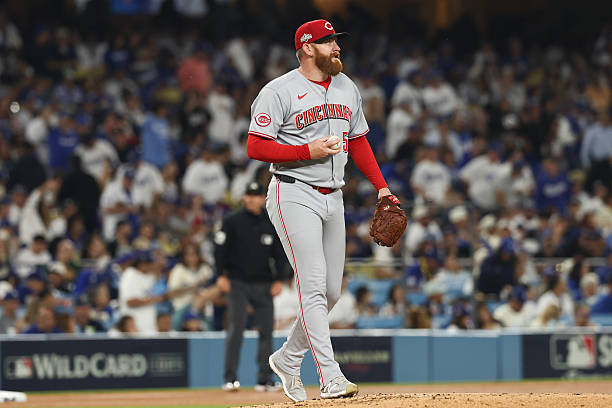
Sunday morning brought news that one of the final key players left in free agency had signed. The Washington Nationals have reportedly signed starter Zack Littell to a one-year contract with a mutual option for 2027.
At the beginning of the offseason, Littell was projected to earn a two-year contract worth roughly $24 million. So why the big change? And why didn’t the San Diego Padres bother to bid against the Nationals for his services?
A journeying swingman
Throughout his career, Littell was mostly a reliever. He performed to varying degrees of success, but it was mostly inconsistent from season to season.
His best years came in 2019 and 2021 with the Minnesota Twins where he posted a 2.68 ERA and 2.92 ERA, respectively. But each of those seasons were bookended by a 6.20 ERA in 2018, 9.95 in 2020, and 5.08 in 2022.
Because of his struggles, Littell wasn’t converted to a starter until after being picked up by the Tampa Bay Rays in 2023. He started 14 games for the club and put up a solid 3.93 ERA. The Rays held onto him in 2024 before trading him at the 2025 deadline to the Cincinnati Reds.
Across 32 starts in ‘25 between Tampa Bay and Cincinnati, Littell authored a 3.81 ERA and a 1.10 WHIP, shining as a middle-of-the-rotation starter before entering free agency.
Why the hesitancy to sign?
After such a high valuation from the majority of contract projections on Littell, it’s possible that his agents were waiting out the market for a better offer that never came.
It’s unclear yet what the Nationals are paying Littell but that number will likely become public once the team announces the signing. The report of his signing remains unconfirmed.
Given that, it’s surprising the Padres didn’t swoop in to sign him. Earlier this offseason, San Diego was rumored to be checking in on Littell (though those discussions obviously did not come to fruition). Seemingly, the price wasn’t right to outbid Washington.
It will hopefully make more sense once the dollar figure of Littell’s contract is announced. But for a team still in need of reliable pitching, it’s surprising general manager A.J. Preller wasn’t in on the 30-year-old’s services.
Read the full article here