



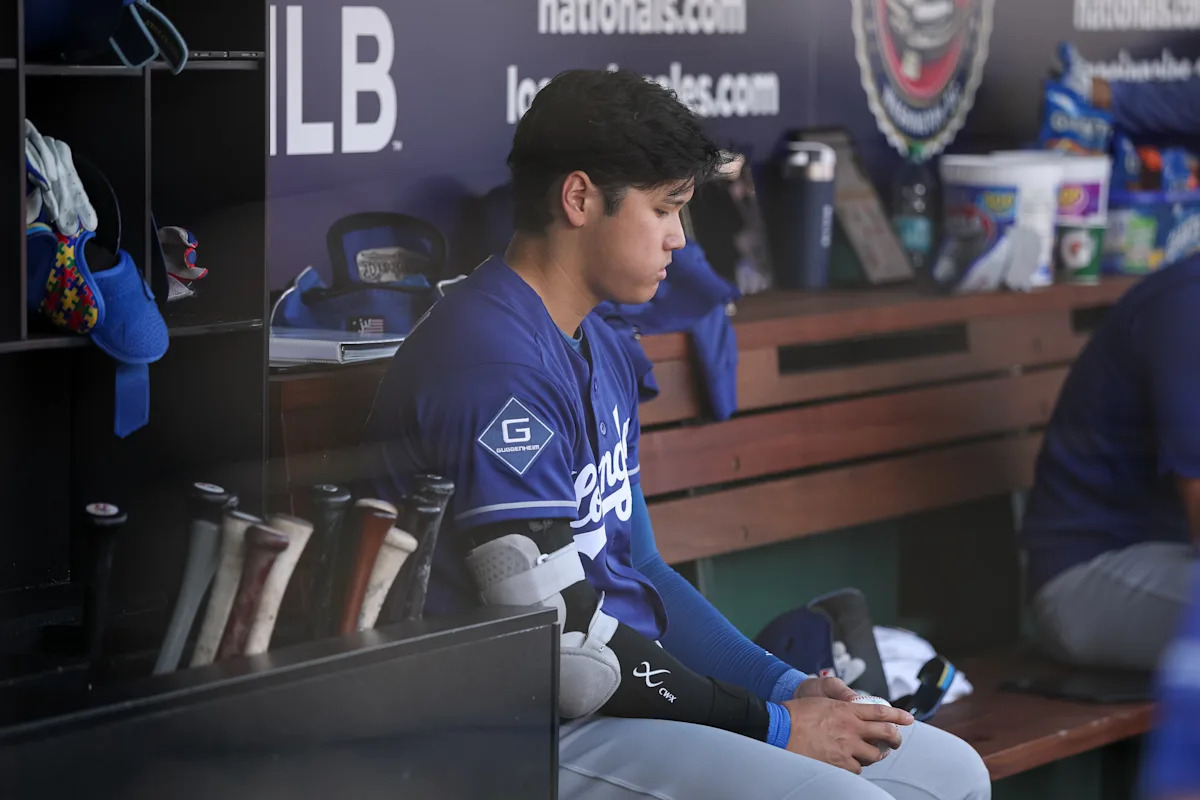
Shohei Ohtani is back to being a full-time two-way player again, which adds another layer of complexity in managing his unique workload.
Ohtani pitched six innings in Wednesday’s series finale against the Toronto Blue Jays, allowing only an unearned run. He was hitless in three at-bats at the plate, with a walk. That double duty is directly followed by the Dodgers’ scheduled off day Thursday, before starting a homestand on Friday.
“How you balance the workload, the focus on the pitching, to then still really lock in on those four or five at-bats, it’s not easy. Obviously, no one else is doing it,” manager Dave Roberts said last week during the opening homestand. “He definitely has a handle on it, I think as much as anyone can.”
Last year the Dodgers were deliberate in easing Ohtani back into pitching, a year and a half removed from his second Tommy John surgery. His two-way status affords the Dodgers an advantage currently unavailable to other teams — he doesn’t count against the limit of 13 pitchers on the active roster, so using a six-man rotation doesn’t deplete the bullpen; and when he pitches, he is allowed to remain in games as the designated hitter as long as he starts the game at both positions.
The Dodgers last year were fine with Ohtani pitching only one or two innings per start for the first few times out, because any amount he pitched were like free money, reducing the workload for the rest of the staff. But they also started him back on the mound in such a limited capacity because the alternative of building up in simulated rehab games proved to be too large of a burden on his time.
“We got to the point where it feels like we should take that next step, and almost finish the rehab at the major league level, because of the taxing nature of what he was doing,” general manager Brandon Gomes said last June. “So much of it the getting hot, throwing a live (batting practice) at 1:30, two o’clock, cooling down, then coming back and getting ready to lead off a game. I can’t even imagine how taxing that is.”
Another taxing stretch for Ohtani comes when pitching at home. When he bats leadoff, he has to pitch the top of the first inning, then go directly to the on-deck circle to prepare for his at-bat to begin the bottom of the frame.
“I do think that first at-bat is a tough one, especially when you’re at home. When you go from the mound to the on-deck circle to the batter’s box, I’m not saying it’s a throwaway, but it’s hard. It’s a quick transition,” Roberts said. “But then to figure out, how do you restructure the lineup for that one particular day, to appease that one at-bat, that’s a bigger question.”
Ohtani batted first in his March 31st start against at home, and grounded out to third base. He’s batted first 10 times in the bottom of the first inning directly after pitching the top of the frame, and has three hits, including two home runs, with two strikeouts. Roberts indicated during the homestand that it would take some time before considering moving Ohtani down in the lineup for games he pitches at Dodger Stadium.
“I’m more of a slow mover,” Roberts said. “So I would probably wait a little bit.”
Ohtani was fully stretched out by last September, and is stretched out now to start 2026. That means his workload could look more like his final three years with the Angels (2021-23), when he averaged 25 starts and 142 2/3 innings while also averaging 635 plate appearances per year.
Through Wednesday, Ohtani has batted 58 times and faced 47 batters while pitching, his 105 total plate appearances 19 more than Miami Marlins ace Sandy Alcantara, with the next-highest total. Ohtani’s most PA in a month last season was 193, batting 121 times and facing 72 batters while pitching last August.
In his rookie season, the Angels were conservative with Ohtani, who would not hit on the day he pitched, the day before, nor on the day after. He did not pitch in 2019 after his first Tommy John surgery and pitched only twice in 2021. In his first three seasons in Anaheim, Ohtani never batted the day he pitched (the two-way rule which allowed him to both pitch and be DH in the same game wasn’t implemented until 2022), and he only batted the day after he pitched once, in 2021, and was hitless in four at-bats with three strikeouts.
|
Situation |
PA |
HR |
BB |
K |
BA/OBP/SLG |
|
Ohtani pitching |
367 |
19 |
15.3% |
24.5% |
.277/.390/.542 |
|
Ohtani day after pitching |
285 |
24 |
10.2% |
29.5% |
.257/.337/.589 |
Ohtani with the Dodgers has just four hits in 36 at-bats on the days after he pitched, but overall in his career his numbers in those situations have been pretty good, though with more strikeouts and fewer walks. The Dodgers are more concerned with managing his overall fatigue, and having fewer games batting the day after the heavy load of pitching, the better.
The schedule doesn’t always work out that cleanly for Ohtani to pitch the day before an off day, but it did this week, and likely will next week as well, with the Dodgers hosting the Texas Rangers and New York Mets at home before another off day next Thursday, April 16.
“If it’s feasible, we will certainly take that into consideration,” Roberts said. “I think you’ve seen that we’ve done that in the past.”
Last year, Ohtani made 14 regular season pitching starts plus four more during the postseason. Excluding the last of those starts — Game 7 of the World Series — Ohtani pitched before a Dodgers off day eight times in 18 start. One of which was by his own doing by eliminating the Milwaukee Brewers in Game 4 of the National League Championship Series with arguably the greatest individual performance in baseball history, hitting three home runs to go with 10 strikeouts in six scoreless innings on the mound.
Directly after the All-Star break last year, the Dodgers had six Thursdays off in a seven-week span, right around the time Tyler Glasnow and Blake Snell returned, giving the team a fully-operational six-man rotation. Ohtani pitched five Wednesday’s in a row, four of which came with a built-in off day the following day. He also sat in a day game on Thursday, August 21 against the Colorado Rockies, his only true day off of last season while the division was still up for grabs.
After the Dodgers homestand, they play 32 games in a 34-day stretch, making it tougher to do any sort of maneuvering to pitch Ohtani directly before an off day. How they find ways to get him rest as he carries this dual workload will be one of the stories of the season. But it basically comes down to continually checking in with Ohtani to see how he’s holding up.
“When you’re pitching, the focus is pitching, then trying to layer in the importance of hitting. The day after, that’s case by case, start by start. Home, road, travel, there’s a lot of different variables,” Roberts said. “For me, it’s more just having a conversation and seeing how he feels, because he’s very in tune with his body.”
Read the full article here


