



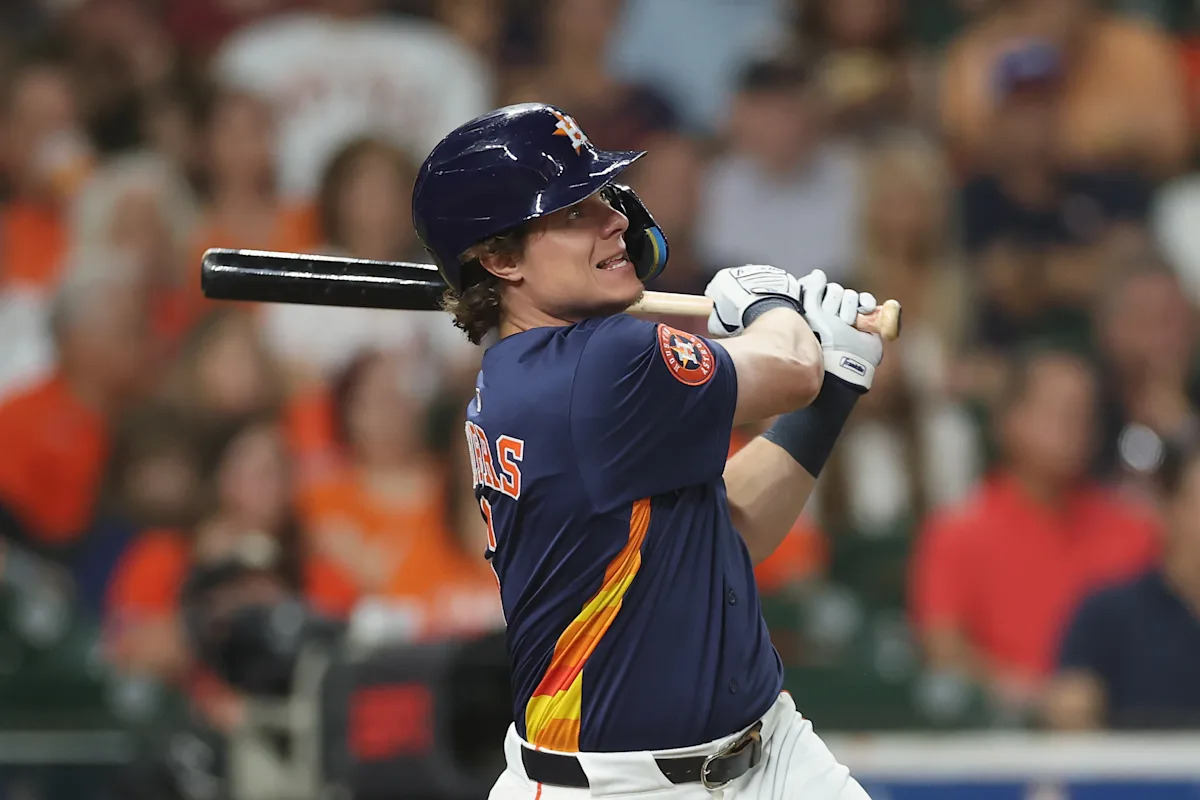
As we pass through the diamond, I should note that I have been playing a little footloose and fancy free with the outfield distinctions. In point of fact, just about every outfielder outside of Yordan Alvarez is capable of playing all three spots and most of them likely will play multiple positions. So, who I choose to put where largely depends on where we might expect them to play, but also as a way to space it out so we get the same number of guys in each lab.
For our purposes here, we are looking at Jake Meyers and Zach Cole, but we should acknowledge that Joey Loperfido and Cam Smith could also see time in center. Like we did, I will include a player not on the Astros (or currently in MLB) as a frame of reference for Zach Cole. We are not necessarily predicting that he will have this player’s career, but I’m sure we would be in for it if he did.
-
Chase rate: This is the percentage of balls a player swings at outside of the zone. The league average normally lives around 30 percent, but we will be looking at three year intervals and we should notice trends more than where a player is in relationship to the league average.
-
Hard hit percentage: This is simply the percentage of balls that a player hits hard. Hard hit balls become hits and extra base hits more often than softer contact. Typically 35 percent is around the league average in this category.
-
BABIP: This is batting average on balls in play. Home runs are obviously excluded since they are not in play. The league average tends to hover around .300 but it will largely depend on hard hit percentages and breakdowns between groundballs, flyballs, and line drives.
-
Contact percentage: This is the percentage of swings that turn into contact. Typically 75 percent is around league average.
-
HR/FB percentage: This is the percentage of flyballs that result in home runs. Ten percent is typically around the league average.
Jake Meyers
|
Chase |
Hardhit |
BABIP |
Contact |
HR/FB |
|
|
2023 |
26.6 |
27.9 |
.283 |
74.1 |
11.2 |
|
2024 |
30.3 |
37.0 |
.263 |
74.2 |
9.8 |
|
2025 |
23.7 |
38.9 |
.353 |
81.1 |
3.8 |
|
Aggregate |
26.9 |
34.6 |
.300 |
76.5 |
8.3 |
There were a number of people (me included) who were critical of the Astros hitting coaches the last few years, but it has to be noted that not everyone got worse under those guys. Meyers made real gains in his chase rate, hard hit rate, and contact rate last season. At least some of that is likely to carry over into this season. So, in all likelihood, Meyers is a better offensive player in 2026 than he was in 2023 and 2024. However, he might not be quite as good he was last season.
That is largely because of the out of context BABIP. Even with gains in hard contact, that kind of jump is not sustainable. At best, he might live between .310 and .320 in that category and that is assuming a return to career norms in home runs per flyball. If you give him positive regression in that category then he might be roughly on par with last season overall.
However, the likelihood is a hitter that lives around .250 or .260 with decent speed numbers and okay power numbers. So, that could end up being something in the neighborhood of .250/.300/.380. Couple that with very good defensive metrics and you have an above average regular overall, but in all likelihood you will not see 2025 Meyers again.
Zach Cole
|
Chase |
Hardhit |
BABIP |
Contact |
HR/FB |
|
|
2023 |
—- |
—- |
.366 |
64.3 |
20.4 |
|
2024 |
—- |
—- |
.336 |
67.2 |
14.9 |
|
2025 |
20.0 |
44.1 |
.418 |
64.9 |
31.1 |
|
Aggregate |
20.0 |
44.1 |
.373 |
65.5 |
22.1 |
These are all minor league numbers for Cole. Cole has four of the five tools in spades. If we add plate discipline as a tool then he has five of the six tools in spades. Unfortunately, that sixth tool might be the most important one. Like Matthews and Dezenzo before him, there is just a ton of swing and miss in his game. Players have succeeded at the big league level while missing the hit tool, but they are fewer and further between. The question will be if he can make enough gains in contact to give those other tools enough room to breathe.
As we noted above, there is a player that Cole has been compared to that we can profile here. Joey Gallo is no longer playing in the big leagues, but he had some big seasons with the Rangers before washing out. In short, the lack of contact eventually caught up with him, but he might be the apex of what Cole can accomplish at the big league level. Between 2017 and 2019, Gallo hit more than 100 home runs. Cole has more speed than Gallo, so he could be even more. Just look at the numbers and see what you notice.
|
Chase |
Hardhit |
BABIP |
Contact |
HR/FB |
|
|
2017 |
26.5 |
53.0 |
.250 |
59.0 |
30.1 |
|
2018 |
27.6 |
49.5 |
.249 |
61.7 |
27.6 |
|
2019 |
22.6 |
52.7 |
.368 |
59.7 |
37.3 |
|
Career |
24.2 |
49.1 |
.254 |
60.6 |
25.8 |
The career numbers showed he tapered off a little in hard hit and pure power after those three initial seasons. Simply put, you cannot survive long with a contact rate like that. I do not have a minor league to major league decoder ring, but most players do not make more contact at the big league level initially. So, Gallo seems like a reasonably comp for Cole.
Gallo reached a career high of 4.4 FWAR in 2021, so I think most people would be pleasantly surprised if the Astros got that out of Cole. Keep in mind, he adds a speed element that Gallo did not. Unfortunately, he doesn’t have quite the power rate or hard hit rate that Gallo did. Perhaps he makes a bit more contact and ends up approximating the numbers above overall. The question will be whether Astros fans want to stomach the swing and miss in order to tap into the impressive power and speed. What do you think?
Read the full article here


