


Formula E will take a massive leap in the 2026-27 season when it debuts its highly-anticipated Gen4 package. Featuring a more powerful 800bhp powertrain, more aerodynamic components and more advanced battery technology, the Gen4 car will propel Formula E to new heights and bring it closer to Formula 1 in terms of outright performance.
Drivers will relish the improved speed and acceleration, and Formula E is already working closely with promoters to ensure tracks can accommodate the new car.
That said, the Gen4 car will be much bigger than its predecessor, while also relying more heavily on aerodynamics to generate downforce. This, in theory, could make it harder for cars to follow each other.
The current Gen3 era has been defined by wheel-to-wheel racing, frequent positions changes and strategic energy management. Initial testing for Formula E’s next car has already begun, but drivers admit it is still hard to accurately predict if they will be able to continue to race as closely with each other.
“This is the thing. The racing in Formula E is good. We need to find a way that it doesn’t affect the racing too much,” reigning champion Oliver Rowland told Autosport. “We know through years of lessons that faster cars with more downforce generally create worse racing. So, we need to analyse that. Obviously, there’s the energy management aspect with more aero, which means there might be even more pack racing. So it’s just a fine balance.
“I think F1 is obviously going to experience that this year with the energy management and the slipstream stuff. So I’m quite interested to see how they go as well.”
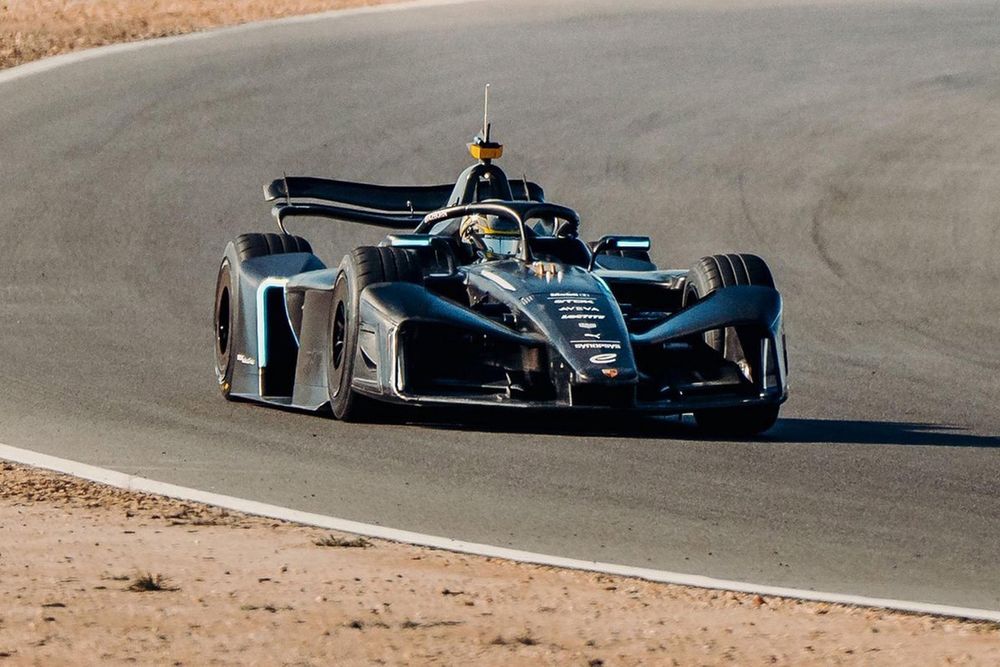
Mahindra’s Gen4 Formula E car
Photo by: Mahindra Racing
Energy saving and harvesting has played a vital role in the Gen3 era, and it’s common for drivers to go in conservation mode early on before charging through the field later in the race.
Another defining feature of the current cars is their relative tolerance to contact, as minor front wing damage makes little difference to the overall performance, but this may not be the case with the Gen4 car, which relies more heavily on aero.
“Obviously the car is a lot bigger than the current Gen3 car, and then obviously it depends on how much energy saving work to do,” Jaguar driver Mitch Evans said. “I think we’re going to have to be a lot more disciplined in terms of contact. Here, you can get away with a bit of contact at the moment. But I think the Gen4 car will be a bit more sensitive to cosmetic damage on the car. So from that side, maybe you have to be a little bit more respectful between one another. But until we get firm rules on how it’s going to play out, it’s really hard to judge.”
Currently, drivers can access the full 350kW mode in qualifying, before the power is slashed during the race.
Formula E is keen on showcasing the full capabilities of its Gen4 package, which will be able to produce as much as 600kW.
Evans suggested varying aerodynamic configurations between qualifying and race trim could help Formula E strike the balance between outright speed and raceability.
“As long as we can still follow [other cars] quite well, then that’s good,” he said. “It’s quite a unique thing about a single-seater category that we can run really close. But the Gen4 car’s target and mission is to take Formula E to the next step, and you have to add a bit of aero to that to achieve it. So there’ll probably be different downforce levels for qualifying and the race. Maybe there’ll be a lower downforce for the race, so there’ll be less drag and probably better racing.”
Porsche Gen 4
Photo by: Porsche
Formula E is still working on finalising the sporting regulations for next season, which could play a decisive role in defining the on-track product.
When Formula E dropped pitstops with the arrival of higher-range Gen2 cars, it came up with the concept of Attack Mode, which has proved to be extremely successful in making races exciting.
Formula E’s chief championship officer Alberto Longo indicated the series is again willing to innovate as it aims to finalise the Gen4 sporting framework by the end of March.
“The good thing about the Gen4 is that it has no restrictions or very limited restrictions,” Longo said. “This gives us a lot of opportunities to showcase those cars in a completely different way that we have been doing today.
“We are always thinking out of the box with properties like the Pit Boost, the Fan Boost and obviously, with the Attack Mode. We always like to do new things and definitely, this car is going to allow us to become even a little bit more crazy.”
FIA’s chief technical officer for Formula E Vincent Gaillardot stressed that close racing is a priority for stakeholders, but cautioned against drawing firm conclusions from early simulations.
“We did some simulation with manufacturers during the combined test. It’s difficult to predict,” Gaillardot said.
“All the car parts are obviously much stronger due to the much higher top speed, so we have to take a different design and calculation. There is much more protection around the wheels due to the aerodynamic device. After that, we wait and see.”
We want to hear from you!
Let us know what you would like to see from us in the future.
Take our survey
– The Autosport.com Team
Read the full article here