



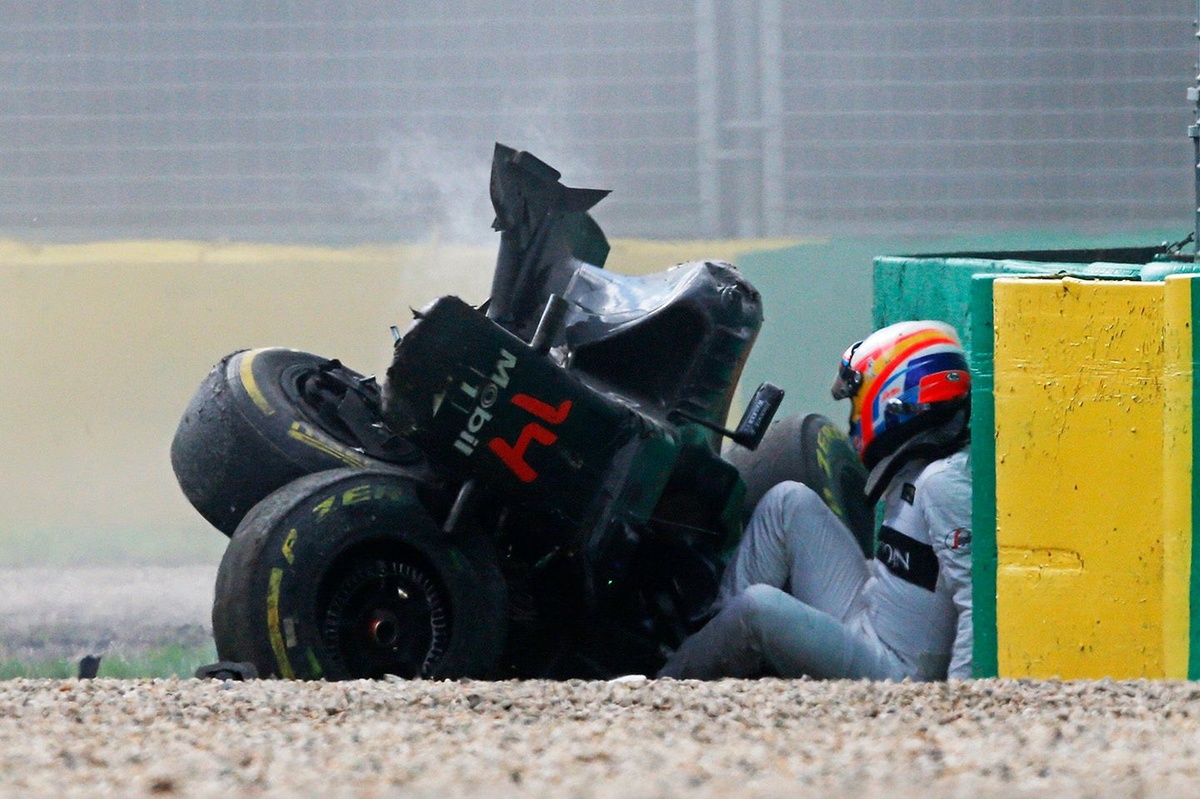
March 20, 2016 remains one of those days when Formula 1 frightened us, but also demonstrated its continuous progress in safety and its determination to always go further. It was 10 years ago, during the Australian Grand Prix, and a shocking crash sustained by Fernando Alonso is still vivid in some memories.
On lap 17 of the race, while battling for 19th place at the wheel of an underperforming McLaren-Honda, the two-time world champion attempted to overtake Esteban Gutierrez around the outside of Turn 3 but struck the rear wheel of the Haas. He was immediately sent towards the outside wall and, deprived of any steering control, the car slid into a patch of grass and gravel where it dug into the ground.
It then began to roll, before coming to rest upside down near a tyre barrier. Alonso quickly climbed out of the wreckage unharmed. Although shaken, he was on his feet. Nevertheless, he suffered a pneumothorax and broken ribs, forcing him to miss the following grand prix.
When this accident occurred, F1 was in the midst of searching for a solution to better protect drivers’ heads. The halo had already been tested for several months, first introduced by Ferrari during that year’s winter testing and evaluated alongside another device, the Aeroscreen. Faced with the tiny gap through which Alonso managed to extract himself from his McLaren, questions quickly arose, also allowing those opposed to the halo to criticise the FIA.
Fernando Alonso, McLaren MP4-31, crash
Photo by: James Gasperotti / Motorsport Images
The governing body logically launched an investigation into the Spanish driver’s accident and, for the first time, benefited from footage captured by the new ultra-high-speed cameras installed in F1 cars since 2015. These notably helped improve understanding of the implications had the halo been present in such a situation.
Staggering figures
Less than three months later, the conclusions were made public. First came the staggering figures. The video recording, combined with data provided by accelerometers, revealed the scale of the impact.
At the moment of contact with Gutierrez, Alonso was travelling at 313 km/h; when he hit the wall, the lateral deceleration impact was measured at 45G; then a similar impact of 46G was recorded during the roll. For 0.9 seconds, the car was completely airborne and, when it landed, the rear experienced a longitudinal acceleration of 20G. As for the famous high-speed camera, it revealed that the driver’s head struck the left side of his headrest twice.
“What we want to understand is the exact dynamics of the head, neck and shoulders in a crash with high g-forces, and how they interact with other parts of the cockpit environment such as the head protection, the HANS, the harnesses and everything that may be in the space around the driver,” explained Laurent Mekies in his report, then managing director of the FIA’s research institute, now team principal at Red Bull.
“This camera allows us to better understand the exact forces experienced by the head during a given movement, the elongation of the neck, how it interacts with the headrest, how the latter works and what we need to do for the next generation of cockpits.”

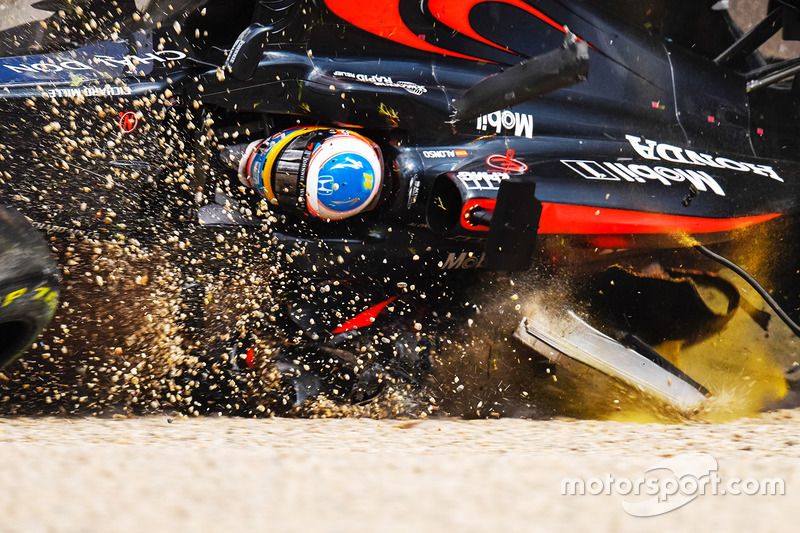
Fernando Alonso’s crash in Melbourne in 2016.
Photo by: Sutton Images
Beyond this crucial aspect of cockpit safety elements, the FIA then incorporated the findings of its investigation into its broader research on driver head protection. The governing body pushed its search for answers as far as possible. It even went so far as to simulate Alonso’s accident with the halo. The results, published in early 2017, were very encouraging and even convinced several drivers when they were presented with them.
“We flipped one of our chassis with a halo,” Mekies explained at the time. “We put Andy Mellor [FIA technical consultant] inside to assess the worst-case scenario and asked him to get out, precisely in Fernando’s position. Incredibly, he managed it,” Mekies smiled. “So, we feel that in this case, the halo provides space for the driver.”
This marked another barrier being broken in the FIA’s long effort, determined to introduce the halo in F1 before extending it more widely to other single-seater categories. Like this obstacle, others gradually fell away, sometimes accompanied by philosophical debates that fuelled discussions.
In any case, by the winter of 2018, the new F1 cars were indeed unveiled equipped with the halo. Since then, the presence of this safety device has never been questioned again. Just ask Romain Grosjean, among others.
We want to hear from you!
Let us know what you would like to see from us in the future.
Take our survey
– The Autosport.com Team
Read the full article here


