

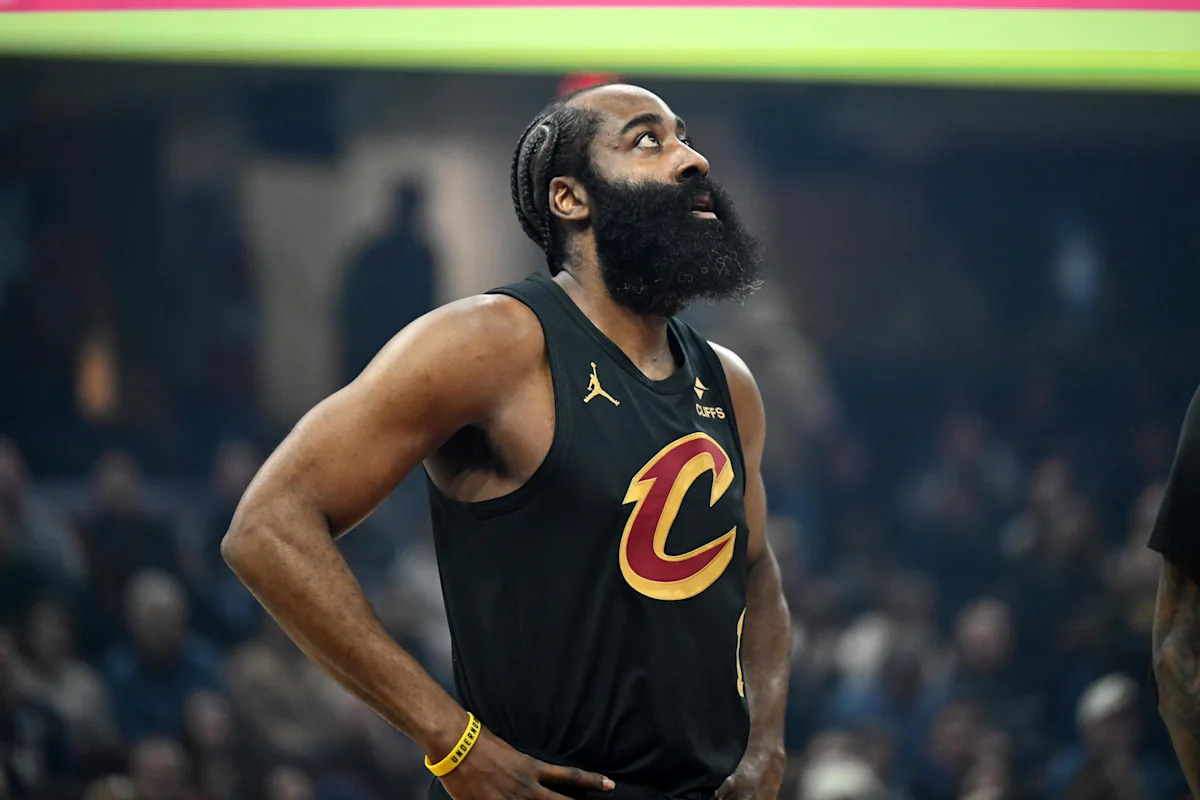
All-time great players achieve that status by continually defying norms, yet Father Time remains undefeated.
James Harden will be remembered as one of the ten best guards in league history when all is said and done. His peak as a one-man offense in the 2010s with the Houston Rockets hasn’t been topped by many; neither has his incredible longevity. He’s 189 assists away from becoming the only player besides LeBron James to rank in the top ten all-time in both points and assists. But even all-time greats have an expiration date.
The Cleveland Cavaliers made a gamble earlier this summer that Harden would continue to play at or near an All-Star level by signing him to a new deal that will pay him an average of $32 million annually over the next three seasons.
Harden’s game has aged gracefully over the last handful of years. He isn’t the one-man offense he was in his prime, yet he has continually found ways to fit into and elevate groups as a supporting piece.
That carried over this past season to Cleveland. The Cavaliers played their best in the playoffs when Harden was on the floor. His ability to orchestrate the offense and take over late in games when needed is one of the reasons why the Cavs were able to advance to the Conference Finals for the first time in eight seasons.
If we judge his new contract on how he just played, this would be a good deal for Cleveland.
Every dollar matters in a salary cap league. That’s especially true for a team like the Cavs that has been doing everything in its power to cut costs after spending last season in the second apron. However, you aren’t going to get a guard playing at or near an All-Star level that isn’t on a rookie deal for cheaper.
To evaluate the contract, let’s first try to pinpoint where exactly Harden is from a skill perspective going into this season.
Player ranking guides shouldn’t be taken as gospel truth, but they do provide a general consensus for where someone stands in the league hierarchy. Currently, The Ringer and NBA 2K27 have him as the 31st-best player. HoopsHype lists him as the ninth-best guard.
This is in line with where some of the catch-all stats have him as well. Dunks and Threes’ actual estimated-plus minus has him at 38th (93rd percentile) last season. Basketball-Reference’s catch-all stats view him a little more favorably, as he was 21st in player efficiency rating (20.7), 19th in box-plus-minus (3.9), and 14th in value of replacement player (3.6).
How much stock you want to put into any of that is up to you. What we can comfortably say is that ranking him as the 31st-best player in the league is completely reasonable.
Now, let’s look at where he stacks up in annual value on his contract. Harden’s contract is expected to start just below $30 million for this upcoming season and should escalate to $34.9 million on the third and final year of his deal.
The $29.7 million he is expected to earn next season would give him the 64th-highest annual salary in the league. That placement is good value for what you’re expecting to get from him, especially considering the quality of many of the players making more than him. Jimmy Butler ($56.8 million), Trae Young ($49.5 million), Zach LaVine ($50 million), Domantas Sabonis ($45.5 million), and Brandon Ingram ($40 million) are all set to make $10 million more than Harden next season. This list puts into perspective how bad some contracts are, and how this isn’t one of them, based on how Harden has been playing.
However, that evaluation is contingent on Harden still being at or near his recent level. NBA history suggests that he won’t continue to do so over the next three years.
LOS ANGELES, CA – NOVEMBER 3: James Harden #1 and Chris Paul #3 of the LA Clippers looks on during the game against the Miami Heat on November 3, 2025 at Crypto.Com Arena in Los Angeles, California. NOTE TO USER: User expressly acknowledges and agrees that, by downloading and/or using this Photograph, user is consenting to the terms and conditions of the Getty Images License Agreement. Mandatory Copyright Notice: Copyright 2025 NBAE (Photo by Juan Ocampo/NBAE via Getty Images) | NBAE via Getty Images
Finding a recent comparison for Harden is difficult. Few guards have sustained the consistent level of play for as long as he has. One that comes to mind is Chris Paul.
Catch-all stats are flawed, but they can be used as guideposts for where a career is going. Harden finished 32nd in ESPN’s Player Efficiency this past season at age 36. At the same point in his career, Paul ranked 38th.
Paul made his final All-Star appearance at age 36. He was coming off another impressive season, helping lead the Phoenix Suns to 64 wins. There wasn’t much in his game at that time that would suggest he would begin to decline. That inevitably started during his age-37 season.
Paul was still good at 37. His overall points, assists, and efficiency were down from the year before, but he was still a high-quality player. However, a closer look at some of the advanced stats would suggest a noticeable drop-off that would continue
Paul went from 38th to 76th in ESPN’s Player Efficiency Rating between his age-36 and age-37 seasons. That slide continued as he finished 148th in Player Efficiency Rating during his age-38 season and then 170th in his last full season at age 39.
Harden has more size than Paul, which should help him age better. However, there’s no denying the simple fact that we don’t typically see good guard play from guys at this point in their careers.
There aren’t many examples of someone playing at or near an All-Star level at age 37. Only 12 players in league history have been on an All-Star team at age 37. The list keeps getting smaller the older you get. Only five players have been All-Stars at age 38 (LeBron, Tim Duncan, Michael Jordan, Karl Malone, and Kareem Abdul-Jabbar), and just three at age 39 (LeBron, Jordan, and Abdul-Jabbar).
More to that point, it’s rare for 39-year-olds to even be in the league. There are only three currently rostered players who will be 39 or older at the start of the season: Mike Conley, Al Horford, and LeBron.
Just because there isn’t a historical precedent for guys playing at a high level in their late 30s doesn’t mean it’s impossible. Last season, Kevin Durant made the All-NBA Second Team, and Steph Curry was still playing at an elite level at age 37. Both are expected to be All-Star-quality players again this upcoming season. Harden certainly has the talent to follow in their footsteps.
Overall, history isn’t on Harden’s or the Cavs side. A significant drop-off in play comes for everyone at some point. That’s true even for all-time great guards like Harden. Odds are this happens for Harden sometime over the lifetime of this new contract.
Still, this is a deal the Cavs felt they had to make. They mortgaged future money in 2028 for more flexibility now to get out from under the second apron and execute a sign-and-trade for Peyton Watson. Neither of those things would’ve been possible if Harden had simply opted in to his $42.3 million player option.
Now, we’ll wait and see whether or not this short-term gamble ages like Harden’s gas station wine or a French Sauvignon Blanc.
Read the full article here