






The FIA has tweaked the Formula 1 driver guidelines for the 2026 campaign with a focus on more flexibility and common sense being applied in what is seen as a big win for those racing.
That is because on numerous occasions the stewards have been criticised for using these guidelines as gospel, rather than just being a basis to help come to a well thought-out solution.
Brazil last year was the biggest indication of that, as stewards blamed Oscar Piastri for causing a three-way collision with Kimi Antonelli and Charles Leclerc at Turn 1 – thus handing him a 10-second penalty.
The McLaren driver was on the inside, but locked up his front-left and slid into Antonelli who subsequently hit Leclerc with the Ferrari suffering terminal damage.
Stewards felt that Piastri wasn’t sufficiently alongside, that his lock up indicated an ambitious manoeuvre and, according to the rules, the penalty was correct.
But it was still controversial because it was clear watching that Piastri didn’t entirely cause the collision, with many on the grid claiming Antonelli quickly shut the door on him.
Oscar Piastri, McLaren, Andrea Kimi Antonelli, Mercedes
Photo by: Andy Hone/ LAT Images via Getty Images
So, it created confusion and Carlos Sainz, in particular, compared it to many of his own incidents during the 2025 season.
This, plus other controversial decisions last year, led to a meeting between teams, drivers and the FIA at the penultimate round in Qatar and the result is witnessed in the newly tweaked guidelines.
One of the biggest changes concerns a lock-up, which no longer implies that a driver has lost control as its occurrence might actually be down to the “laws of physics” or simply trying to avoid another car.
That is something Piastri tried to argue at Interlagos and another point of his was that he couldn’t just “disappear”, as the whole sequence occurred in the matter of seconds.
So, the stewards will now recognise that in an attacking manoeuvre, once a car has gained the right to the corner, the other cannot simply “disappear” with the apex potentially varying depending on the racing line and nature of the corner.
Changes have also been applied to the penalty point system, with those only being given out for “dangerous, reckless or apparently deliberate actions resulting in a collision”, or “for other unacceptable or unsportsmanlike behaviour”. Piastri, as an example, received two penalty points for last year’s incident.

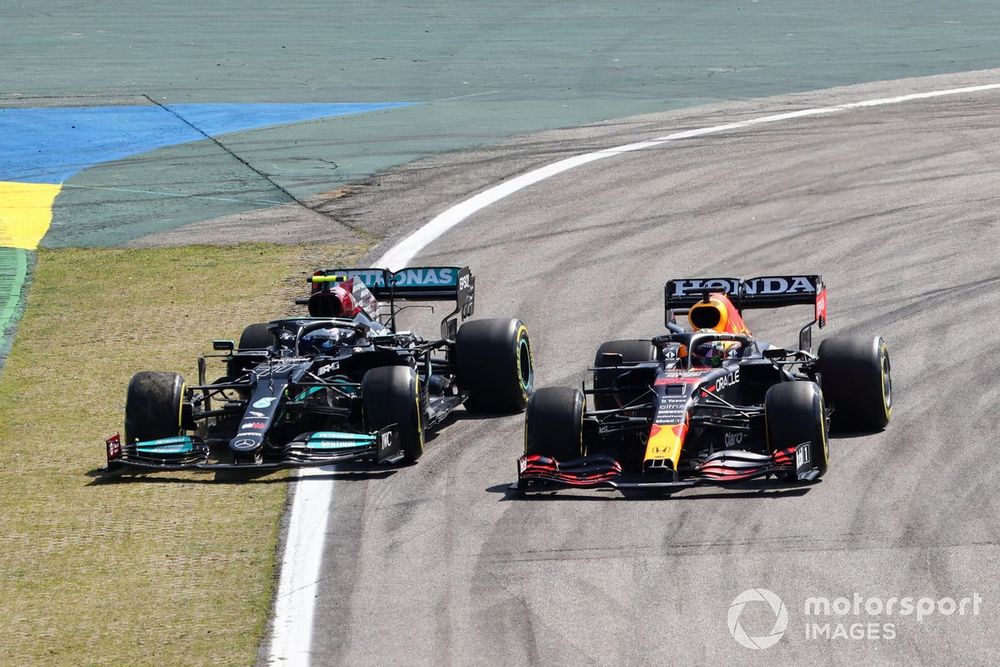
Max Verstappen, Red Bull Racing RB16B, Valtteri Bottas, Mercedes W12
Photo by: Steve Etherington / Motorsport Images
Elsewhere, there are now stricter guidelines on defending drivers who leave the track. This is because on several occasions, an attacking car on the outside might be pushed off with that being deemed as a racing incident – Max Verstappen defending from Lewis Hamilton in the 2021 Brazilian Grand Prix being an example.
But now, the guidelines state: “If, while defending a position, a car leaves the track [or cuts a chicane] and re-joins in the same position, it will generally be considered by the stewards as having gained a lasting advantage.
“Therefore, generally, the position should be conceded. It will be the sole discretion of the stewards to determine if the driver of a car is ‘defending a position’.”
We want to hear from you!
Let us know what you would like to see from us in the future.
Take our survey
– The Autosport.com Team
Read the full article here


