






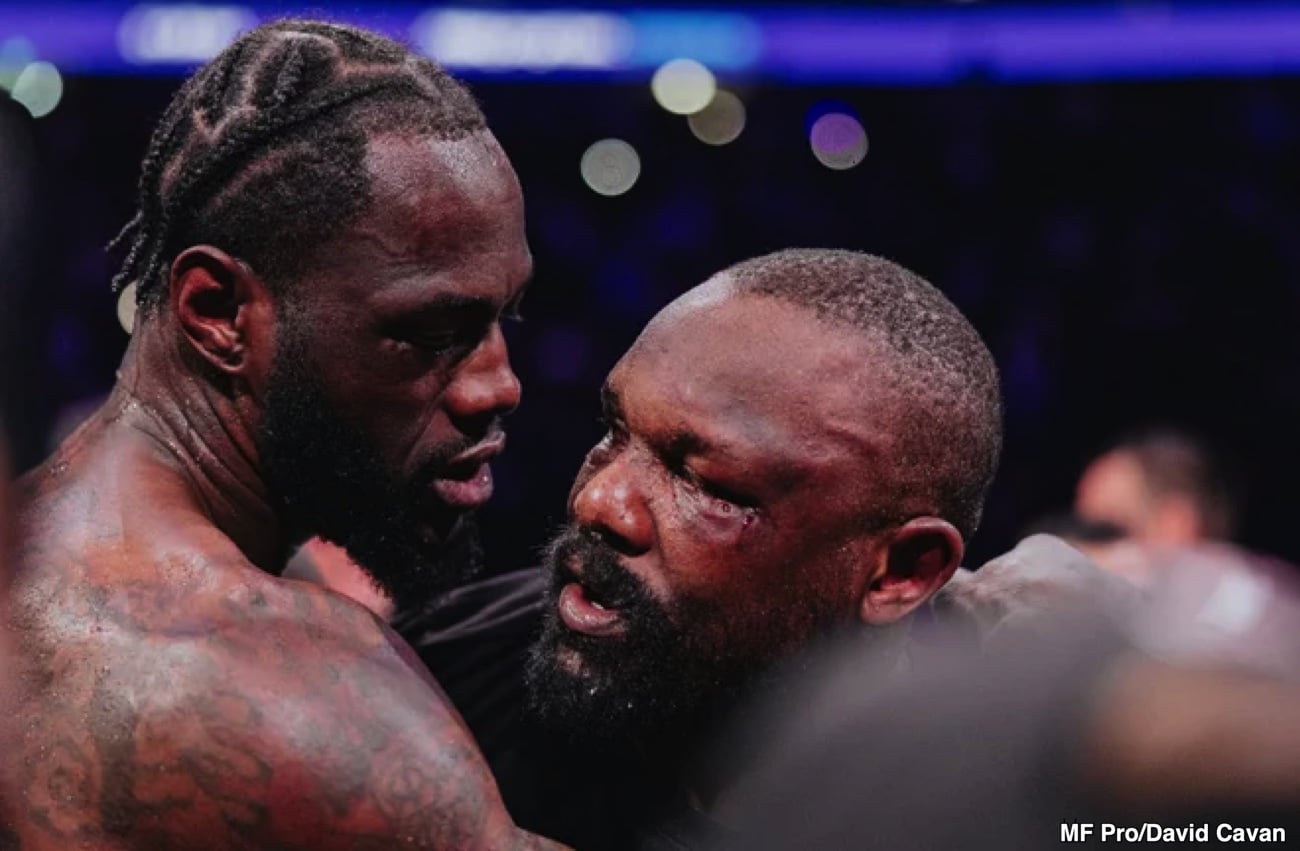


“He’s definitely a little bit on the downward spiral. He’s definitely a shot fighter,” McGuigan said to Boxing King Media.
McGuigan noted that Wilder’s power remains intact, but the ability to deliver it has eroded. He described a fighter struggling to find range, missing opportunities, and failing to finish moments that once would have ended fights quickly.
“The last thing you lose is your punch, but his timing was terrible. He just could not hit Derek,” Barry said about Deontay.
What McGuigan is failing to mention is Wilder’s two shoulder surgeries as a factor in his failure to finish off opponents. In baseball, once the shoulder’s labrum or rotator cuff is compromised, the explosive internal rotation required to hit 98 mph often vanishes, forcing the player to become a pitcher rather than a thrower. Wilder is currently undergoing that exact, painful transformation.
The physical evidence from his recent outings, specifically against Tyrrell Herndon and Derek Chisora, supports this theory that this is a structural mechanical failure rather than just a “timing” issue.
Wilder has moved away from the laser straight right hand. A straight punch requires full extension and a stable shoulder socket to transfer force from the legs through the fist.
If the shoulder is unstable due to multiple surgeries, the body instinctively protects the joint. Clubbing or looping the punch, using the shoulder as a hinge rather than a piston, is a subconscious way to avoid the sharp pain or instability of a full, snapping extension.
His hesitation to let the right hand go against Herndon was a massive red flag. For a man whose entire career was built on “Fear the Right Hand,” a reluctance to throw it suggests he no longer trusts the hardware to hold up under the torque of a maximum-effort shot.
While Barry McGuigan pointed to timing, timing is often a byproduct of physical capability. If the hand speed drops by even 10% because of shoulder stiffness, the “timing” looks off because the opponent has those extra milliseconds to slip the shot.
To compensate for lost explosive power, Wilder is loading up more. This makes him predictable. He’s trying to manufacture power through effort rather than snap, which is the boxing equivalent of a pitcher telegraphing a curveball.
If you can’t fully extend the arm without discomfort, your effective range shrinks. Wilder is missing shots he used to land because he is pulling the punch short to protect the shoulder.
When a fighter is labeled “shot,” it usually implies a chin that can no longer take a punch or legs that have gone heavy. In Wilder’s case, it’s a weapon failure. He is a sniper whose scope is cracked and whose barrel is warped.
He can still club a journeyman into submission with his sheer size and remaining strength, but against the elite, who operate in the inches and milliseconds, that lost 90 mph fastball is the difference between a knockout and a lopsided decision loss.
Wilder has become a veteran pitcher relying on grit and junk, but in the heavyweight division, you eventually run into a hitter who can sit on the slow stuff.


Read the full article here


