



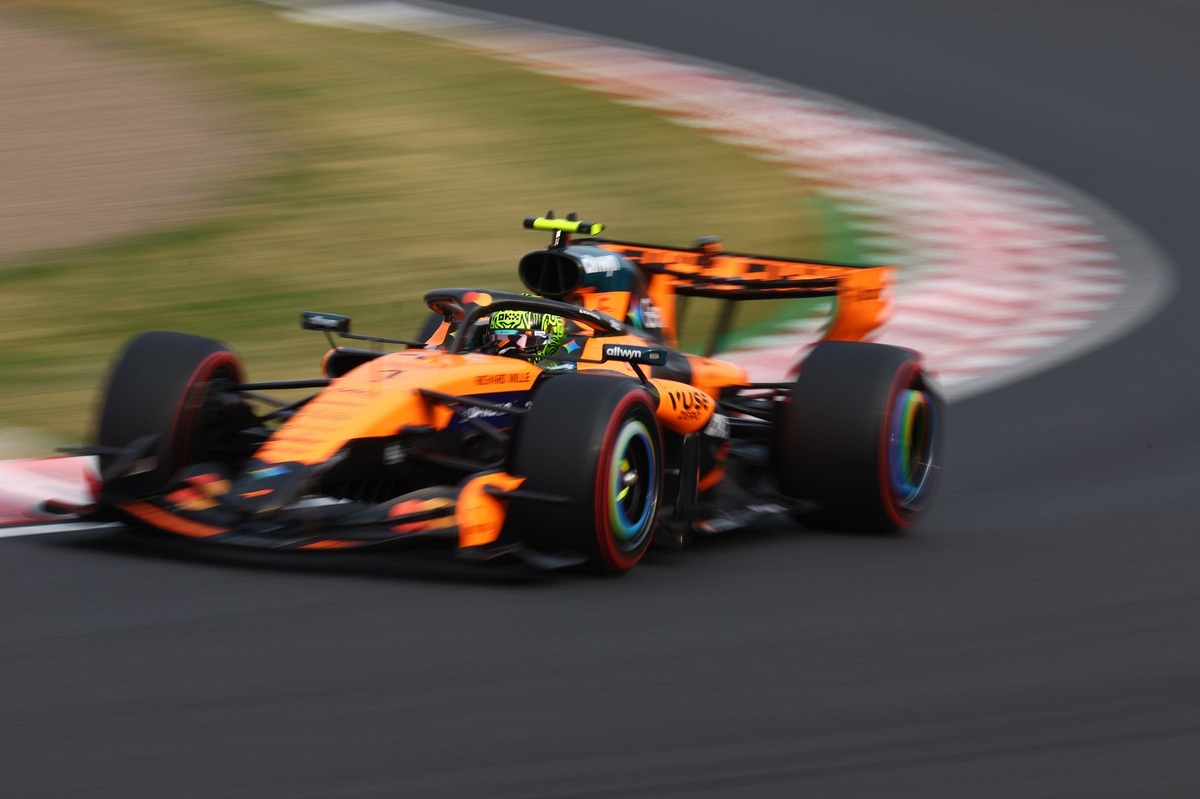
At Suzuka, the yo-yo effect was slightly less extreme than during the season opener in Melbourne, although the overall picture still did not satisfy all of the drivers. Lando Norris ultimately crossed the line in fifth place and saw that – together with Oscar Piastri’s strong showing – as a sign that McLaren is making significant progress.
The racing as a whole, however, left the reigning world champion far from satisfied.
“Honestly some of the racing, I didn’t even want to overtake Lewis. It’s just that my battery deploys, I don’t want it to deploy, but I can’t control it,” Norris said when asked by Autosport.
“So, I overtake him, and then I have no battery left, so he just flies past. This is not racing, this is yo-yoing. Even though he [Hamilton] says it’s not, it is yo-yoing.”
Drivers at the mercy of the power unit?
The fact that overtakes no longer have much value is one factor for Norris, but the McLaren driver finds it even more frustrating that he sometimes feels powerless behind the wheel.
“When you’re just at the mercy of whatever the power unit delivers, the driver should be in control of it at least, and we’re not.”
According to Norris, this problem mainly occurs when a driver uses overtake mode, so when they are within one second of the car ahead. It led to a moment when Norris overtook Hamilton in the final chicane, after which he was immediately countered again on the main straight.
“Well, the problem is, it deploys into 130R. I have to lift, otherwise I’ll drive into him, and then I’m not allowed to go back on throttle. If I go on throttle, my battery deploys, and I don’t want it to deploy because it should have cut. But because you lift and you have to go back on [throttle], it redeploys.”
Lando Norris has been frank in his assessment of the 2026 rules
Photo by: Simon Galloway / LAT Images via Getty Images
This meant that the battery drained again and Norris had no energy left at the end of the start-finish straight to defend against the Ferrari driver.
“There’s nothing I can do about it. There’s just not enough control for a driver, and that’s why you’re just too much at the mercy of what’s behind you. That’s just not how it should be.”
What role did the Suzuka layout play?
Max Verstappen shares that view. According to the Dutchman, the Suzuka layout once again exposed how difficult it is for drivers to time an overtake in such a way that they are not immediately vulnerable to a counterattack with an empty battery.
“In general, you just have to be very careful with how you use your battery. It’s a bit tricky,” Verstappen said. “The problem is of course that you have a long straight and then only a little chicane and then a long straight again.”
The Red Bull driver is referring to the long straight before 130R. Drivers can then only recharge the battery in the Casio Triangle and through super clipping in 130R, which also explains why the speeds there dropped so dramatically.
“So, if you deploy in one straight you have nothing on the other. On some other tracks if you have a long straight and then you have maybe a few corners and you have time to charge, here you don’t,” Verstappen explained.
“That’s basically in a lot of places where you want to go for an overtake, then there’s only one corner to charge and then a long straight again. So that makes it basically impossible to use the battery because it’s completely inefficient to do that.”
It means that drivers can no longer overtake in places where they normally would, which is why the overall picture at Suzuka certainly does not leave Norris satisfied.
“So yeah, some things can be improved, but the FIA know that, I hope they do it. Yes, the racing can look great on TV, but the racing inside the car is certainly not as authentic as it needs to be.”
We want to hear from you!
Let us know what you would like to see from us in the future.
Take our survey
– The Autosport.com Team
Read the full article here


